
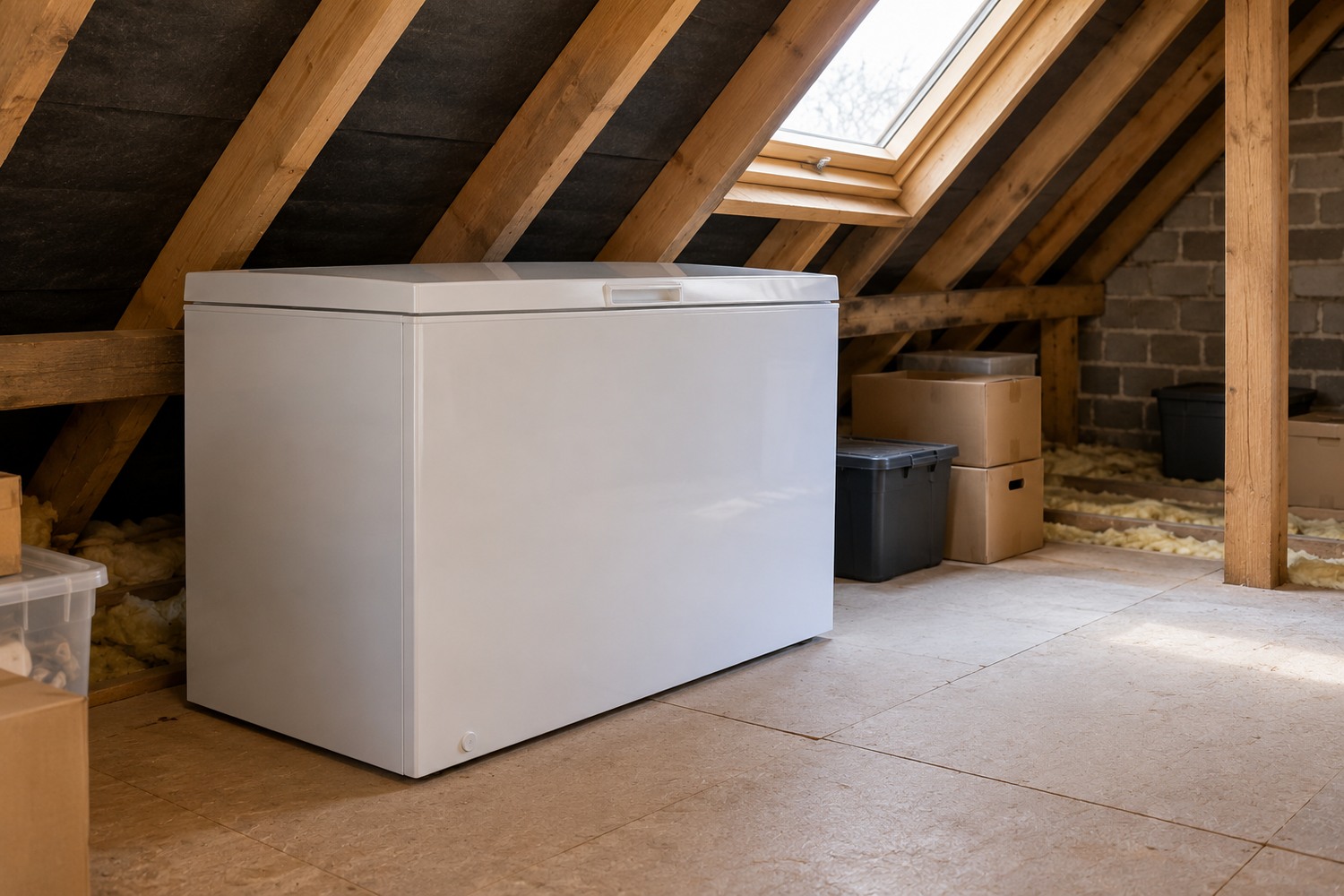
If your kitchen doesn’t have the space you may wonder; can you put a freezer in the loft? For an ordinary unconverted UK loft, putting a freezer up there is usually a bad idea. A boarded loft may look like useful storage space, but the boards don’t prove that the structure can safely carry a loaded freezer. Loft temperatures can also swing from very cold in winter to extremely hot in summer, and getting a heavy appliance through the hatch is a serious practical obstacle. A properly converted loft room is different: it may be suitable if the exact freezer’s installation requirements, floor capacity and electrical safety needs are met.
Before you buy a compact freezer or haul an existing one upstairs, check the building and the appliance separately. A freezer advertised as suitable for a garage isn’t automatically suitable for a loft.
Freezer in a loft: the main questions
| Issue | Ordinary boarded loft | Properly converted loft room |
|---|---|---|
| Floor support | Must be assessed; boards alone prove little | Usually designed for room use, but check appliance loading |
| Summer temperature | Can become extremely hot | Usually better controlled, though still worth checking |
| Winter temperature | May fall below the freezer’s permitted range | Depends on insulation and heating |
| Moving the appliance | Hatch and loft ladder are major obstacles | Proper staircase may allow safer access |
| Power and fire safety | Requires careful assessment and suitable wiring | Still needs an appropriate socket and safe installation |
| Routine access | Awkward for shopping and defrosting | Generally easier, provided the layout permits it |
Can loft joists take the weight of a freezer?
Don’t assume they can. Many ordinary lofts were intended to support the ceiling below and limited light storage, not necessarily a heavy appliance plus frozen food and someone standing beside it. A boarded storage area isn’t the same as a floor designed for regular occupation.
The relevant load is more than the freezer’s empty weight. You need to consider its maximum loaded weight, where the feet bear on the floor and the condition and arrangement of the structure beneath. You can’t establish structural suitability simply by putting down thicker boards or a sheet of plywood.
If this is an unconverted loft, ask a competent structural engineer or builder with suitable structural expertise to assess it before installing an appliance. Loft-conversion guidance from UK local authorities routinely requires structural assessment and often engineered strengthening where a new usable room is created.
Will a freezer work in a hot loft in summer?
A traditional roof space can become much hotter than the rooms below. Freezers release heat to their surroundings to keep food cold. In very warm air, a freezer may run for longer and use more electricity; if the room exceeds its specified maximum operating temperature, it may struggle to maintain the required temperature.
Check the climate class and actual ambient-temperature range in your model’s manual. Common classes include SN at approximately +10°C to +32°C and N at approximately +16°C to +32°C, although individual models may have special capabilities. A loft’s maximum temperature can’t reliably be judged on a mild spring day.
If you’re even considering a loft location, measure the air temperature near the proposed position over a realistic range of weather. A room thermometer that logs maximum and minimum values can help, but it doesn’t replace a suitable structural and installation assessment.
What about freezing temperatures in winter?
An uninsulated loft can become very cold in winter. Contrary to what you might expect, a freezer isn’t necessarily designed to operate in sub-zero room temperatures. Standard models have stated minimum ambient temperatures, and performance outside that range isn’t guaranteed.
Some Beko freezers, for example, have technology designed for colder environments and are advertised for use down to -15°C. That’s specific manufacturer guidance, not a universal freezer feature. Even a low-temperature-rated model still has a maximum operating temperature and other installation requirements, so it may remain unsuitable for a loft that overheats in summer.
Can you get a chest freezer through a loft hatch?
Often this is the most obvious practical barrier. Measure the freezer’s full external dimensions, the clear hatch opening, the loft ladder or staircase and the space available to turn the appliance safely. Also check its transport orientation requirements: some freezers must be kept upright or allowed to settle before switching on.
Don’t try to drag or hoist a heavy freezer through a typical loft hatch yourself. Many folding loft ladders and hatches are not designed for this sort of load. A professional lifting plan may be expensive or impractical. The machine also has to come back out eventually for repair or replacement.
Does the freezer need ventilation in a loft?
Yes. The appliance’s condenser system needs to release heat. The freezer manual specifies clearances around the sides, rear and sometimes top, depending on the model. Don’t wedge it between rafters or place it hard against stored boxes or insulation.
A loft’s general roof ventilation isn’t proof that the appliance has adequate local airflow. Keep grilles clear, leave service access and avoid placing combustible stored materials around the freezer. Electrical Safety First advises keeping ventilation openings unobstructed and installing freezers with room for air to circulate.
What electrical supply would you need?
A freezer should have a suitable permanent electrical supply that complies with its manual and the applicable wiring rules. A loft light connection or a long extension lead from a room below isn’t an appropriate substitute for a properly installed socket.
Ask a qualified electrician to assess any new supply. In England, relevant domestic electrical work must comply with Part P; the rules and notification requirements depend on the work, and other UK nations have their own frameworks. Electrical Safety First recommends plugging large refrigeration appliances into a nearby wall socket rather than an extension lead.
What about fire safety?
Fridges and freezers are electrical appliances that run around the clock. If something goes wrong in a rarely visited loft, it may take time for someone to notice. A loft may also contain stored cardboard, insulation and other materials that mustn’t block or interfere with the appliance.
London Fire Brigade advises registering white goods for safety-recall notices, not overloading sockets and taking care with second-hand appliances. Electrical Safety First recommends suitable smoke and heat alarms in the home. Get competent advice about the property’s fire-safety arrangements before creating a new appliance space in the loft, particularly if you’re also converting it for regular access.
What happens if the freezer leaks during defrosting?
Most chest and upright freezers don’t need a mains water inlet, but water can still escape while defrosting or after an extended power cut. In a loft, spilled water could soak insulation, ceiling plasterboard and rooms below.
Follow the manufacturer’s method for collecting defrost water and never use a hairdryer, heater or sharp tool to speed up defrosting. A water-leak alarm might provide warning, but it won’t prevent a spill and doesn’t solve the structural or temperature problems.
Is a converted loft room different?
Yes. A properly converted loft with a suitable structural floor, staircase, electrical installation and more controlled temperatures is a much more plausible location. Even then, check the freezer’s actual weight and dimensions, ventilation clearances, operating-temperature limits and servicing access.
A room that’s been plasterboarded or boarded out isn’t necessarily a legally or structurally converted loft. If you’re unsure what work was done, obtain professional advice before using it for a heavy appliance.
Better alternatives if you’re short of freezer space
A garage, utility room or spare room may be easier to access than a loft, but these locations also need assessment. Garage installations particularly depend on the freezer’s permitted ambient temperature range; an enclosed cupboard can cause ventilation and fire-safety concerns.
We’ve also covered keeping a chest freezer in a bedroom and placing a freezer in an under-stairs cupboard. Those alternatives aren’t automatically approved, but they may help you compare the practical limitations.
Useful products to consider
Before choosing a freezer, measure the intended space and read the exact installation manual. You can compare maximum-and-minimum room thermometers on Amazon UK to understand temperature changes, or browse freezer thermometers for checking internal food-storage conditions.
These are general shopping links, not tested product recommendations. Buying a thermometer doesn’t mean a loft has been shown to be structurally, electrically or thermally suitable.
Frequently asked questions about Can You Put a Freezer in the Loft
Can you put a mini freezer in a boarded loft?
Only after checking structural support, room temperatures, ventilation, electrical safety and access. Being small doesn’t remove these requirements, and boarding alone doesn’t establish load capacity.
Can a freezer work in an uninsulated loft?
An uninsulated loft often experiences temperature extremes that may exceed the freezer’s stated operating range. Check the exact model and measured conditions; for many homes it’s an impractical location.
Can you use a freezer rated for garages in the loft?
Not automatically. A rating for cold garage conditions doesn’t establish that the appliance will work safely in a loft’s potentially extreme summer heat, or that the floor and wiring are suitable.
Do you need building regulations approval for a freezer in the loft?
Simply owning an appliance doesn’t automatically turn a loft into a conversion, but structural strengthening, new electrical work or creating a habitable room may fall under relevant building rules. Ask building control and qualified professionals about your proposed work.
Would a chest freezer be easier than an upright freezer?
Not necessarily. A chest freezer needs a large floor area and full lid-opening clearance; an upright model is taller and needs door-opening room. Both present weight and access issues through a loft hatch.
What temperature should frozen food be kept at?
For ordinary long-term frozen-food storage, around -18°C is the usual target. A freezer thermometer helps monitor the internal temperature, but doesn’t confirm the loft itself is a suitable installation location.
Bottom line
If you’re asking can you put a freezer in the loft – An ordinary unconverted loft is usually not a good place for a freezer. Structural loading, extreme temperatures, moving the appliance through a hatch and electrical or fire-safety concerns make it a difficult choice. A genuinely converted loft room may be possible if professionals confirm the structure and the specific freezer’s instructions allow the installation.
Sources and further reading
- Electrical Safety First — Fridge and freezer safety
- Beko UK — Freezers in low ambient temperatures
- London Borough of Redbridge — Loft conversion structural and fire-safety guidance
- GOV.UK — Electrical safety: Approved Document P
- London Fire Brigade — White goods and fire safety
Disclosure: Progressive Housewares may earn a commission from qualifying purchases through affiliate links, at no extra cost to you. We haven’t tested the products linked in this article.