
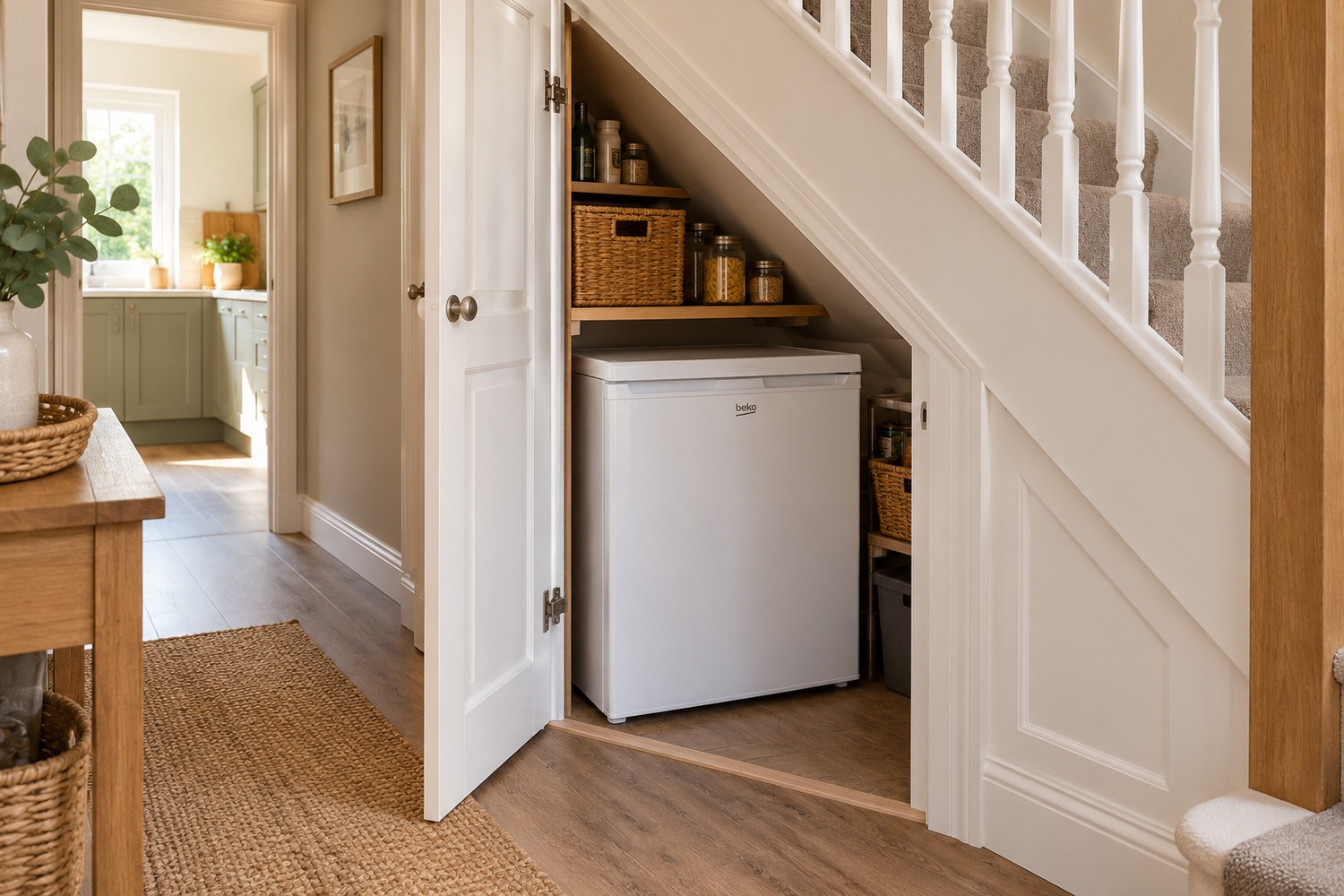
You might be able to put a freezer in an under-stairs cupboard, but it’s not automatically safe simply because the appliance fits. You need to check the freezer’s installation instructions, ventilation, room temperature, electrical supply and access. Most importantly, an under-stairs cupboard can form part of the fire protection around your home’s escape route. That deserves particular care before placing an electrical appliance there.
So if you’re asking can you put a freezer in an under-stairs cupboard – In some homes, a properly designed space might be suitable for an appropriately installed freezer. In others—especially a small, unventilated cupboard opening onto the only staircase—it’s a poor choice. Don’t put a freestanding freezer inside a sealed cupboard unless its manufacturer explicitly allows that installation.
Quick checklist: is your under-stairs cupboard suitable?
| Check | Why it matters |
|---|---|
| Freezer installation manual | Confirms whether enclosure is permitted and what clearances are required |
| Ventilation route | Heat produced by the appliance needs somewhere to escape |
| Cupboard temperature | The location must remain within the model’s stated ambient operating range |
| Fire safety and staircase | The cupboard may affect a protected escape route or fire separation |
| Electrical supply | Safe, accessible socket without unsuitable extension leads |
| Door and maintenance access | Room to open drawers, clean vents and move the freezer safely |
If you can’t meet every applicable requirement, choose another location or get advice from a competent installer.
Why is ventilation so important?
A freezer moves heat out of its interior and releases that heat into the surrounding room. If it’s trapped inside a tightly enclosed cupboard, the air around it can become warmer. That can make the appliance work harder and may affect performance and longevity.
Which? advises following the freezer manual’s specified wall clearances and keeping ventilation openings unobstructed. Bosch’s advice for freestanding refrigeration appliances also emphasises checking the model’s ventilation requirements; these differ by design. Don’t copy a gap measurement from a different model and assume it’s safe for yours.
A freestanding freezer is not the same as an integrated freezer. Integrated appliances are designed for installation within compatible kitchen cabinetry with specified ventilation paths. A normal freestanding model may not be approved for that kind of enclosure.
Can you leave the cupboard door closed?
Only if the freezer’s instructions and the cupboard’s design permit it. An ordinary cupboard door can restrict the movement of air needed to remove heat, especially where the cupboard has no dedicated inlet and outlet airflow.
Leaving the door ajar isn’t a reliable substitute for a properly designed installation. And cutting ventilation holes into an under-stairs cupboard could compromise fire-resisting construction if that cupboard helps protect the staircase. Don’t cut vents through a fire-rated door or enclosure without appropriate specialist advice and approval.
What about fire safety beneath the stairs?
Freezers are electrical appliances that normally run day and night. Although appliance fires aren’t common, their location matters because smoke or fire beneath a staircase could affect people trying to leave upstairs rooms.
In England, government guidance for Approved Document B explains that protected stairways are designed to maintain a safer route for escape, and that even cupboard doors within such enclosures need consideration according to risk. Separate government fire-safety guidance also treats ignition hazards and storage near protected escape routes seriously.
Not every domestic staircase has the same legal requirements. The arrangement can be particularly significant in flats, houses in multiple occupation (HMOs), rental properties, loft conversions and buildings with a designated protected stairway. For example, some councils specify fire-resisting under-stairs cupboards in HMOs where an ignition source is present.
Before installing a freezer beneath a staircase, ask a competent fire-safety professional, building-control team, landlord or managing agent as appropriate. Don’t assume a domestic cupboard is exempt from all safety considerations. Adding an appliance or altering ventilation may change the fire-risk assessment.
Will the cupboard be too hot or cold for a freezer?
Every freezer has an operating temperature range. Its climate class, and any additional cold-weather technology, determine which room temperatures it can tolerate.
For example, Beko’s UK guidance lists common climate classes including SN (+10°C to +32°C) and N (+16°C to +32°C), while noting that some particular models can operate outside those normal ranges. This doesn’t mean all Beko or other freezers share the same requirements.
An under-stairs cupboard in the middle of a heated home may stay fairly warm, especially if it lacks ventilation. One next to an external wall or in an unheated entrance area may become colder. Measure the cupboard temperature over time if you’re uncertain, and compare the results with the exact model’s stated minimum and maximum ambient temperatures.
How much space does a freezer need under the stairs?
Start with the appliance’s actual external height, width and depth, then add the manufacturer’s required ventilation clearances. Also consider its plug and power cable, hinges, door swing and the space needed to remove internal drawers.
- Measure the cupboard at several heights. A sloping staircase means the available height may change sharply from front to back.
- Check the narrowest doorway opening. The freezer has to pass through it safely, not just fit after installation.
- Use the model’s installation drawing. Don’t assume a nominal “under-counter” freezer fits every under-stairs space.
- Plan door opening. Many freezers need extra clearance to open fully and remove drawers.
- Leave service access. You’ll need to inspect connections and keep any ventilation areas clean.
Don’t wedge a freezer beneath the sloping ceiling with almost no top space. The clearance requirement depends on the specific product, not a universal rule.
Can you plug a freezer into an under-stairs socket?
Ideally, use a suitable wall socket in accordance with the appliance’s instructions. Which? recommends plugging a freezer directly into a wall outlet rather than an extension lead. Keep the socket accessible for safe isolation and avoid trapping or crushing the cable behind the appliance.
If you don’t already have an appropriate socket, get a qualified electrician to assess the location. Don’t run an extension lead beneath flooring, overload adaptors or attempt new wiring as a DIY shortcut.
Is a compact or under-counter freezer better?
A compact freestanding under-counter freezer may suit a tight space better than a tall upright model, but compact doesn’t mean cupboard-safe. You still need enough cooling airflow and approval for the intended placement.
An integrated freezer might be a possibility only where the cupboard can be professionally designed as a compatible housing, including its specified airflow arrangement and fire protection. Don’t treat a general under-stairs cupboard as if it were an ordinary integrated kitchen unit.
What about a freezer thermometer?
A thermometer can help you monitor the freezer’s internal temperature after a suitable installation. For normal domestic frozen-food storage, around -18°C is the usual target. But a good temperature reading doesn’t prove that the surrounding cupboard is adequately ventilated or that the location is fire-safe.
You can browse freezer thermometers on Amazon UK or compare compact under-counter freezers. Check each model’s full installation manual before buying for an under-stairs location. These are general shopping searches, not endorsements or claims that the listed freezers are safe inside enclosed cupboards.
What are safer alternatives if the cupboard isn’t suitable?
Depending on your home, you could consider a suitable open, ventilated utility area, an appropriately designed kitchen position or a garage where the chosen freezer is specifically rated for the temperature range. A garage isn’t automatically suitable either: some freezers can’t tolerate very cold ambient temperatures.
If your under-stairs space is currently a protected cupboard or part of your only escape route, preserving that safety function may matter more than using the space for refrigeration.
Frequently asked questions on Can You Put a Freezer in an Under-Stairs Cupboard
Can you put a freezer in a cupboard with no ventilation?
Don’t do so unless the appliance is specifically approved for the installation. Freestanding freezers generally require ventilation to remove heat. A sealed cupboard can cause overheating or poor performance.
Can I cut vents into the cupboard door?
Not without checking the cupboard’s fire-safety role first. A ventilation opening in a fire-resisting enclosure can compromise its protection, so seek professional advice.
Is it safe to put a freezer under wooden stairs?
The fact that the staircase is wooden doesn’t, by itself, determine whether the setup is safe. Fire separation, escape routes, ventilation, wiring and the appliance’s instructions all need consideration.
Will a freezer work in a cold under-stairs cupboard?
Only if the actual room temperature remains within the freezer’s specified ambient operating range. Some models have special low-temperature ratings, but many don’t.
Can I install a chest freezer under the stairs?
Possibly only where the manufacturer’s clearances, lid-opening space, ventilation, access and fire-safety requirements can all be met. A sloping ceiling often makes top-opening lids impractical.
Does a freezer need to be kept away from an escape route?
Escape-route safety is an important consideration. Which? specifically advises against putting a freezer in a hallway because escape routes must remain clear. For a cupboard beneath stairs, get an assessment of the building’s particular fire-safety arrangement before proceeding.
Bottom line
Don’t install a freezer in an under-stairs cupboard simply because the measurements fit. Check model-specific ventilation and temperature limits, safe electrical access, and whether the cupboard helps protect the staircase or escape route. If it’s enclosed, unventilated or part of a protected escape route, seek qualified advice and be prepared to choose another location.
Sources and further reading
- Which? — Freezer safety
- Bosch UK — Measuring and ventilating a freestanding refrigeration appliance
- Beko UK — Climate classes and freezer location
- GOV.UK — Approved Document B fire safety FAQs (England)
- GOV.UK — Fire-safety risk assessment: sleeping accommodation
- Arun District Council — HMO fire-safety standards
Disclosure: Progressive Housewares may earn a commission from qualifying purchases through affiliate links at no extra cost to you. We haven’t tested the products linked in this article.