
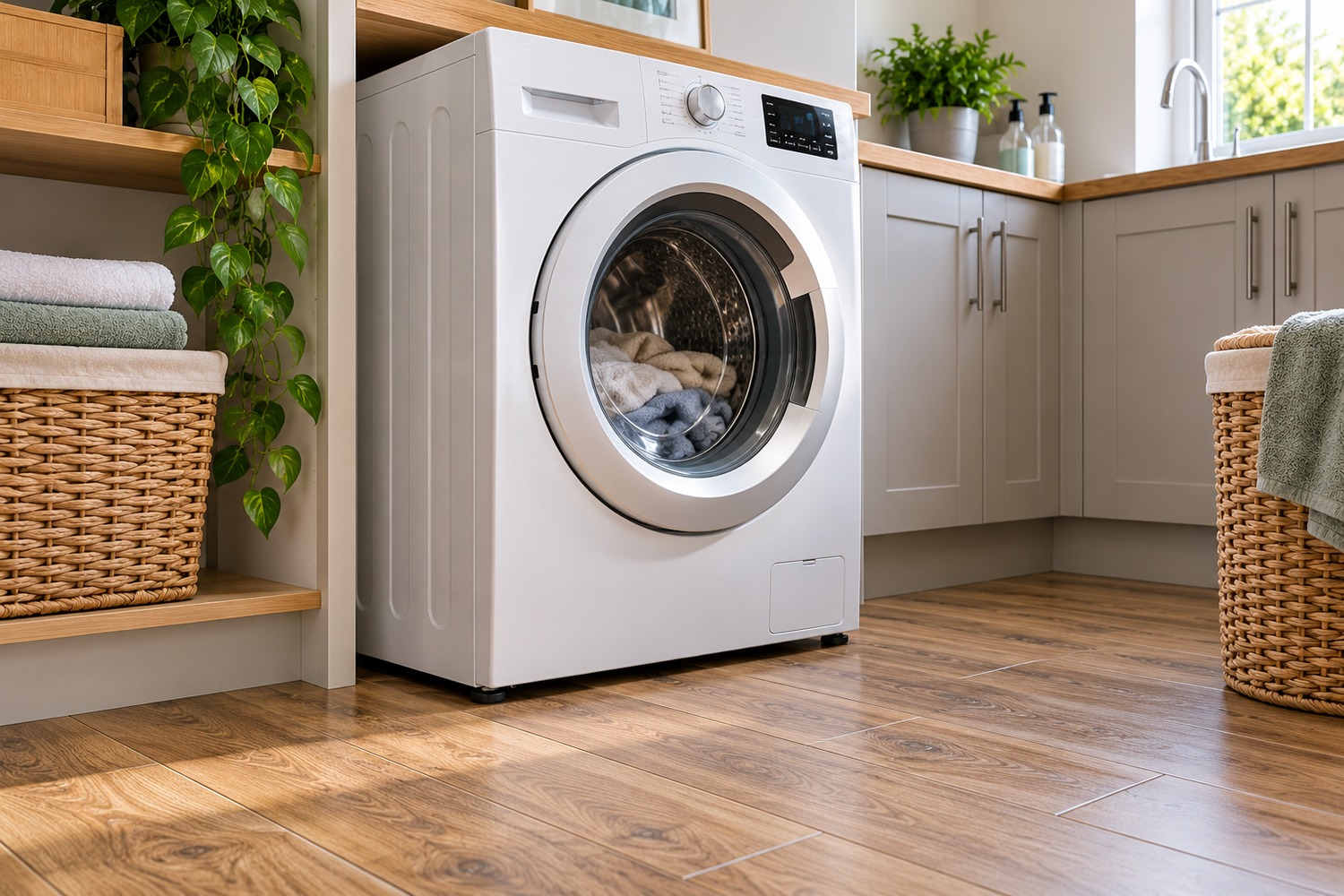
It’s a common question – can you put a washing machine on laminate flooring? Yes, you can sometimes put a washing machine on laminate flooring, but only if the floor is firm, level and capable of supporting the appliance without unwanted movement. The bigger question isn’t whether the visible surface is laminate: it’s what’s underneath it. A machine standing on laminate over a stable concrete base may behave very differently from one standing over thick, compressible underlay or flexible floorboards.
Always check the installation instructions for your washing machine and the requirements of the laminate-flooring manufacturer. Some combinations may not be suitable. If the machine rocks, knocks or walks across the floor during spinning, don’t assume an anti-vibration mat will fix it.
When is laminate flooring suitable under a washing machine?
Laminate isn’t automatically unsuitable, but the whole installation must be considered: the subfloor, underlay, floating-floor installation and all four washing-machine feet.
| Floor arrangement | What to consider |
|---|---|
| Laminate over firm concrete | Potentially suitable if the flooring system permits the appliance’s weight and the feet stay stable |
| Laminate over thick, soft underlay | Greater chance of compression or movement under the machine’s feet |
| Laminate over suspended timber flooring | Check for bounce or deflection in the underlying floor as well as the laminate |
| Floating laminate trapped under fitted units | Check the flooring’s expansion and heavy-appliance guidance |
| Uneven or damaged laminate | Don’t install until the support and level have been assessed |
These are considerations, not universal approvals. The appliance and flooring instructions take priority.
Why might a washing machine vibrate more on laminate?
Washing machines exert changing forces on the floor while the drum spins. If the surface or underlay compresses unevenly, the machine can rock and transfer more vibration into the surrounding flooring.
Homeowners have described this exact issue on the UK DIYnot forum. One reported that a machine which had worked on lino became much more troublesome after laminate was laid beneath it. Another described a laminate plank that appeared to flex near a rear foot during spinning. These accounts show why the problem is worth investigating, although a forum diagnosis isn’t proof of the cause in every home.
Other causes include incorrectly adjusted feet, transit bolts left in a newly installed machine, an uneven laundry load, loose hoses and faults with internal suspension. Don’t blame the laminate until you’ve checked those possibilities.
What about laminate over concrete?
A concrete subfloor can provide a strong, stable base, but there’s still a layer of laminate and possibly underlay between the appliance and the concrete. If that underlay is particularly compressible or the flooring has an uneven patch, the machine’s feet may not be equally supported.
On a firm floor, first check the appliance’s levelling and the laminate’s installation guidance. If the floor visibly flexes, separates or creaks beneath the machine, ask a flooring installer to assess the underlying support rather than trying to clamp down a floating floor yourself.
What about laminate over wooden floorboards?
Suspended timber floors can move more than concrete floors, particularly if the boards or joists have some bounce. That movement can be amplified during a high-speed spin. Laminate and underlay may add another layer of flexibility.
Miele’s UK support guidance says a concrete floor is the most suitable base for its washing machines. For installation on wooden flooring, it describes a suitably supported plywood panel secured to the joists, with specific dimensions for the situation it covers. That’s manufacturer-specific advice, not permission to screw a panel through any laminate floor. Follow your own model’s instructions and consult a qualified installer if structural work is needed.
Should you lay laminate underneath the washing machine or stop it short?
There’s no answer that suits every kitchen or utility room. Running laminate beneath the appliance gives a continuous-looking floor and may make the machine easier to pull out. Stopping it before the appliance allows the machine to stand on a separate, appropriately finished support surface.
However, most click-fit laminate floors are installed as floating floors, and they need freedom to expand and contract. Trapping the floor under fixed units or restricting its movement may conflict with the flooring manufacturer’s instructions. Cutting around an installed washing machine can also affect its height, stability and future access.
If you’re replacing the flooring, decide how the machine will be supported before laying the boards. Your flooring installer can check whether the appliance belongs on the laminate or on a separately prepared base. Maintain the manufacturer’s expansion gaps and don’t fasten down floating laminate simply to reduce a vibration noise.
How to check a washing machine that vibrates on laminate
- Stop using the machine if it’s moving dangerously. If it is walking across the floor, striking cupboards or damaging hoses, stop the cycle safely and investigate before using it again.
- Check that all four feet are supported. With the appliance switched off, test whether it rocks diagonally. Don’t reach underneath or tilt a heavy appliance without safe assistance.
- Use a spirit level. Check from side to side and front to back, then adjust the feet and tighten their locknuts as your manual directs.
- Confirm transit bolts were removed. On a newly installed machine, follow the manufacturer’s instructions for checking shipping restraints. Don’t operate it with bolts still fitted.
- Look at the floor. Check for visibly flexing boards, soft spots or uneven underlay near the feet.
- Review the load. A single heavy item or an unevenly distributed load can create substantial vibration.
- Listen for unusual sounds. Knocking, scraping or vibration that suddenly worsens may indicate a mechanical problem or a loose hose. Contact an appliance engineer if ordinary checks don’t resolve it.
Bosch and AEG both recommend checking the transit bolts and ensuring the machine is level on a hard, stable surface when investigating vibration. Don’t run repeated high-speed spin cycles simply to see whether a visibly unstable machine settles down.
Do anti-vibration feet work on laminate flooring?
Sometimes, but they’re not a substitute for a stable floor. Rubber pads or purpose-designed feet may help reduce vibration transmission in certain installations. Other combinations can introduce unwanted movement or raise the machine unevenly, so compatibility matters.
Electrolux discusses anti-vibration accessories as one possible step after checking the levelling, transit bolts and clearance around the appliance. If the laminate or the subfloor is bouncing, a pad alone won’t correct the underlying structural issue. Follow your washing-machine manufacturer’s recommendations before buying accessories.
Can a washing machine damage laminate flooring?
Yes, particularly if its feet rub or shift, if the floor compresses unevenly or if water gets into the laminate joints. An appliance that moves repeatedly can scuff the finish or affect the flooring beneath it.
Leaks are an additional concern. Many laminate products contain a wood-based core that can swell when water reaches unprotected joints or edges. Some ranges are marketed as water-resistant, but that doesn’t mean every laminate floor will withstand a washing-machine leak.
Check hoses and connections regularly, deal with leaks promptly and follow the flooring manufacturer’s water-exposure guidance. If water gets under the boards, surface drying may not be enough.
What can you buy to help with installation?
A spirit level is useful for checking whether your machine is correctly aligned. If your appliance maker approves them, you could also compare washing-machine anti-vibration feet on Amazon UK. Check dimensions, load ratings and any model-specific restrictions before ordering.
Don’t buy thicker pads or a generic plinth as a quick fix for a floor that visibly flexes. Where the subfloor is the problem, professional assessment may be more useful than additional accessories.
Frequently asked questions on Can You Put a Washing Machine on Laminate Flooring
Can you put a washing machine directly onto laminate?
Potentially, if both the washing-machine and flooring manufacturers permit it and the complete floor assembly is suitably firm and level. The presence of laminate alone doesn’t confirm that the installation is safe.
Will a washing machine make laminate flooring buckle?
It can contribute to flooring problems if a floating floor’s movement is restricted or the subfloor is unsuitable. Buckling can also result from moisture or incorrect expansion gaps. A flooring specialist can identify the likely cause.
Should I put a rubber mat under the washing machine?
Only where an appropriate mat is compatible with the machine and flooring. A soft mat may worsen rocking in some installations. Start with the installation instructions and basic levelling checks.
Can a washing machine stand on laminate over underfloor heating?
Check the appliance, flooring and heating-system instructions before installing it. Heat, heavy point loads and flooring movement all need consideration; don’t assume an approved laminate floor automatically makes every appliance placement suitable.
Is vinyl flooring better than laminate under a washing machine?
Some vinyl products tolerate spills better than some laminate floors, but the appliance still needs a firm, level supporting base. The installation method and subfloor are just as important as the visible finish.
Should I screw laminate down to stop vibration?
No, not unless the flooring manufacturer specifically directs that installation method. Floating laminate generally needs room to move, and fastening it down can create additional problems.
Bottom line
A washing machine can sometimes stand on laminate flooring, but the combination must be stable and permitted by both manufacturers. Check the subfloor and underlay, ensure every foot is properly levelled, and investigate bouncing or knocking before trying anti-vibration accessories. Where the floor itself flexes, get advice on the underlying support rather than attempting to pin down the laminate.
Sources and further reading
- Miele UK — Vibrations during spinning
- Bosch UK — Washing machine vibrates and moves
- Electrolux UK — Reducing washing-machine vibration
Disclosure: Progressive Housewares may earn a commission from qualifying purchases made through affiliate links, at no additional cost to you. We haven’t tested the products linked in this article.