
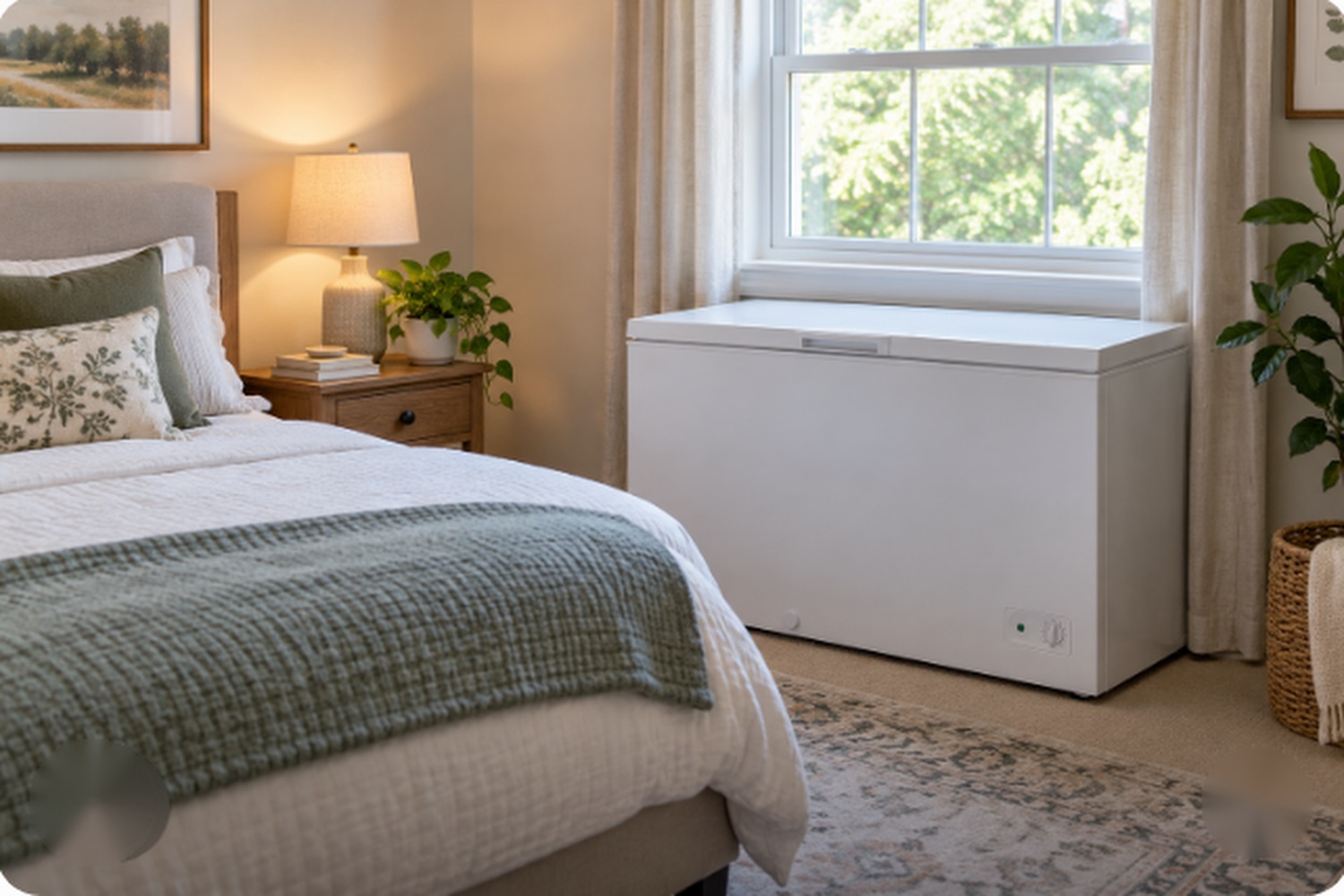
Yes, a chest freezer can sometimes go in a spare bedroom, provided the specific appliance is approved for that type of location and there’s enough ventilation, a suitable electrical socket and a firm, level floor. It’s a common question; can you put a chest freezer in a bedroom, but be aware that putting a freezer in a bedroom where somebody regularly sleeps deserves more thought: you’ll be living with its compressor noise, the heat it releases and an electrical appliance running all day and night.
There’s no universal UK rule that every domestic chest freezer has to be in the kitchen. Equally, don’t assume every bedroom is suitable just because the freezer fits through the door. Your freezer’s installation manual takes priority over general advice, and the home’s fire-safety arrangements matter.
Quick checklist: is the bedroom suitable?
| Check | Why it matters |
|---|---|
| Clearance and ventilation | Heat must escape and all grilles must remain unobstructed |
| Floor support | The surface must carry the freezer plus its contents without rocking |
| Ambient temperature | The room must stay within the exact model’s climate-class limits |
| Electrical supply | Use a suitable wall socket without relying on extension leads |
| Noise and heat | Compressor cycling may disturb sleep and warm the room |
| Lid opening | The lid must open enough to remove baskets and stored food |
| Leaks and defrosting | Plan for cleaning, condensation and any defrost-water drainage |
| Fire safety | Don’t obstruct doors, escape routes or access to alarms and sockets |
Is it safe to keep a chest freezer in a bedroom?
It may be possible in a suitable room, but electrical and fire safety shouldn’t be an afterthought. Electrical Safety First says fridges and freezers should be installed close to a wall socket, away from flammable clutter and with space for air to circulate behind them. It also recommends registering the appliance so you can receive safety-recall information.
A bedroom can contain soft furnishings, clothing and stored paper items. Keep anything combustible away from ventilation openings and any clearances specified by the appliance maker. Never tuck the freezer into a wardrobe, beneath a bed, behind curtains or in a sealed alcove unless its manual explicitly permits that installation.
A freezer runs continuously, even though its compressor switches on and off. Follow the manufacturer’s electrical instructions, keep a working smoke-alarm arrangement in the home and never ignore scorching, crackling, repeated tripping or a burning smell. If these occur, stop using the appliance safely and seek professional advice.
Will a freezer make the bedroom hot?
A freezer removes heat from inside its cabinet and releases that heat into the room. Its motor also consumes electricity, which ultimately adds heat to the surroundings. In a small bedroom this may make the space feel warmer, especially in summer or where ventilation is limited.
The effect depends on the freezer’s size, efficiency, room conditions and how often it’s opened. It would be misleading to promise a particular temperature rise without measurements. If the bedroom already overheats in warm weather, putting an additional heat-producing appliance in it may be undesirable.
How noisy is a chest freezer in a bedroom?
You may hear a low hum as the compressor operates, occasional clicks when it starts or stops, and other normal refrigeration sounds. Whether they’re disturbing depends partly on how sensitive you are to noise and where the freezer stands.
Look up the model’s declared airborne acoustic noise emission in decibels when comparing freezers. That gives you a consistent specification to compare, though the character of a hum or vibration can still matter in a quiet bedroom. Don’t assume a product described as ‘quiet’ will be inaudible while you’re trying to sleep.
If this is a spare bedroom used for storage, the noise may matter much less than in a bedroom occupied every night. You can also hear a freezer through adjoining walls or floors, so consider nearby rooms.
Does the bedroom floor matter?
A chest freezer needs a firm, stable, level surface capable of carrying its loaded weight, not just the weight printed on the delivery label. Food stored inside adds to the load. Most domestic bedroom floors may be adequate for many appliances, but don’t make assumptions about a damaged, visibly flexing or unusually weak floor.
Soft carpet is another issue: it can interfere with stability or airflow below some appliances. Check whether the exact freezer is approved for the floor covering. Don’t place it on improvised boards or mats without making sure the solution complies with the manufacturer’s instructions.
If you’re uncertain about a suspended floor, the condition of joists or a particularly large chest freezer, consult a competent builder or structural professional before installation.
What temperature does the room need to be?
Every freezer has an ambient operating-temperature range. It’s usually stated through its climate class and any additional model-specific instructions. Beko’s UK guidance, for example, lists SN as approximately +10°C to +32°C and N as +16°C to +32°C, while explaining that some models are designed for colder conditions. Those are examples, not permission to apply Beko specifications to every freezer.
A heated bedroom often stays within ordinary household temperature ranges, but unused bedrooms, loft rooms and rooms next to an unheated exterior space can vary considerably. Check the exact model’s manual rather than buying solely on its litre capacity.
How much ventilation and space does a chest freezer need?
Chest freezers release heat through different parts of the cabinet depending on the design. Some have visible grilles; others have heat-exchanging surfaces built into the outer walls. The manual will specify the required clearance at the sides, back and sometimes above the appliance.
There isn’t one clearance measurement that works for every freezer. Measure the room and the whole installation, not just the freezer’s width and depth. Keep air vents unobstructed and leave enough space to access the plug and clean around the unit.
Also measure the lid’s opening arc. A chest freezer might fit beneath a sloping ceiling but be impossible to open fully. You’ll need room to reach into the bottom and lift out baskets without straining.
Can you put a chest freezer in an upstairs bedroom?
Potentially, yes. An upstairs location adds practical considerations: carrying the freezer up stairs, the combined weight of the appliance and its contents, noise transmitted to rooms below, and dealing with defrost water. Tell the delivery company about stairs before ordering, as not every delivery service offers upstairs placement.
If the floor is uncertain or the freezer is particularly large, get professional advice. Don’t attempt to lift a heavy freezer upstairs alone. When moving it, follow the manufacturer’s transport and settling instructions before switching it on.
Could the freezer leak and damage a bedroom floor?
A chest freezer doesn’t normally need a mains water connection, so there’s no inlet hose like the one on a washing machine. However, water can still appear during manual defrosting, after a power failure, from spills or from certain condensation problems.
When defrosting, follow the appliance’s instructions for collecting and disposing of water. Never use a hairdryer, heater or sharp metal tool to remove ice. Electrical Safety First specifically warns against using heating appliances to defrost a freezer.
A simple battery-powered water-leak alarm near an appropriate low point may offer early warning of unexpected water, but it won’t prevent spills and may not detect moisture trapped elsewhere. Protecting the floor must not obstruct the freezer’s ventilation or compromise its stability.
Where should you plug in a bedroom chest freezer?
Use a suitable nearby wall socket as the manufacturer directs. Electrical Safety First recommends avoiding extension leads with large refrigeration appliances and ensuring cables aren’t trapped beneath the freezer.
If the bedroom has no suitably placed socket, ask a qualified electrician about installing one rather than trailing a long extension cable across the room. Keep access to the plug or isolation point in mind, and don’t overload sockets with other heaters or high-demand appliances.
Is a spare bedroom different from a room somebody sleeps in?
Yes, in practical terms. A spare bedroom used mainly for storage might be an acceptable appliance location if every safety and installation requirement is met. In a room occupied nightly, compressor noise and warmth may make the arrangement less comfortable. You should also be especially careful not to block the exit or position electrical equipment among bedding and clothing.
For a rented home, flat or shared building, check any lease, tenancy or building-management restrictions before placing a large appliance in a bedroom. Some spaces have additional fire-safety arrangements that shouldn’t be altered.
Could a small upright freezer be better?
Possibly. An upright model may have a smaller footprint and provide front-opening access, while a chest freezer may be easier to organise for bulky frozen goods and can have different energy-use characteristics. Both still require model-specific ventilation, an appropriate floor and safe electrical installation.
If the only available position is a narrow alcove, the way the door or lid opens may determine which style is practical. Don’t choose purely by litres; measure usable clearances.
What might you need to buy?
Before choosing a freezer for a bedroom, compare the actual dimensions, noise declaration, energy label, ambient temperature rating and installation clearances. You can browse compact chest freezers on Amazon UK, but verify the relevant manual on the manufacturer’s own site before buying.
A freezer thermometer can help you check internal food-storage temperature, and a room thermometer may help establish whether an unused bedroom stays within the appliance’s permitted range. These are general shopping links rather than individually tested product recommendations.
Frequently asked questions can you put a chest freezer in a bedroom
Can you sleep in the same room as a chest freezer?
It’s not automatically prohibited in every domestic setting, but the freezer must be installed exactly as instructed, with clear ventilation and proper electrical safety. Noise and heat can also affect comfort. If there are restrictions in your accommodation or you can’t meet the installation requirements, choose another location.
Does a chest freezer give off fumes?
A correctly operating sealed refrigeration system shouldn’t routinely release refrigerant into the room. If the appliance is damaged, there’s a suspected refrigerant leak or unusual odour, stop using it safely and contact an appropriately qualified service provider. Don’t tamper with the refrigeration circuit.
Will a chest freezer increase mould in a bedroom?
A freezer doesn’t normally add large quantities of water vapour to the room. However, condensation or leaks can occur, and putting equipment against cold walls may complicate ventilation. Investigate existing dampness rather than relying on the freezer to change the room’s humidity.
Can a chest freezer go on bedroom carpet?
Only where the specific manufacturer’s installation instructions permit that floor surface. Thick or soft carpet may affect stability or ventilation, so don’t assume it’s suitable.
Can you put a chest freezer in a cupboard in the bedroom?
Don’t put an ordinary freestanding chest freezer inside a closed cupboard unless its manufacturer explicitly approves that configuration. It needs airflow and enough space to open its lid safely. Our related guide Can You Put a Freezer in an Under-Stairs Cupboard? discusses enclosed spaces in more detail.
What temperature should a chest freezer maintain?
For ordinary frozen-food storage, around -18°C is the usual target. Follow your freezer’s instructions and check with a suitable freezer thermometer if necessary.
Bottom line
A chest freezer can sometimes go in a bedroom, particularly a spare room, but only if the appliance is approved for the location and installed safely. Check ventilation, socket access, floor support, room temperature and lid clearance before buying. In a bedroom used for sleeping, consider the extra noise and heat as well as the fire-safety and access implications.
Sources and further reading
- Electrical Safety First — Fridge and freezer safety
- Vestfrost Solutions — Example chest-freezer installation and ventilation guidance (model-specific PDF)
- Netmums — Where households keep second freezers
Disclosure: Progressive Housewares may earn a commission from qualifying purchases through affiliate links, at no extra cost to you. We haven’t tested the products linked in this article.