
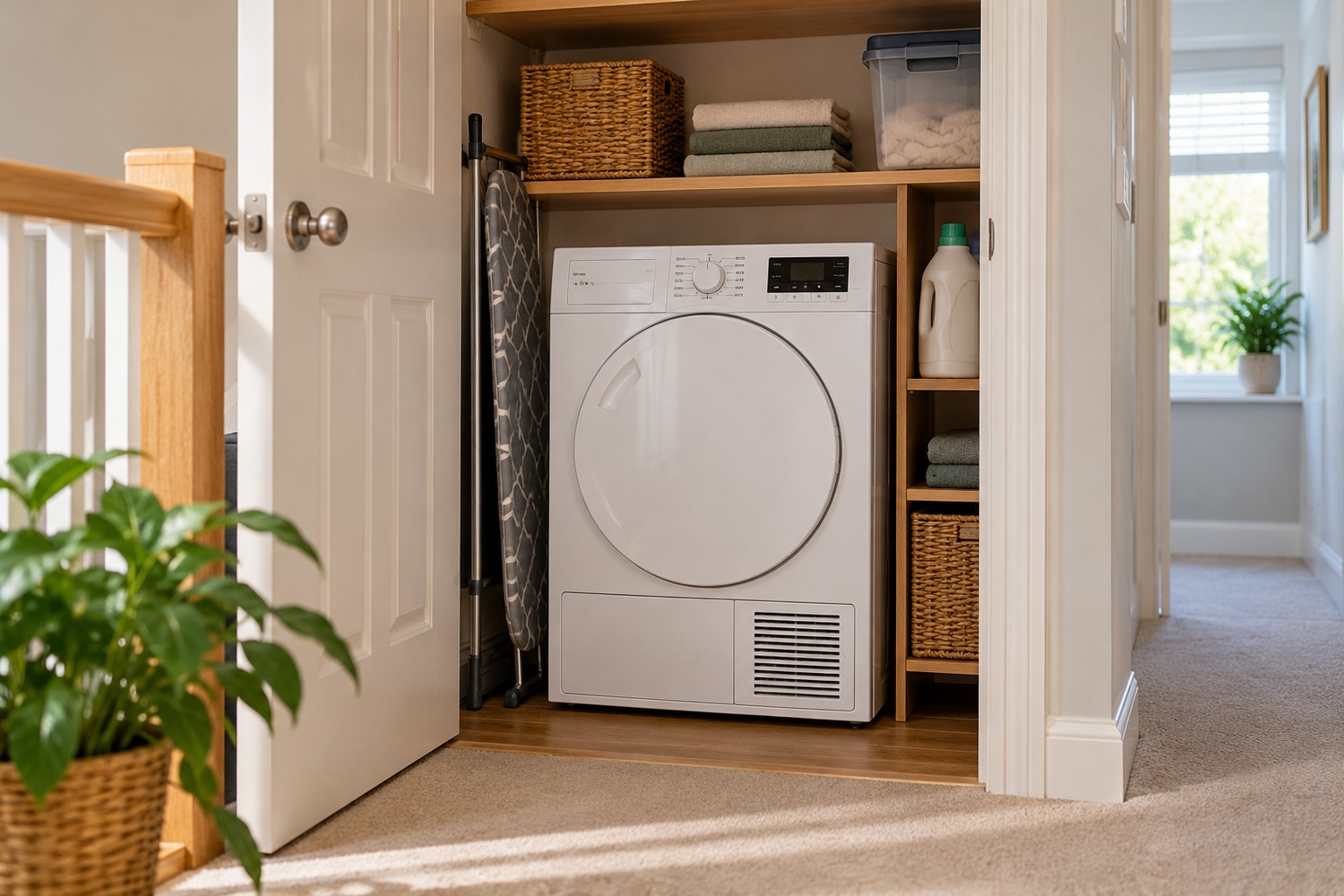
No — you generally shouldn’t place a tumble dryer directly on top of a freezer. Unless the manufacturers of both specific appliances expressly approve that arrangement and provide an appropriate installation method, assume it isn’t safe. A freezer’s top is not automatically designed to carry the weight of a working dryer, and the two appliances have different needs for support, heat dissipation and ventilation.
It’s understandable if your kitchen or utility room has only enough floor space for one appliance, – you may then wonder can you put a tumble dryer on top of a freezer? But stacking two items that happen to be similar widths doesn’t make them a compatible pair. There are safer ways to use the vertical space.
Why stacking a tumble dryer on a freezer is risky
The main concerns are support, stability, heat and airflow. A dryer can be heavy even before you add wet laundry. It also produces movement during operation. A freezer is designed primarily to refrigerate food, not to act as a load-bearing platform for another appliance.
A stack that appears steady when everything is switched off may behave differently during a cycle. A slipping or falling dryer could cause serious injury, damage the freezer, strain electrical cables or block access to switches.
The four compatibility checks
| Question | Why it matters | What to do |
|---|---|---|
| Can the freezer support the dryer? | Its top panel and cabinet may not be rated for that load | Check the exact freezer manual and seek written manufacturer confirmation |
| Can the dryer be safely restrained? | Movement could cause a fall | Use only a specifically approved support or installation system |
| Will either appliance’s ventilation be restricted? | Both machines reject heat into their surroundings | Follow each model’s clearances and vent positions |
| Can both be operated and serviced safely? | Height affects controls, loading, plugs and emergency access | Check access and have a competent installer assess the arrangement |
Is the top of a freezer strong enough?
You can’t judge strength by pressing on the freezer lid or checking whether it feels solid. A panel may support light everyday items yet be unsuitable for a heavy appliance, particularly one that moves or vibrates. Internal components, door hinges and insulation can also affect what parts of the cabinet can safely carry.
This applies to chest freezers as well as upright models. A chest freezer’s lid must open, and putting a dryer on it would obstruct access as well as placing an unverified load on the lid. Never improvise with timber offcuts or rubber pads to make the machines look level.
Can you use a washing-machine stacking kit?
Not unless the stacking-kit maker and both appliance manufacturers explicitly confirm compatibility with your freezer and dryer. Typical laundry stacking kits are intended for specified washing-machine and tumble-dryer combinations. Their brackets, straps or frames may depend on a washing machine’s particular top panel and dimensions.
A generic kit advertised as ‘universal’ isn’t proof that it can safely join a tumble dryer to a freezer. Check the approved appliances rather than relying on width alone.
What about heat and ventilation?
Freezers release heat as they operate and need clear ventilation paths. Tumble dryers also need airflow to work properly and manage heat and moisture. Placing one directly on another can obstruct vents or create an unusually warm space around the freezer.
Electrical Safety First’s freezer guidance says not to block ventilation openings and to leave room for air circulation behind refrigeration appliances. Its tumble-dryer guidance likewise recommends adequate space around the dryer and warns against enclosed locations.
Don’t assume a heat-pump dryer eliminates the issue. It doesn’t need an external vent hose, but it still has manufacturer-specified airflow and clearance requirements. A condenser dryer also needs suitable airflow; a vented dryer needs the correct external exhaust arrangement.
Could the dryer’s vibration make it fall?
It’s an additional risk. Tumble dryers contain a rotating drum, and loads can move during a cycle. They don’t vibrate in exactly the same way as washing machines during high-speed spinning, but movement and an elevated centre of gravity still matter.
Don’t try to solve an unapproved stack by adding anti-vibration feet or using a ratchet strap around the appliances. Those products aren’t a substitute for a tested, compatible support system.
What if your tumble dryer is smaller than the freezer?
Smaller dimensions don’t automatically make it safe. Even a compact dryer may exceed what the top of the freezer can support, and its feet may concentrate weight onto a small area. Similarly, a wider freezer isn’t inherently a stable platform.
The relevant information is the installation approval and load-bearing design, not whether the dryer looks neatly centred.
Can you build a shelf above the freezer instead?
A properly designed, independently supported platform may be worth exploring if you have limited floor space. The key difference is that the freezer would not be carrying the dryer. A suitable structure would need to support the appliance’s weight and movement, allow proper ventilation for both machines and provide safe access.
That’s a project for a competent installer or appropriately qualified tradesperson, not an ordinary bookcase or a shelf fixed casually to plasterboard. Check the dryer’s manual for whether elevated installation is permitted at all. Do not enclose either appliance tightly or block the freezer’s required clearances.
Other space-saving options
- Stack a compatible tumble dryer above a washing machine: only with a manufacturer-approved arrangement and stacking kit.
- Move the freezer: explore another well-ventilated location that meets its stated ambient-temperature requirements.
- Choose a different dryer arrangement: a suitable separate position or a combined washer-dryer may work better, depending on your laundry needs.
- Ask an installer about purpose-built utility cabinetry: any design must separately support appliances and respect access and ventilation requirements.
If you’re considering moving appliances into a different room, check the manuals and the building’s electrical provision before ordering.
Electrical safety matters too
A freezer normally runs continuously, while a dryer can draw significant power when operating. Electrical Safety First advises against plugging either type of large appliance into an extension lead. Use suitable sockets as directed by the appliance manufacturers, don’t trap cables between cabinets and keep electrical connections accessible.
The London Fire Brigade advises avoiding overloaded sockets and cleaning tumble-dryer lint filters after each load. The UK government’s home fire-safety guidance also advises not running tumble dryers overnight.
What could you buy instead?
If the two-appliance stack isn’t approved, shopping for a generic stacking kit isn’t the answer. For a compatible washing-machine and tumble-dryer combination, you can compare laundry stacking kits on Amazon UK, but verify the exact model compatibility before buying. You could also browse freestanding utility-room storage for non-appliance items, keeping appliance ventilation and access clear.
These are general shopping links, not recommendations for stacking a dryer on a freezer. We haven’t tested specific products.
Frequently asked questions can you put a tumble dryer on top of a freezer
Can you put a small tumble dryer on a chest freezer?
Not as a general rule. The lid needs to open, and it’s unlikely to be an approved platform for a working appliance. Check both manufacturers’ instructions rather than relying on size.
Can you put a freezer on top of a tumble dryer instead?
That isn’t automatically safe either. The dryer may not be designed to support a freezer, and access, airflow and stability all remain concerns.
Will a stacking kit stop the dryer moving?
A properly approved kit can be part of a suitable laundry-appliance installation, but ordinary washing-machine/dryer kits are not automatically compatible with freezers.
Is it safe if the tumble dryer is a heat-pump model?
A heat-pump dryer still has weight, airflow and stability requirements. Its technology doesn’t make the freezer beneath it load-bearing.
Can I put a dryer on a shelf directly above a freezer?
Potentially, if the dryer manufacturer permits elevated placement and a properly designed structure independently supports it. A competent installer should check the structure, anchoring, ventilation and safe access.
Bottom line
Don’t place a tumble dryer directly on top of a freezer unless both manufacturers expressly approve that exact installation. In most homes, treat the idea as unsuitable. If you’re short of floor space, investigate a correctly supported shelf or another appliance position rather than using the freezer as a stand.
Sources
- Electrical Safety First — Tumble dryer safety
- Electrical Safety First — Fridge and freezer safety
- London Fire Brigade — White goods fire safety
- GOV.UK — Fire safety in the home
Disclosure: Progressive Housewares may earn a commission from qualifying purchases through affiliate links, at no extra cost to you.