
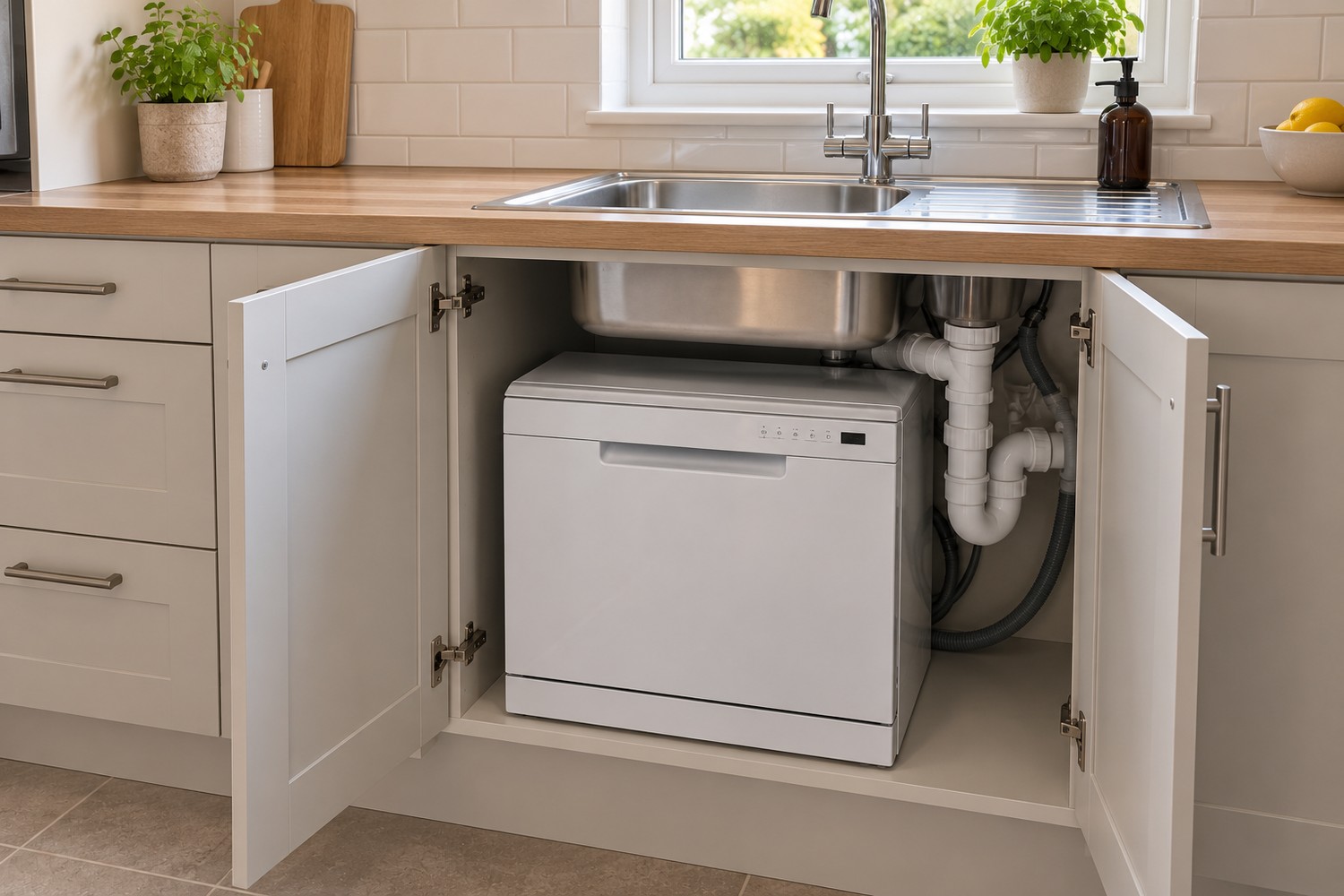
Sometimes, but a standard dishwasher usually won’t fit directly beneath the bowl of a kitchen sink. The sink basin, waste trap and pipes take up the same space the dishwasher needs. A compact model may fit in some kitchens, but only if its manufacturer permits the intended installation and there’s enough room for ventilation, plumbing, electrical access and the door to open. Often, the easier option is a dishwasher next to the sink or beneath the draining-board side.
If you’ve got a small kitchen the area beneath the sink can look like wasted space, so you may as yourself; can you put a dishwasher under the kitchen sink? But before removing a cupboard or buying a compact machine, measure what is actually available — and check what’s hidden behind the cabinet doors.
Under-sink dishwasher: what usually works?
| Position | Is it practical? | Main issue |
|---|---|---|
| Directly below the sink bowl | Usually difficult | Basin, trap and pipework reduce height and depth |
| Below the draining-board side | Often more practical | Depends on the cabinet layout and appliance dimensions |
| In the cupboard next to the sink | Often a good option | Proper water, drain and electrical connections are needed |
| Compact dishwasher inside sink cupboard | Sometimes possible | Must be approved for enclosed installation with suitable clearance |
| Countertop dishwasher beside the sink | Useful alternative | Needs a stable worktop and suitable water and waste arrangement |
These are general layout possibilities, not guarantees for every kitchen or product. The exact installation diagram and cabinet measurements decide what’s feasible.
Why won’t a full-size dishwasher usually fit beneath the sink?
A typical freestanding or integrated dishwasher occupies most of the height between the kitchen floor and worktop. Directly beneath a sink bowl, the bowl itself protrudes downwards; the trap, drain and water pipes may extend even lower.
Even where the cupboard looks wide enough, the available clear height and depth might be far smaller than expected. Trying to force a dishwasher into that space can damage hoses or waste connections and make future leaks difficult to spot.
Don’t treat a nominal 60cm cabinet width as proof of compatibility. Manufacturers specify the actual appliance width, height, depth, any adjustable-foot range and necessary connection space. An integrated dishwasher may also have particular cabinet-door or plinth requirements.
Is a slimline dishwasher the answer?
A slimline dishwasher is narrower than a typical full-width model, but it isn’t necessarily much shorter. That means it can solve a width problem without solving the height problem created by the sink bowl.
If your available gap is narrow but full-height, a slimline model might be worth investigating. If the sink and trap occupy the upper half of the cupboard, a compact or tabletop dishwasher is a more plausible option — provided the manufacturer approves the arrangement.
Can a countertop dishwasher go inside the under-sink cupboard?
Potentially, but don’t assume every countertop dishwasher can be enclosed. Many are designed to stand freely on a worktop, with specific clearance and ventilation requirements. Some also need easy access to a tap, water tank or hose connection.
Putting such a machine inside a cupboard can restrict airflow, complicate refilling or emptying water, trap moisture and make the door awkward to open. Check the exact manual for permitted placement and ventilation. If the instructions say the appliance needs an open worktop position, don’t install it behind a cupboard door.
How to measure the space properly
- Measure the opening. Note the clear width between cabinet sides and the height from the finished floor to the lowest obstruction.
- Find the lowest part of the sink. Measure the underside of the bowl, not just the worktop height.
- Map the pipes. Record where the sink waste, trap, water valves and any existing hoses sit.
- Measure usable depth. Allow for pipes, plugs and the manufacturer’s specified clearance, rather than measuring to the back wall alone.
- Check the door swing. Make sure the dishwasher door can open fully without hitting a kitchen unit, doorway or bin.
- Compare with the actual installation drawing. Use the model’s measurements and permitted connection locations; product listing headlines aren’t enough.
If you’re planning to alter the kitchen cabinet, allow for access to the trap and isolation valves after installation. A solution that fits on paper but can’t be serviced is unlikely to be a good one.
Can you put a dishwasher beneath the draining board instead?
Often, yes — and it’s usually the better place to investigate first. In many UK kitchens, the draining board extends over a neighbouring base unit while the actual sink bowl is over a separate cupboard. The area beneath the draining board may therefore have almost the full worktop-to-floor height available.
You’ll still need to check the actual cabinet construction, dishwasher dimensions, door opening and connection routes. Not every sink has a separate draining-board section, and some kitchens have supports or other fittings in the way.
An adjacent cabinet can also be practical because the dishwasher is close enough for a plumber to assess a suitable water supply and wastewater connection without placing it directly below the bowl.
What plumbing does an under-sink dishwasher need?
A dishwasher requires a suitable water supply and a properly arranged route for wastewater. The exact connection depends on the model. Some compact machines use a tap connection or built-in water tank; full-size machines normally have permanent plumbing connections.
For a permanent installation, a plumber should confirm that the supply, isolation valve, drain connection, trap and hose routing are appropriate. Follow the dishwasher manufacturer’s minimum and maximum hose-height limits, and use a suitable waste connection that prevents leaks and unwanted backflow.
Don’t just push the drain hose into an existing sink pipe or leave it loose in the cupboard. Poorly secured or incorrectly routed connections can leak or allow dirty water to return to the appliance. A qualified installer can determine whether an existing appliance spigot or a different waste-trap arrangement is suitable.
Where should the electrical socket be?
Dishwashers need safe electrical access as well as water and drainage. Electrical Safety First recommends a suitable wall socket instead of an extension lead and advises having the appliance fitted by a competent installer.
A socket under a kitchen sink isn’t automatically prohibited in every case, but it must be located so leaks or water from hoses and valves are unlikely to affect it. Electrical Safety First’s guidance on BS 7671 addresses this exact issue. Ask a qualified electrician to assess the position if there isn’t already a safe, accessible supply.
Don’t trap a plug behind the machine, route a cable across the floor or fit a socket where water is likely to drip onto it. After installation, make sure there is a practical way to isolate the power if needed.
Will steam and moisture damage the cupboard?
Moisture is another reason to follow the manufacturer’s installation instructions. A dishwasher may release warm, humid air when the door is opened after a cycle, and a leaking connection can wet cabinet panels before anyone notices.
Where an integrated appliance requires protective strips or barriers beneath the worktop, fit the parts supplied or specified. Never wrap the appliance tightly in insulation or seal its ventilation openings in an attempt to protect cabinetry.
If you notice swelling panels, persistent dampness or a musty smell, investigate the cause instead of assuming it’s normal.
How much might the kitchen need altering?
A workable installation might involve removing an existing base cupboard, changing the plinth, adjusting adjacent cabinets or rerouting pipes. In other kitchens, the sink bowl leaves so little room that changing the cabinet won’t help.
Get a clear installation quote before buying the dishwasher. Compare the total cost of appliance, plumbing, electrical work and cabinet alterations with the option of using a neighbouring cupboard or a genuine worktop model.
What should you buy for a small kitchen?
If the space directly beneath the sink is too low, you can browse compact countertop dishwashers on Amazon UK or compare slimline dishwashers for a suitable adjacent opening. A water-leak alarm may be a useful extra precaution in a properly installed kitchen.
These are general shopping searches, not individually tested recommendations. Confirm that the exact dishwasher is approved for the installation you have in mind before ordering.
Frequently asked questions can you put a dishwasher under the kitchen sink
Can you install a slimline dishwasher directly under a kitchen sink?
Sometimes, but slimline generally means narrower, not short enough to clear a deep sink bowl. Measure the available height and check the model’s installation diagram.
Does a dishwasher have to go next to the sink?
No. It needs a suitable water supply, drain and electrical connection, so an adjacent position is often convenient, but other positions may work if they’re professionally installed and meet the manufacturer’s requirements.
Can you put a mini dishwasher inside a closed cupboard?
Only if that particular model permits enclosed installation and its ventilation, access and plumbing requirements can be met. Don’t assume a countertop appliance is designed for that use.
Can you use the existing sink waste for a dishwasher?
Often a dishwasher can connect through a suitable kitchen waste arrangement, but the trap, hose routing and connections must be correctly specified. Have a plumber assess the installation rather than improvising the connection.
Will the sink still work if a dishwasher is installed beneath it?
It should, in a correctly designed installation, but the sink, trap and water connections must remain functional and accessible. If the only way to fit the appliance is to obstruct the waste system, choose another position.
Is a dishwasher under the draining board different from one under the sink bowl?
Yes. The draining-board side of many sinks doesn’t extend deeply into the cupboard, so there’s often much more space than directly underneath the bowl and trap.
Bottom line
A dishwasher can sometimes fit under a kitchen sink, but directly beneath the bowl is usually the hardest position. A compact model may work if approved for that location. For most kitchens, the adjacent cupboard or space beneath the draining-board side is more practical. Measure carefully, check the exact manufacturer’s instructions and have plumbing and electrical connections installed safely.
Sources and further reading
- Electrical Safety First — Dishwasher safety and installation
- Electrical Safety First — Wiring regulations help, including sockets under sinks
- Electrical Safety First — Kitchen electrical safety
Disclosure: Progressive Housewares may earn a commission from qualifying purchases through affiliate links, at no additional cost to you. We haven’t tested products linked in this article.