
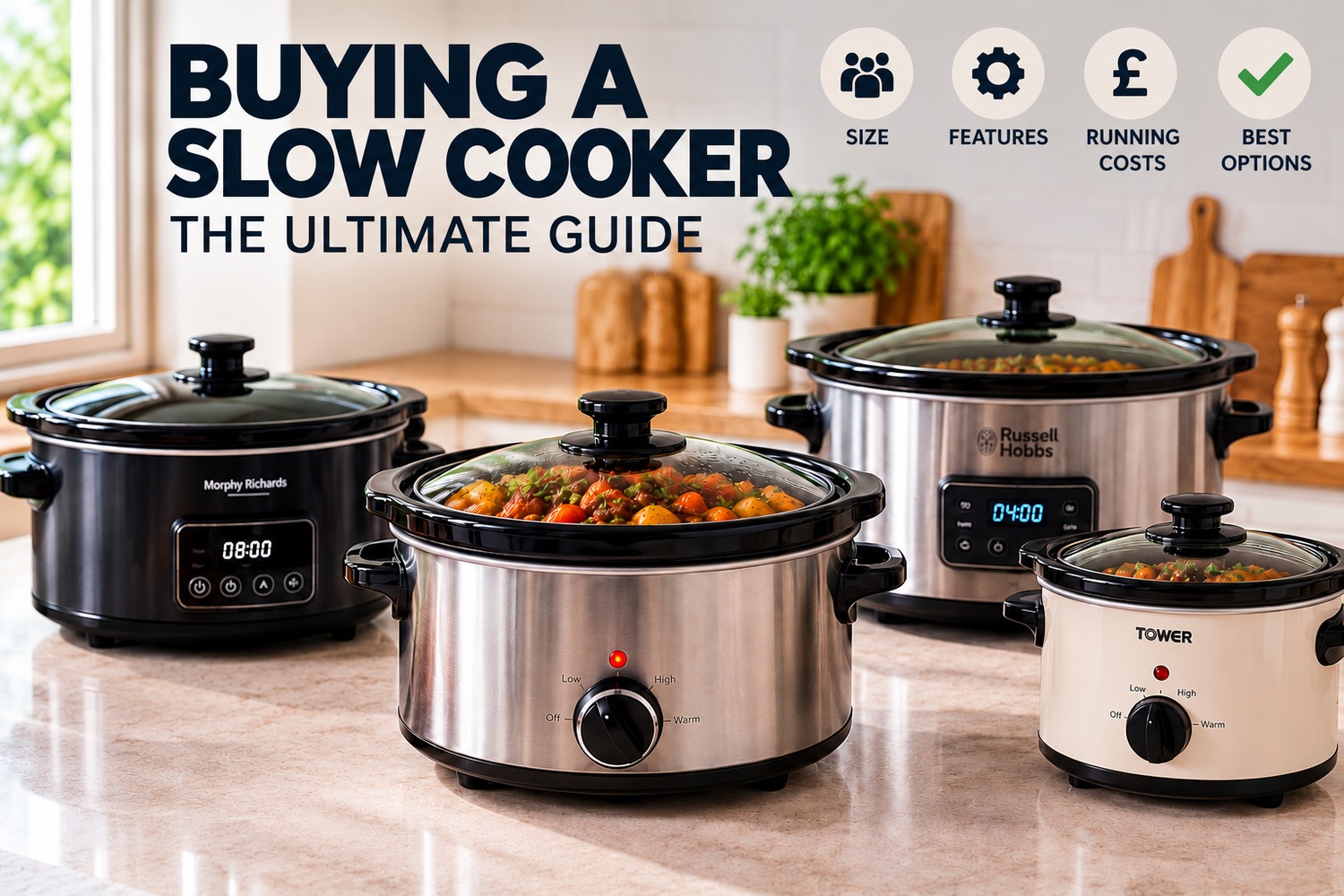
This slow cooker buying guide is for anyone choosing a cooker for a UK kitchen, whether it’s their first appliance or a replacement for an old model. The choices can be surprisingly confusing: a compact 1.5-litre cooker, a family-sized oval pot, a programmable digital design or a multi-cooker with slow cooking among many modes. The most expensive choice is not automatically the best one. Start with the meals you cook, the number of people at your table and the practicality of lifting, cleaning and storing the appliance.
A good slow cooker should make ordinary meals easier without compromising cooking safety. Consider its usable pot dimensions, filling instructions, electrical safety, temperature settings and whether you genuinely need extras such as a cooking timer or removable hob-safe insert. If you can answer those questions before shopping, you’re less likely to choose a cooker that looks appealing but ends up sitting unused in a cupboard.
Slow Cooker Basics: What Exactly Are You Buying?
A traditional slow cooker is a countertop appliance with an electrically heated base, a vessel that holds the ingredients and a close-fitting lid. Its purpose is to apply gentle heat over time to recipes that benefit from moist cooking. Stews, casseroles, curries and many braised meat dishes suit the method particularly well. The pot often removes from the heating base for serving or cleaning, although different models have different restrictions on how the insert may be used.
A slow cooker is not simply a hot food warmer, nor is it the same as a pressure cooker. Pressure cookers shorten cooking time under pressure, while ordinary slow cookers use longer cooking periods. Buffet kettles and warming pots may not be designed to bring raw ingredients safely to cooking temperature, so check the intended use of an unfamiliar product rather than relying on the shape of its lid or bowl.
The History of Slow Cooking
Slow cooking as a technique predates electricity by centuries. Cooks have long used covered vessels and gentle residual heat to turn tougher ingredients into tender meals. Modern electric appliances brought a variation of this method onto the domestic kitchen counter, so a stew no longer needed someone to keep adjusting a hob flame throughout the day. The recognisable combination of heated base, covered pot and simple controls became associated with convenient home cooking in the twentieth century.
Contemporary slow cookers still depend on the same culinary principles, even when they use digital timers, sensors and touchscreens. Many people buy one for convenience, but the basic cooking result comes from moist heat, the ingredients and the appropriate amount of time. A programmable cooker may be easier to fit around a working day, though it is not automatically better at producing a delicious stew than a well-chosen manual appliance.
How the Cooking Technology Works
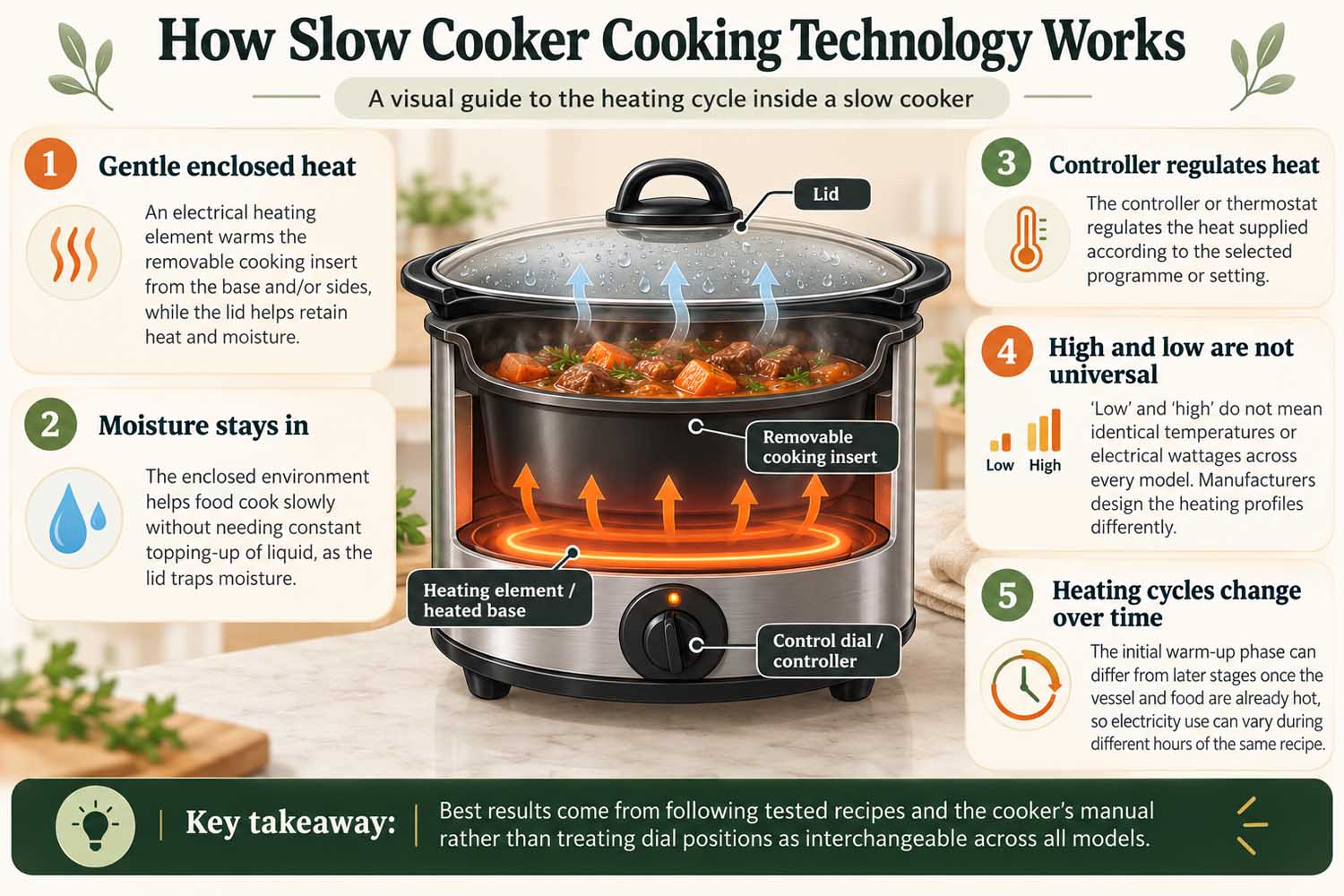
An electrical element transfers heat through or around the removable cooking insert, and the lid helps retain moisture. The controller regulates the heat supplied according to the programme. That enclosed environment makes it possible to cook a suitable casserole slowly without constantly replenishing liquid. However, ‘low’ and ‘high’ don’t necessarily translate into two universal temperatures or electrical wattages across every model. Manufacturers design the heating profiles differently, and thermostats may cycle elements on and off.
The initial warming phase can behave differently from the later phase when the food and vessel are already hot. A cooker may therefore consume a different amount of electricity in different hours of the same recipe. Temperature control should follow tested cooking instructions; avoid treating a dial position as permission to change recipes arbitrarily. A model that is simple to understand, with an accessible manual and clear indications of its settings, is preferable to an elaborate but confusing interface.
- Less hands-on cooking: suitable stews can cook with minimal attention once prepared.
- Batch cooking: prepare several portions for future meals.
- Versatility: casseroles, soups, curries and some braised joints.
- Practical meal planning: organise ingredients around your routine.
- Limitations: slow cooking does not produce a crisp or roasted finish.
What Are the Main Benefits Of Slow Cookers?
Convenience leads the list. Ingredients can often be prepared in advance, and a stew may cook with little intervention while you get on with other tasks. A slow cooker can also be useful for making multiple portions of the same meal, which helps with planning lunches or freezing future dinners. Long moist cooking suits certain inexpensive meat cuts and makes many vegetable soups straightforward. These benefits are especially valuable if you like casseroles but dislike attending a saucepan for hours.
There are limitations too. Slow cooking isn’t fast cooking, and not every recipe works simply by adding everything to a pot and waiting. Delicate vegetables can become mushy, and food that depends on crispness or browned skin may be disappointing. An appliance that handles only your occasional winter casserole could still be worthwhile, but don’t assume you need one simply because slow cookers are popular. Think about how regularly you’ll prepare suitable recipes.
The Potential Drawbacks of Slow Cookers Before You Commit
A large slow cooker can be awkward to store, and a heavy stoneware insert becomes heavier when full. Some models have lids and handles that make serving inconvenient. You may need to use a separate frying pan to brown meat first, adding a little washing up. Long cooking programmes also require planning; if you only decide what to eat at half past six, your slow cooker may not be the appliance that solves dinner tonight.
Learning the technique takes a little experimentation with recipes specifically designed for slow cooking. A casserole that relies on considerable evaporation on the hob may turn out watery when cooked under a tight-fitting lid. Other foods need adding later in the programme. Consider whether your kitchen has a safe, level and heat-resistant place to operate the appliance with the clearance specified by its manufacturer. A crowded countertop may make regular use impractical.
Health and Nutrition: What a Slow Cooker Can Offer
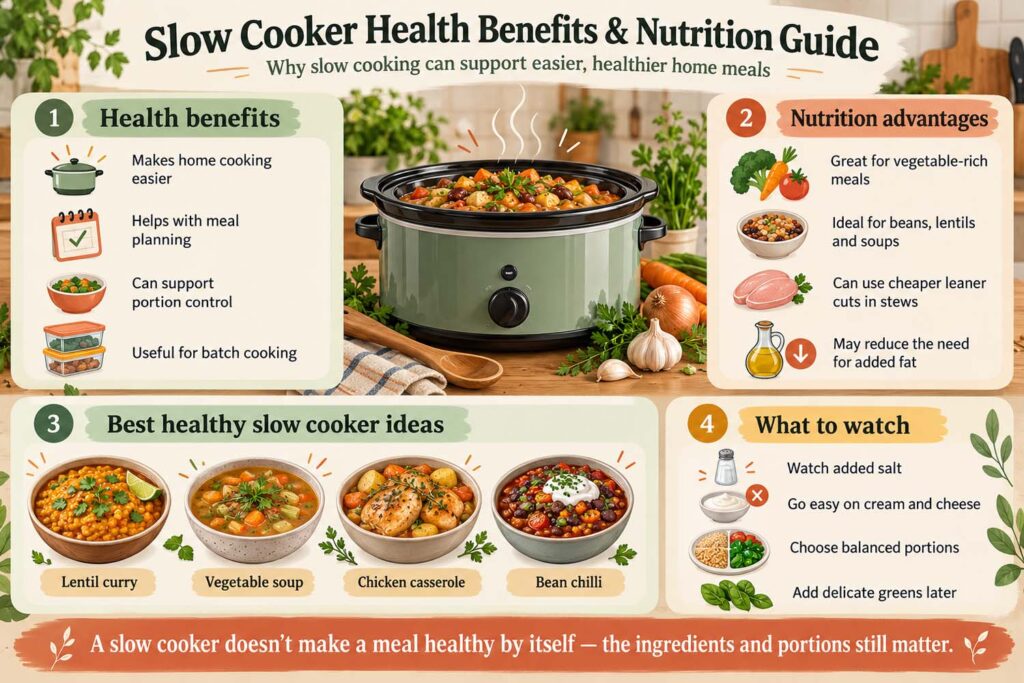
The appliance doesn’t make a recipe healthy on its own. A vegetable-rich lentil soup can be nutritious, while a creamy, salty casserole can still be high in salt or saturated fat. What matters is the balance of ingredients and the size of the portions. Slow cooking can support healthier habits by making homemade meals more convenient, allowing you to include vegetables and useful protein sources and reducing reliance on unplanned takeaway meals.
For recipe ideas from a UK healthcare organisation, the NHS Foundation Trust’s healthy eating on a budget resource includes slow-cooker meals suitable for everyday eating. It’s worth choosing a variety of recipes rather than relying entirely on one stew. People with particular dietary requirements should still read ingredients carefully and follow relevant medical or dietary guidance. When you’re serving leftovers, correct storage matters as much as a nutritious original recipe. Choose a cooker that makes realistic quantities you can eat, refrigerate or freeze safely.
Cooking Versatility: What Foods Work Best With Slow Cookers?
Soups, chilli, curries, ragù, lentil dishes and braised meat are familiar successes. The enclosed moist heat can help soften suitable cuts and blend flavours gradually. Many people also use a cooker for pulled-meat-style dishes or tomato-based vegetable stews. Certain desserts and breads have specialist slow-cooker recipes too, but don’t assume an ordinary oven recipe will transfer directly. Cooking times, liquid quantities and consistency can all change when evaporation is reduced.
Whole chickens and meat joints require special attention to both shape and safe preparation. For bulkier ingredients, compare our guide to fitting a 2kg beef joint, guide to a 2kg gammon joint and whole chicken slow cooker sizing guide. For meat-free meals, slow cookers for vegetarians looks at suitable vegetables and pulses. Some raw dried beans, especially kidney beans, require particular high-temperature preparation and must not simply be put into a slow cooker dry. Always choose an appropriate recipe for the ingredient.
- Correct capacity and usable fill limits
- Removable insert that is manageable when full
- Secure lid and comfortable handles
- Clear low/high settings and readable instructions
- Timer or automatic keep-warm if your routine benefits
- Approved hob-safe insert if you regularly brown food
- Cleaning instructions you can realistically follow
- Replacement parts and manufacturer support
A Slow Cooker Buying Guide to Prioritising the Right Features
The core features are a reliable heating base, suitable removable bowl, clear controls, properly fitting lid and safe construction. A useful addition is automatic keep-warm, which some models enter when a timed cooking programme finishes. That may help when dinner service is delayed slightly, but it isn’t a substitute for refrigeration or unlimited hot holding. Check exactly how the model behaves at the end of its cooking cycle.
Consider features you will genuinely use every week, rather than chasing the largest number printed on a product listing. A clear dial might be preferable to complex menus; alternatively, a countdown and automatic programme change could be helpful if you often return home after the scheduled cooking time. Stable handles, an insert you can wash easily and accessible manufacturer instructions often make more difference than phone connectivity. See our programmable slow cooker guide for a closer look at digital versus manual controls.
Manual and Programmable Slow Cookers
Manual cookers are often controlled by a dial with low, high and sometimes warm. They can be straightforward to learn and effective for familiar recipes. A programmable model may let you set a cooking duration and automatically change modes or alert you when the period ends. But the word ‘digital’ alone doesn’t guarantee any particular functionality, so read the manual rather than assuming the screen provides delayed start or automatic shut-off.
A cooking timer and delayed-start function are not the same. Delaying heating while raw perishable ingredients sit at room temperature can create food-safety risks. Don’t improvise delayed cooking with an ordinary plug-in timer. In choosing between these options, think about how often you will be away while a meal cooks, whether the manufacturer permits that usage and how you intend to serve the meal safely afterwards. Simplicity can be a feature in its own right.
Standard Size of Slow Cookers UK
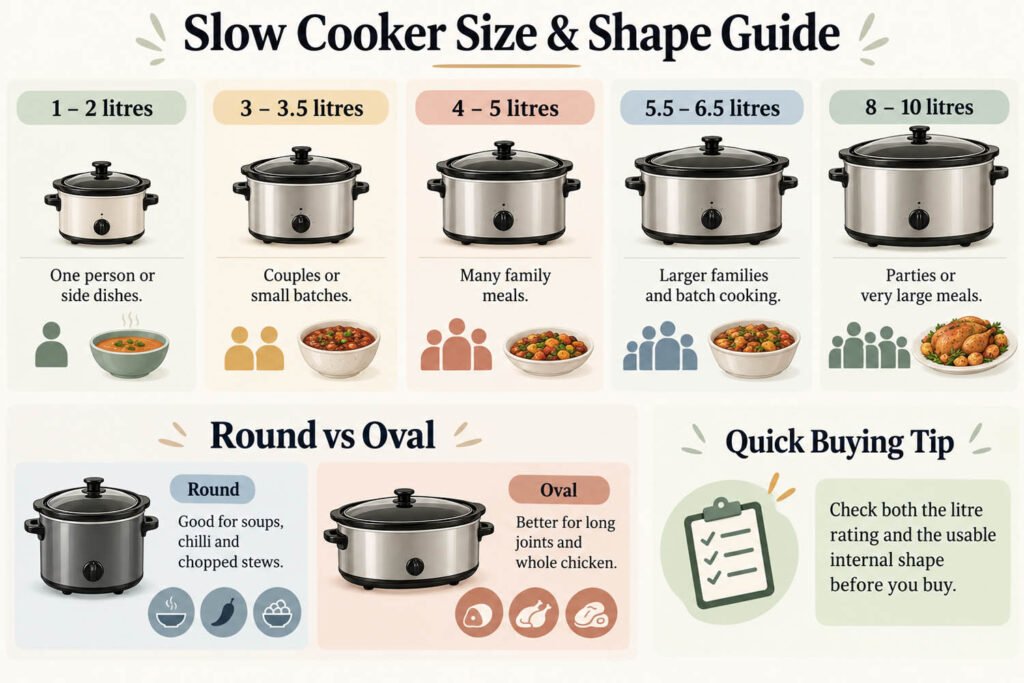
There is no official single standard UK capacity. Compact cookers of around 1.5–2 litres can suit very small batches, while 3–3.5 litres is a practical reference for couples and modest meals. Around 4–5 litres often appeals to families, and 5.5–6.5 litres or more can suit large portions and batch cooking. The printed capacity is not necessarily the amount you can safely fill with food.
| Cooker size | Good starting point for | Practical note |
|---|---|---|
| 1–2 litres | Single portions / sides | Very limited batch size |
| 3–3.5 litres | Couples / small batches | Check bulkier ingredients |
| 4–5 litres | Many family meals | Versatile everyday range |
| 5.5–6.5 litres | Large meals and leftovers | More storage and weight |
| 8–10 litres | Entertaining and crowds | Consider two smaller pots |
Look for minimum and maximum fill guidance, and compare the recipes you’re planning to cook. A tall, narrow pot may hold the same litres as a long oval one but be less useful for a bulky joint. Our complete UK slow-cooker size guide explains capacity ranges in detail, while our guide to capacities used in recipes discusses how recipe writers specify cooker size. The right working volume matters more than any broad claim that one particular size is ‘standard’.
What Size Slow Cooker for One or Two People?
For one person, a smaller pot may be easier to store and wash. However, somebody who enjoys preparing several future meals might prefer a slightly larger cooker that still meets the manufacturer’s fill requirements. An oversized pot isn’t automatically convenient: tiny portions may sit below a recommended minimum fill level or cook differently from how the recipe was tested. See our guide to slow cookers for one person for a more detailed discussion of solo cooking.
For two people, capacity should reflect whether you cook exactly two portions or deliberately make leftovers. A compact model can be ideal for smaller stews, but dishes containing bulky potatoes and vegetables may need more room than expected. Review several recipes you genuinely like, note their ingredient quantities and ask whether the advertised model gives enough usable capacity without requiring you to double every meal.
What Size Slow Cooker for a Family of Four or Five?
Families need to consider appetites, whether children eat adult-sized servings and how much food is served on the side. A curry served with rice can require less cooker volume than a complete potato-and-vegetable stew. A model around 4–5 litres may suit many everyday family recipes, while a larger cooker offers more flexibility for generous portions. Our guide to cooking for a family of four examines these choices for four people.
Five adults may need a larger bowl, particularly for hearty one-pot meals. Comparing roughly 5.5–6.5 litres can provide a starting point, though it is not a guarantee of five large servings. Check usable fill volume and the internal dimensions. Our guide to slow cookers for five adults explains why a substantial batch of chilli and a roast joint with vegetables demand different kinds of space. If your household size frequently changes, a pair of appropriately sized cookers may be more useful than one oversized model.
Cooking for Twelve or Entertaining Groups
Catering for a crowd changes the buying decision. One very large appliance might fit a batch of soup or chilli, but it may be cumbersome to move or wash, and not every large advertised pot is a genuine slow cooker rather than a serving warmer. Two medium-size cookers can make it easier to prepare separate meat and vegetarian dishes, or divide an appropriately developed large-batch recipe between appliances.
Our slow cooker capacity guide for twelve people discusses the trade-offs for twelve people. If you entertain regularly, think about electrical sockets, worktop space, the weight of full inserts, safe cooling and how you’ll serve the meal. It’s usually wiser to plan your required food volume and work backwards to the appliance than to assume the highest litre figure is always the best choice.
Round Versus Oval Slow Cooker Shape
Round pots are generally suitable for soups, chopped casseroles, curries and sauces. Oval bowls can make fitting whole chickens or long meat joints easier because the usable internal length may be greater. Still, litre capacity does not tell you everything about the interior. A deep round pot can sometimes be better for a liquid dish than a shallow oval design, depending on your recipe.
Measure the longest and bulkiest ingredients you expect to cook and compare them with the manufacturer’s internal bowl dimensions. Product photographs can be misleading because they rarely show scale. A cooker in which the lid cannot close properly around a joint is not suitable for that method, even if the advertised capacity seems generous. Don’t let exterior handles or decorative housing confuse the measurements you need for the actual cooking insert.
Ceramic, Stoneware or Aluminium?
| Buying consideration | Ceramic / stoneware | Aluminium insert |
|---|---|---|
| Typical weight | Heavier | Often lighter |
| Hob searing | Usually not approved | Possible on selected models |
| Main damage risk | Chipping or cracking | Scratches or coating wear |
| Cleaning | Depends on glaze/manual | Depends on coating/manual |
| Best for | Simple slow cooking | Lighter lifting and optional searing |
Traditional glazed stoneware is familiar, retains heat well and often feels robust during everyday cooking. Its disadvantages are weight and vulnerability to cracking or chipping if mishandled. Aluminium inserts can be lighter, and some are approved for browning food on a suitable hob. Many also have coatings that need particular care. Neither material automatically guarantees better flavour, energy savings or durability across every model.
Consider whether you routinely sauté onions or brown meat. If you do, an approved hob-safe insert can save washing a separate frying pan. But don’t place an ordinary ceramic pot directly onto a cooking zone, and don’t assume every aluminium bowl works on induction. Our ceramic versus aluminium comparison compares weight, cleaning, coating care, searing and other factors in greater detail. Choose the actual model specifications over broad claims about the material.
Lids, Handles and Cleaning
A close-fitting lid helps retain moisture and heat. A glass lid may allow you to see some of the food, although condensation can obscure your view. Handles should be comfortable when using suitable protective gloves, especially for a heavy filled insert. A removable cooking pot can simplify serving, but check whether the insert is dishwasher-safe, whether it may go into an oven and whether particular utensils are permitted.
A cooker you dislike washing is one you’ll use less often. Consider whether the insert fits comfortably in the sink and whether its base can be wiped without difficulty. Always unplug the electrical unit before cleaning, let components cool according to instructions and avoid immersing the heating base. Think about replacement lids and bowls: the ability to buy a spare can extend the practical lifespan of an appliance.
What About Energy Efficiency?
Slow cookers can use a comparatively modest electrical power rating, but they run for several hours. Watts describe the rate of power consumption; kilowatt-hours measure energy used across the whole cooking period. A nameplate rating multiplied by hours gives an illustrative full-power calculation, not necessarily the exact cost of a thermostat-controlled cooking session. Models differ, as do recipes and total cooking durations.
| Assumed draw | Energy used in 8 hours | Cost at 26.32p/kWh |
|---|---|---|
| 100W | 0.8kWh | 21.1p |
| 150W | 1.2kWh | 31.6p |
| 200W | 1.6kWh | 42.1p |
| 250W | 2.0kWh | 52.6p |
Illustrative continuous-power calculations, not tested appliance costs. Actual heating cycles and tariffs vary.
The Energy Saving Trust’s appliance cooking-cost research gives a specific October 2026 example costing about 34p in Great Britain to slow-cook a 3.6kg homemade beef stew. That figure is for a particular tested cooking task rather than every slow cooker. Read our UK slow cooker electricity consumption guide for understanding power consumption and our eight-hour running-cost guide for the cost of an eight-hour cook. If economy is your reason for buying, compare actual kWh used for equivalent finished meals, not just watts on an appliance label.
How Much Does It Cost to Run a Slow Cooker?
Your price depends on the cooker’s electricity consumption and your household tariff. An appliance drawing a constant 200 watts for eight hours would consume 1.6kWh; the actual total can differ because heating elements may cycle and programmes vary. To calculate a planning figure, divide watts by 1,000, multiply by hours and then multiply by your unit price in pounds per kWh.
An electric oven may use more power but cook different foods in a shorter time; an electric hob may be more economical for a very quick dish, while a microwave can be excellent for reheating one portion. To compare appliances fairly, use the same finished recipe, number of servings and any extra cooking steps. Our slow cooker versus electric oven comparison examines when a slow cooker is cheaper to run than an electric oven. Think about cost per useful portion, especially if you prepare food for several days.
Food Safety When Buying and Using a Slow Cooker
Safety should begin before checkout. Choose an appliance intended for UK electrical systems with the correct plug and fuse. Electrical Safety First’s slow and pressure cooker guidance recommends buying from reputable retailers, following manufacturer instructions and checking for appliance recalls. It also advises appropriate placement, suitable clearance, routine checks of plugs and cables and avoiding overfilling. A stable heat-resistant surface is essential.
Cooking safety also matters. Food Standards Agency advice on cooking and reheating explains thorough cooking and the importance of handling leftovers correctly. Follow suitable recipes, refrigerate ingredients when needed and don’t use slow cooking to thaw a large frozen joint. Foods should be heated safely, and leftovers cooled and refrigerated promptly. Follow the manufacturer’s keep-warm guidance rather than treating it as endless food storage. If a cooker has a damaged cable, unusual smells or electrical faults, stop using it and seek appropriate repair advice.
How a Slow Cooker Fits Different Diets
A slow cooker is not limited to meat stews. Lentil soups, vegetable curries, suitable pulse dishes and tomato sauces are common meat-free meals. You can also prepare certain lower-fat recipes or meals based on affordable vegetables and beans. The nutritional result depends on the food you put into it, not on the appliance’s label. Be careful with dried pulses requiring specific preparation, especially raw dried kidney beans.
If your aim is regular homemade meals, choose a pot that accommodates your familiar recipes. A small batch may be practical for one person, while two pots can make separate dishes for guests with different dietary preferences. Think about the number of servings you will actually eat, your storage space and your appetite for leftovers. A giant pot is of little benefit if half the food goes to waste.
Slow Cooker or Multi-Cooker?
Some multi-cookers combine slow cooking with pressure cooking, sautéing, steaming or rice programmes. This can be attractive if cupboard space is limited and you genuinely use several functions. However, their slow-cook programmes may behave differently from a traditional stoneware cooker, and the additional modes come with their own instructions and safety considerations. You cannot assume that recipes transfer perfectly between appliances.
For someone who mainly wants stews and casseroles, an ordinary slow cooker may be easier and less expensive to learn. For a household that already likes pressure cooking or needs multiple functions, a multi-cooker can offer more flexibility. The useful question isn’t which appliance has the longest feature list, but which one you’ll operate safely and regularly. Choose based on your cooking habits and willingness to learn different methods.
What Are Some Common Mistakes to Avoid With Slow Cookers?
Buying on litre size alone is one common mistake. A bulky joint may not fit a round bowl, and a nominal capacity may exceed the recommended cooking fill level. Another mistake is assuming low and high operate identically across brands or that a digital screen guarantees automatic keep-warm. Always read the exact manual and use recipes developed for the appliance.
Overfilling, unnecessary lid lifting, adding too much liquid and cooking delicate vegetables for too long can affect results. Food safety errors are more important: raw perishable ingredients must not sit unchilled while a delayed-start timer waits to begin cooking, and unsuitable frozen meat shouldn’t simply be placed into a slow cooker. Avoid abrasive cleaning that damages surfaces, and don’t ignore worn power cords or damaged inserts. Start simple and learn your model’s behaviour before experimenting.
What Should You Check in the Warranty and Manual?
The manual should explain how much food the appliance may safely hold, which settings to use, how to clean the insert and which heating methods it permits. For a model with a metal pot, look for exact hob compatibility. If the controls change from cooking to warming automatically, verify the intended behaviour and permitted holding time. Absence of clear instructions on essential issues is a reason to consider a different product.
Check the warranty’s coverage and whether replacement inserts and lids are available. Appliances can have perfectly functional electrical bases even after a pot has been chipped or damaged. Spare components may make long-term ownership more economical. Consider customer support and product registration, since manufacturers may use it to contact owners about safety recalls. Keep receipts and basic documentation accessible after purchase.
Planning Your First Five Slow-Cooker Meals
Start with a recipe written for a similar capacity and the manufacturer’s recommended fill levels. A vegetable soup or simple casserole lets you learn how your appliance handles liquids and vegetables. For a second attempt, choose a dish requiring browning in a separate pan so you understand how that additional step affects flavour. Follow tested settings rather than trying to invent cooking times.
For a third meal, cook something with chunky vegetables to see how their size affects texture. Then try a suitable lentil or vegetarian dish, remembering that some dried pulses need special preparation. Finally, make an appropriately sized batch of stew and portion any leftovers safely. These five meals will reveal whether your cooker is a comfortable size, whether its lid and controls are easy to use and how much cleaning effort the insert requires.
- Household: Work out your usual number of diners and whether you want leftovers.
- Recipes: Pick three dishes you genuinely intend to cook.
- Capacity: Check both the litre rating and the manufacturer’s permitted fill range.
- Shape: Choose oval for long joints if the internal dimensions suit; round is fine for many stews.
- Insert: Compare ceramic/stoneware with coated aluminium, including weight and washing.
- Controls: Decide whether a manual dial, countdown or automatic keep-warm is useful.
- Safety: Verify the correct UK plug, clearances and instructions.
- Maintenance: Check dishwasher suitability, warranty and replacement inserts.
- Running costs: Compare realistic kWh for your cooking sessions, not wattage alone.
- Storage: Measure where the appliance will live and how you will lift it safely.
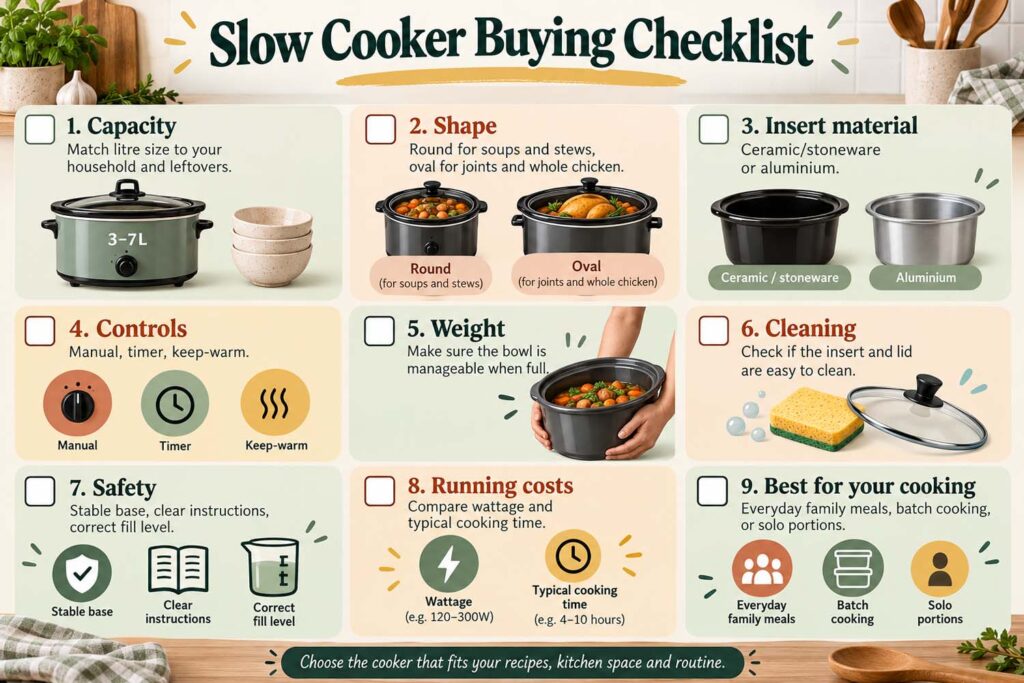
The Ultimate Slow Cooker Buying Checklist
Before you buy, establish your most common number of diners and whether you regularly want leftovers. Write down the meals you prepare most often and whether you plan to cook whole joints or chopped ingredients. Compare internal dimensions and permitted filling levels, and then decide on round versus oval. An appropriate capacity should be your first major decision.
Next, assess the insert material and weight, cleaning instructions, controls, timer and keep-warm behaviour. Check the manufacturer’s manual for electrical safety, clearances, UK plug, warranty and replacement parts. Don’t be swayed by a long list of marketing terms that don’t address your needs. You can compare stock at familiar UK retailers without treating a shopping listing as independent evidence of energy savings or cooking performance.
Frequently Asked Questions
Which size is best for a couple? A compact cooker or one around 3–3.5 litres can suit many two-person recipes; choosing between them depends on leftovers and ingredient bulk. Is six litres too big? Not necessarily for families or batch cooking, but it may be impractical for small portions. Do I need digital controls? Only if the actual timing and keep-warm features fit your routine. What does an oval shape help with? It may accommodate long cuts and poultry more easily than a similarly sized round pot.
Are slow cookers expensive to run? Costs depend on actual kWh and duration, and comparisons with ovens should use the same meal. Can I put a ceramic pot on the hob? Only if the manufacturer approves that specific use. Is slow cooking automatically healthy? No; ingredients and portions still matter. Can I leave the cooker running while out? Follow the manufacturer’s instructions and Electrical Safety First’s slow and pressure cooker guidance rather than assuming all machines and settings are equally suitable.
Final Verdict: How to Choose a Slow Cooker
The best slow cooker buying guide should help you choose a dependable appliance for the meals you actually enjoy. Start with capacity, shape, safe filling levels and a manageable insert, then assess controls and convenience features. A sophisticated digital display will not make up for a cooker that doesn’t fit your favourite recipe, and a giant bowl is of little use if you only make one small serving.
By the end of this slow cooker buying guide, the most important question should be clear: will this particular cooker make your usual cooking easier, safer and more practical? Think about ordinary weeknight meals, realistic batch cooking, cleaning, electricity usage and storage. Check the actual manufacturer’s guidance before buying, and give more weight to suitability and construction than to impressive marketing claims.