
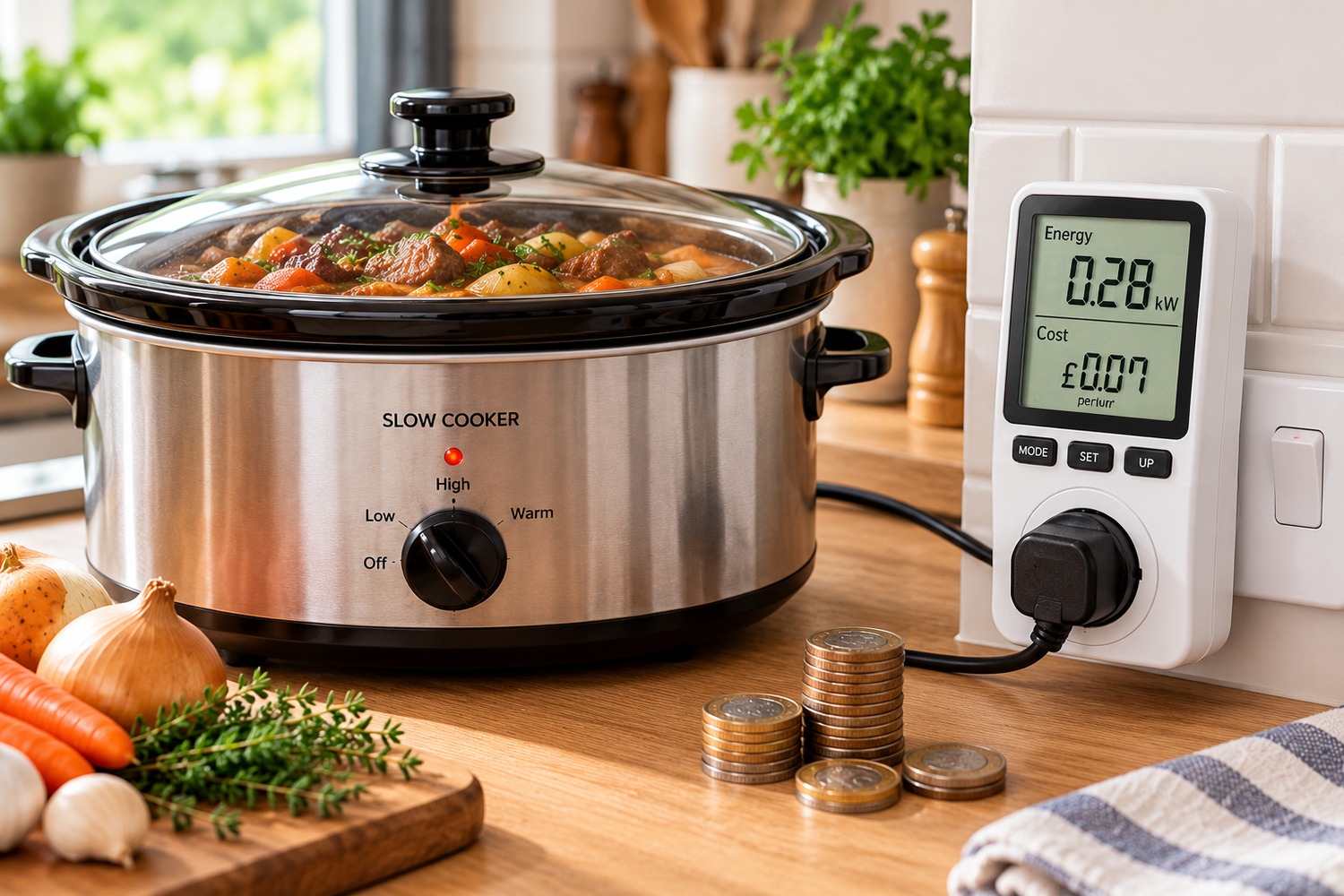
If you’re planning an all-day stew, you may be wondering: how much does it cost to run a slow cooker for 8 hours uk? At the October–December 2026 average electricity unit rate of 26.32p per kWh for standard-variable-tariff Direct Debit customers in Great Britain, a slow cooker rated at 150 watts would cost about 32p for eight hours if it drew its full rated power continuously. A 200W model would cost around 42p on the same basis.
Those figures are simple planning estimates, not measured costs for every slow cooker. Real appliances can cycle their heating elements on and off as they maintain temperature, and their electricity use depends on the model, cooking setting and recipe. Your own unit rate may also differ.
How much does it cost to run a slow cooker for 8 hours UK?
A useful way to estimate the cost is to multiply the appliance’s power in kilowatts by eight hours, then multiply by your electricity unit rate. The table below uses Ofgem’s published 26.32p per kWh average for 1 October to 31 December 2026 and assumes the cooker draws its labelled wattage throughout. In practice, that assumption can overstate its actual consumption.
| Slow cooker rated power | Electricity used in 8 hours if running continuously | Estimated cost at 26.32p/kWh |
|---|---|---|
| 100W | 0.80 kWh | 21p |
| 150W | 1.20 kWh | 32p |
| 200W | 1.60 kWh | 42p |
| 250W | 2.00 kWh | 53p |
| 300W | 2.40 kWh | 63p |
These figures exclude the household’s daily standing charge, since you’d normally pay that whether or not you used the slow cooker. They also don’t include the cost of ingredients or any separate hob cooking needed to prepare a recipe.
Which UK electricity rate are these calculations based on?
Ofgem reports an average electricity unit price of 26.32p/kWh for 1 October to 31 December 2026 for a typical customer in England, Scotland or Wales on a price-capped default tariff paying by Direct Debit. This period’s figure excludes electricity VAT under the temporary rules in force from October 2026. You can check the current rates and regional differences on Ofgem’s official electricity unit-rate page.
The price cap doesn’t mean every UK household pays that exact rate. Fixed deals, prepayment meters, regional variations and time-of-use tariffs can give different prices. Northern Ireland has a different electricity market, so the GB average isn’t the correct rate to apply automatically there. If you want your own cost, use the price per kWh stated on your bill.
How to calculate your slow cooker’s actual running cost
Use this straightforward formula:
Cost in pounds = (watts ÷ 1,000) × hours × electricity price in pounds per kWh.
For example, if your slow cooker is rated at 180W and your electricity rate is 26.32p/kWh, the eight-hour maximum-rated-power calculation is: 0.18kW × 8 hours × £0.2632 = about 38p.
Find the wattage on the appliance’s rating plate, the manufacturer’s instruction book or its technical specifications. If you see a range of figures, use the applicable rated input power rather than assuming every heat setting always draws that amount.
For a better figure, an electricity usage monitor that records kilowatt-hours (kWh) across a normal cooking session can be helpful, provided it’s suitable for the appliance’s plug and rating and used safely. This captures the effect of heating cycles. A smart-meter display may also show overall household usage, but other appliances running at the same time can make an individual slow cooker’s contribution hard to isolate.
Does a slow cooker really use its full wattage for eight hours?
Not necessarily. The wattage on a label is usually the appliance’s rated electrical input, rather than a promise that it takes exactly that amount of power every minute. Many slow cookers switch their heating element on and off to maintain the selected temperature.
That means wattage multiplied by time is best treated as a simple full-power estimate, not a measured electricity bill. You shouldn’t claim an eight-hour cost down to the penny for a particular appliance unless you’ve measured its real energy consumption in that cooking programme.
For illustration, if a cooking session consumed 0.9kWh on a plug-in meter, at 26.32p/kWh it would cost about 24p. That example is hypothetical; it isn’t presented as a test of a real model.
Is low cheaper than high on a slow cooker?
It depends on the design and the recipe. On some slow cookers, low and high settings change how quickly the appliance reaches its operating temperature rather than creating two entirely different final temperatures. The heating cycle and total runtime also matter.
A shorter cook on high isn’t automatically more expensive or cheaper than a longer cook on low. Follow the recipe and manufacturer’s settings, and measure kWh if you want a proper comparison. Avoid switching recipes to an unsuitable setting purely to save a few pence.
Is an eight-hour slow cooker cheaper than using an oven?
It often can be for a large stew or casserole, but the correct comparison is the energy needed to cook the same recipe and number of portions. An oven may have a much higher rated wattage but cycles its elements; it may also cook food more quickly. A microwave may be cheaper for reheating a single portion.
The Energy Saving Trust’s comparison of cooking methods gives a slow-cooker cost example for a specific large batch of stew and explains why batch cooking can be economical. Its figures come from defined food tests, rather than a universal cost for all slow cookers.
If you cook enough for four dinners and freeze three, the electricity cost per portion may be lower than the cost of preparing four separate meals. But that only works if you’ll actually eat the leftovers.
Does slow cooker size affect running costs?
Capacity and wattage are related in broad terms, but not perfectly. Larger slow cookers often have higher electrical ratings, yet the insulation, control system, food quantity and cooking time can all change energy usage. Don’t buy a huge cooker purely because its advertised wattage looks competitive.
A properly sized cooker that you fill according to the manufacturer’s guidelines is usually a more practical purchase. Our guide to choosing a slow cooker for a family of four explains how much capacity typical households may need. If you cook bulky cuts, our slow cooker size guide for a 2kg gammon joint explains why usable pot shape matters as well as litres.
How much would using a slow cooker twice a week cost?
Suppose your eight-hour cooking session actually used 1.2kWh. At 26.32p/kWh, one cook would cost about 32p; two sessions per week would cost about 63p in electricity, or roughly £33 over 52 weeks at the same rate. That’s a worked example, not a forecast of your household’s bill.
Your result will change when electricity rates change or you use different recipes, heat settings and session lengths. It may also be worth considering the ingredients you’re using: a low-running-cost appliance isn’t necessarily a cheap meal if the recipe is expensive.
Should you buy a slow cooker to reduce your electricity bill?
If you already make soups, stews and casseroles regularly, a slow cooker may be worth considering. The potential saving comes from cooking suitable dishes efficiently and making several portions at once — not from a guarantee that any eight-hour session costs a particular number of pence.
If you’re shopping, compare 3.5-litre slow cookers on Amazon UK for smaller households or browse 5-litre slow cookers if you regularly feed more people. Check actual wattage, usable capacity and whether the pot can be removed for cleaning.
If you prefer the cooker to switch from cooking to warming automatically, look at programmable slow cookers with automatic keep-warm. Remember that a timer is a convenience feature and doesn’t itself guarantee a lower electricity cost. These are general Amazon UK searches; we haven’t tested the products listed.
Ways to avoid wasting electricity when slow cooking
- Use an appropriately sized cooker. Check the stated minimum and maximum fill guidance.
- Follow the recipe’s cooking time. Leaving food heating well beyond the required period wastes energy and can spoil its texture.
- Avoid repeatedly lifting the lid. Heat escapes whenever you open it.
- Make useful extra portions. Batch cooking can spread the session’s cost across several meals.
- Choose the right appliance for the job. Reheating one bowl of soup may be quicker and cheaper in a microwave than starting an eight-hour cooking session.
- Use safe placement. Follow the appliance’s manual and keep it away from materials that could overheat.
Frequently asked questions
How much does a 200W slow cooker cost for 8 hours?
At 26.32p/kWh, running continuously at 200W for eight hours would use 1.6kWh and cost about 42p. Actual consumption may be lower if the heating element cycles.
How much does a 150W slow cooker cost for 8 hours?
At the same rate, eight hours at a continuous 150W is 1.2kWh, or about 32p. Measure actual electricity use if you need a more precise figure.
Does a slow cooker cost more to run on high?
Not necessarily per meal. The power cycle and shorter or longer cooking time matter. Compare the kWh used by the appropriate programmes rather than assuming high always costs more.
Is a slow cooker cheap to run in the UK?
For many slow-cooked dishes, it can be relatively inexpensive compared with using a conventional oven, particularly for multiple portions. Your actual cost depends on electricity usage and your tariff.
Should you add the daily electricity standing charge to the calculation?
Usually not when calculating the extra cost of using a slow cooker. The daily standing charge is generally paid whether you run the appliance or not.
Will these figures still apply next year?
No. The example tariff is specifically the October–December 2026 GB average rate. Update the calculations using your current electricity unit price whenever you read this article.
The bottom line on how much does it cost to run a slow cooker for 8 hours UK
At the October–December 2026 average GB electricity rate of 26.32p/kWh, eight hours of continuous use at 150W costs about 32p and at 200W about 42p. Real slow cookers may consume less because their heating cycles vary. For an accurate figure, measure how many kWh your cooker actually uses and multiply that by the current unit price on your electricity bill.
Affiliate disclosure: Progressive Housewares may earn a commission from qualifying purchases through Amazon UK links, at no extra cost to you. We haven’t tested the products linked in this article.