
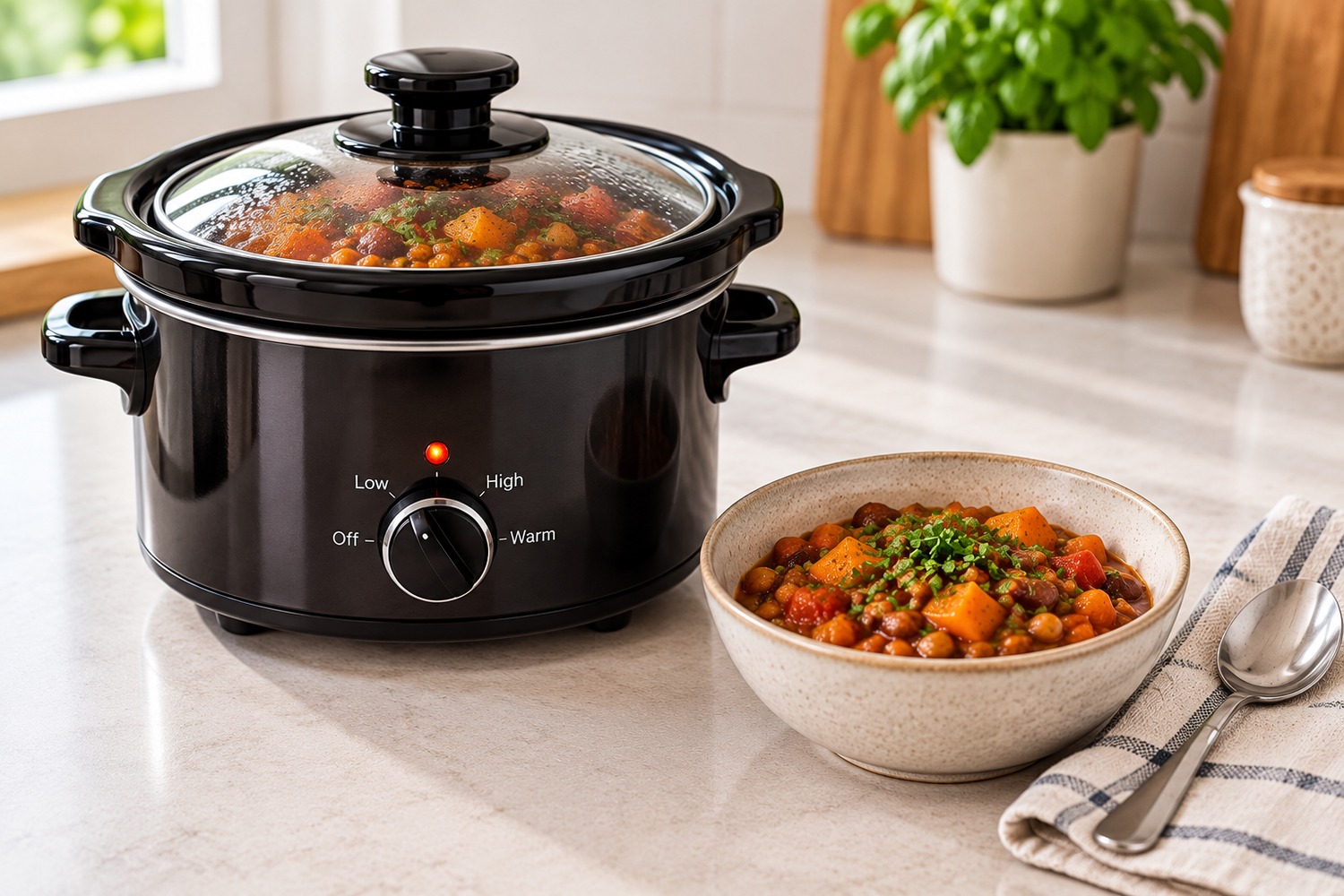
If you live alone, you might be wondering: is it worth buying a slow cooker for one person, or will it just take up precious kitchen space? It can be worth it if you like stews, soups, curries and batch cooking. A compact slow cooker can make several portions with little hands-on effort, and it doesn’t have to cost a fortune. But if you want a different freshly cooked meal every night, rarely plan ahead or have very little freezer space, it may not be your most useful appliance.
The key is to choose a model that suits the quantity you’ll actually cook, rather than buying a family-sized slow cooker and trying to make one tiny serving in it. Here’s when a slow cooker earns its place in a one-person kitchen — and when it doesn’t.
So, is it worth buying a slow cooker for one person?
Yes, if you’ll use it to make two to four portions at a time. You can eat one for dinner, refrigerate another and freeze the rest. That’s a much more practical use of a slow cooker than running a large pot for a single small portion.
It’s particularly useful if you’re happy to eat leftovers, have a busy schedule and want to turn inexpensive ingredients into a hot meal without standing over a hob. A slow cooker is less compelling if most of your meals take 10–15 minutes in a frying pan or saucepan, or if you don’t enjoy dishes that benefit from long, gentle cooking.
The advantages and drawbacks of cooking for one
| Reason to buy one | Reason to think twice |
|---|---|
| Little hands-on cooking once the ingredients are prepared | Meals take hours, so you need to plan ahead |
| Good for making extra portions to freeze | You need fridge or freezer space for leftovers |
| Convenient for stews, soups, chilli and braises | Not ideal for crisp textures or quick stir-fries |
| Compact models can be inexpensive | Another appliance to store and clean |
| Can be economical for suitable batch-cooked meals | Not necessarily the cheapest option for every single meal |
What size slow cooker is best for one person?
For a solo household, roughly 1.5–2 litres is a useful starting point if you want compact equipment and modest batch sizes. A 2–3.5 litre cooker can make sense if you deliberately prepare several portions, have larger appetites or cook bulkier ingredients. Manufacturer capacity figures aren’t the same as usable cooking volume, so always check the fill guidelines in the manual.
| Slow cooker capacity | Best suited to | Watch out for |
|---|---|---|
| 1–1.5 litres | Small recipes and limited storage | May leave little room for batch cooking |
| 1.5–2 litres | One person cooking a few portions | Check the recommended minimum fill level |
| 2.5–3.5 litres | Regular batch cooking for one | Takes more cupboard and worktop space |
| 4.5 litres and above | Large batches and families | Often excessive for everyday solo meals |
If you’re interested in how capacity changes for larger households, our slow cooker size guide for a family of four explains why a bigger model isn’t automatically a better purchase.
Can you cook just one portion in a slow cooker?
Sometimes, but a full-size slow cooker can be a poor match for a very small recipe. Most models specify a minimum and maximum fill range so the food cooks as intended. If the ingredients barely cover the bottom of a large pot, you may struggle to follow recipes reliably.
Rather than assuming that any recipe can be divided by four, check the manual and use recipes designed for a small cooker. Liquid quantities and cooking times don’t always scale neatly with portion size. If you truly only want one bowl of soup, reheating a prepared portion or cooking on the hob may be simpler.
Is a slow cooker cheaper to run when you live alone?
It can be economical for the right dish, especially if you cook multiple portions together instead of heating the oven repeatedly. But don’t assume it’s always cheaper simply because it uses a lower power setting. The appliance runs for several hours, and the cost depends on its actual electricity use, the cooking time and your tariff.
The Energy Saving Trust’s cooking-appliance comparison shows that slow cookers can be a good choice for preparing several meals’ worth of food in one batch. Its published examples are for particular recipes and test conditions, not a guaranteed cost for every slow cooker or one-person meal.
For a fair comparison, think about cost per portion rather than just cost per cooking session. Four dinners from one slow-cooker batch could offer better value than four separate oven meals; a quick single serving prepared in a saucepan might still be cheaper.
Which meals make a slow cooker worthwhile for one?
The strongest candidates are recipes that taste good after slow cooking and store well. You don’t need to make the same stew every week.
- Chilli: make a few portions and vary the serving with rice, jacket potatoes or wraps.
- Vegetable and lentil soup: useful for lunches, especially in colder months.
- Chicken casserole: convenient for tender, saucy meals, following the appliance’s cooking and food-safety instructions.
- Bean or lentil curry: a good option for batch cooking when using ingredients and preparation methods suitable for slow cooking.
- Beef stew: particularly suitable for longer cooking with economical cuts.
If you like occasional larger joints, our guide to choosing a slow cooker for a 2kg gammon joint shows why bulky ingredients require more capacity. That’s a different purchase from a compact cooker intended for everyday solo meals.
What features are worth paying for?
You don’t need a complicated digital model just because it has more buttons. For one person, you should prioritise a size that suits your meals, simple controls, a removable cooking pot that’s easy to wash and a lid that fits securely.
A programmable timer or automatic keep-warm setting may be useful, but it isn’t essential. Check exactly how each feature works: some models switch to warming after a programme, while basic manual models don’t switch themselves off. Follow the manufacturer’s guidance on cooking times, food temperatures and unattended use.
Also consider the weight of the removable pot, whether it fits in your sink, and how much worktop or cupboard space the whole appliance occupies. These everyday details tend to matter more than a long list of cooking modes.
Where to buy a compact slow cooker
If you’re ready to buy, you can compare 1.5-litre slow cookers on Amazon UK or browse 2-litre slow cookers. These sizes are a reasonable starting point for smaller batches, but check the manufacturer’s recommended fill range before choosing.
If you prefer to prepare several meals and freeze them, look at 3.5-litre slow cookers on Amazon UK as well. Compare the actual appliance dimensions, pot capacity, controls, warranty and current price. These are shopping links rather than recommendations based on products we’ve tested.
What about food waste and leftover safety?
A slow cooker can help reduce food waste if you plan your portions and store leftovers properly. But cooking four dinners only saves money if you actually eat them.
The Food Standards Agency’s food-safety advice says cooked leftovers should be cooled and refrigerated within two hours, eaten within 48 hours or frozen if you won’t eat them in time. Reheat leftovers until they’re steaming hot throughout, and only reheat them once.
Portion the batch into shallow, suitable containers rather than leaving a large pot of food sitting at room temperature for hours. Don’t use a slow cooker’s low setting simply to warm cold leftovers unless the appliance manufacturer specifically says that’s a safe reheating method.
When buying a slow cooker probably isn’t worth it
You should skip it for now if you mainly cook quick meals for one, dislike repeated portions or don’t have anywhere to store the appliance. The same applies if you want crisp roast vegetables, pan-fried dishes or meals ready immediately after work without any advance planning.
A saucepan and hob remain excellent for quick soups, pasta sauces and smaller meals. An air fryer may be more convenient for reheating or crisping a single portion, while a microwave is useful for properly reheating food you’ve already cooked. There’s no reason every solo kitchen needs all of these appliances.
Frequently asked questions
Is a 3.5-litre slow cooker too big for one person?
Not if you regularly batch cook, but it may be unnecessarily large if you only make one or two small servings. Check the appliance’s minimum fill guidance and your available freezer space.
Is a 1.5-litre slow cooker big enough for one person?
For many simple solo meals and modest batches, yes. Actual portion numbers depend on the recipe and how much space the cooker needs above the food.
Can I leave a slow cooker on while I’m at work?
Follow the specific model’s manual, electrical safety instructions and guidance on unattended operation. Use a suitable wall socket, place it on a stable heat-resistant surface with the recommended clearance and don’t exceed the appliance’s stated cooking or warming guidance.
Will cooking for one in a slow cooker save money?
It may when you make several meals at once and use affordable ingredients, but energy savings aren’t automatic. Compare the total cost of ingredients and cooking with the number of portions you’ll actually eat.
Do I need a slow cooker if I already have a saucepan?
It depends, a saucepan may be all you need for quick meals. A slow cooker earns its place if you value unattended low-and-slow cooking and regular batch preparation.
The verdict on is it worth buying a slow cooker for one person
A slow cooker is worth buying for one person if you’re happy to cook more than one portion and like meals that benefit from slow cooking. Start by comparing compact 1.5–2 litre models, or consider something a little larger if you’ll freeze several portions. If you rarely batch cook and mostly want quick dinners, keep your money and use the cookware you already have.
Affiliate disclosure: Progressive Housewares may earn a commission from qualifying purchases through Amazon UK links, at no extra cost to you. We haven’t tested the products linked in this article.