
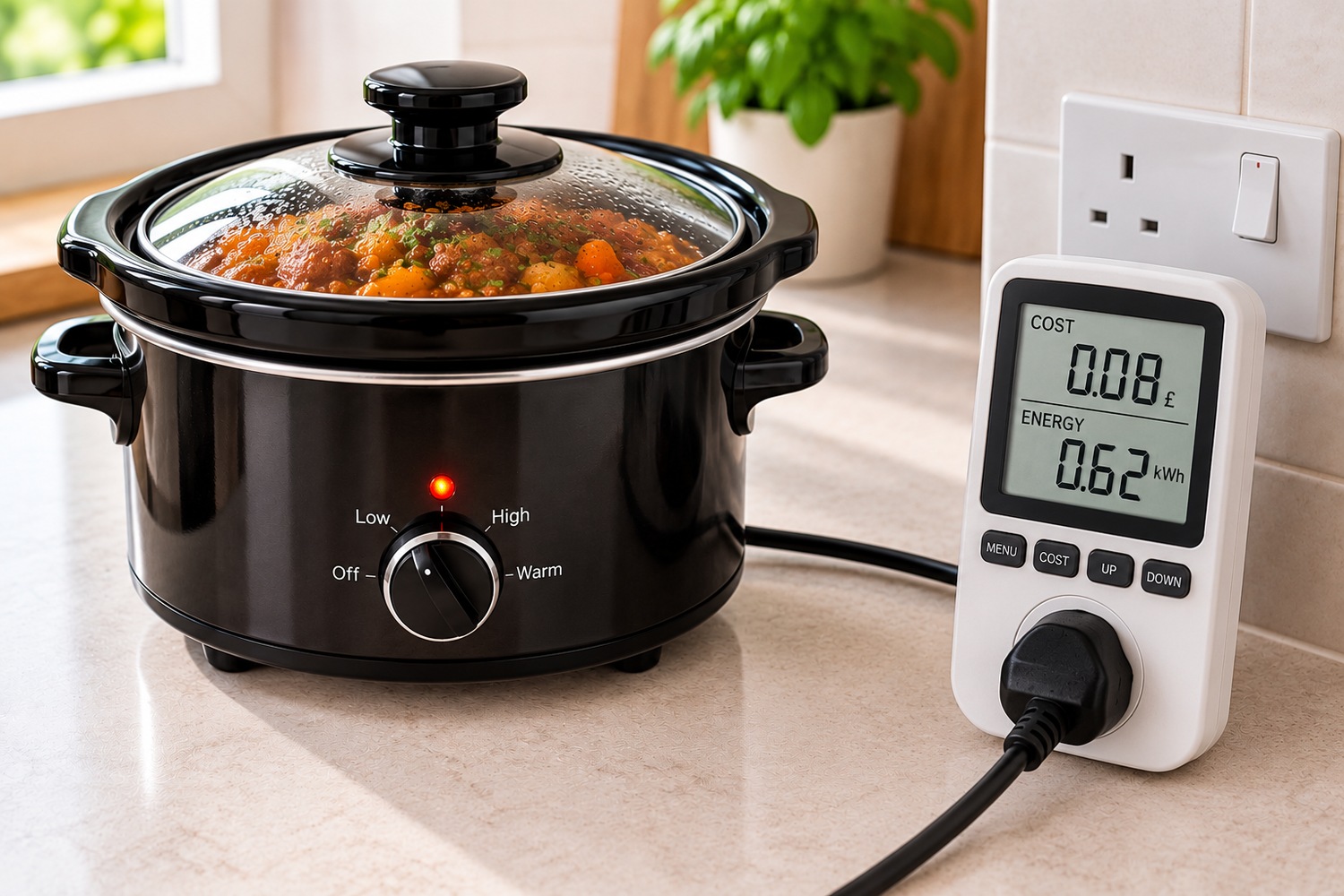
If you’ve wondered how much electricity does a slow cooker use uk households should budget for, the answer depends on the appliance’s wattage, cooking time and how often its heating element switches on. A 200W cooker drawing its full rated power continuously for eight hours would use 1.6kWh, costing about 42p at the October–December 2026 average Great Britain electricity rate. That’s a planning calculation, not a measurement of every slow cooker.
Slow cookers can be economical for stews and large batches because they heat a covered cooking pot rather than a whole oven cavity. However, a cooker that’s left on for hours doesn’t necessarily cost less than using a hob briefly. This guide explains watts, kilowatt-hours and real-life meal costs without pretending that every appliance behaves identically.
The quick answer: slow cooker watts, kilowatt-hours and cost
Electricity usage is measured in kilowatt-hours (kWh). A kilowatt is 1,000 watts, while a kilowatt-hour is the electricity consumed by one kilowatt of power running for one hour. Your electricity supplier charges by the kWh, not by the number of hours you’ve left the cooker switched on.
For the examples below, I’ve used 26.32p/kWh. That’s Ofgem’s average electricity unit price for 1 October to 31 December 2026 on a default tariff paid by Direct Debit across England, Scotland and Wales. It isn’t the exact rate every UK household pays, and Northern Ireland has a different electricity market.
| Assumed constant input | 1 hour | 8 hours | 12 hours |
|---|---|---|---|
| 100W | 2.6p | 21.1p | 31.6p |
| 150W | 3.9p | 31.6p | 47.4p |
| 200W | 5.3p | 42.1p | 63.2p |
| 225W | 5.9p | 47.4p | 71.1p |
| 300W | 7.9p | 63.2p | 94.8p |
The table assumes each appliance continuously uses exactly the stated watts. Real slow cookers may cycle their heating elements, so these are not guaranteed bills. Always distinguish the rated power printed on the appliance from its actual energy consumption across a complete recipe.
How much electricity does a slow cooker use per hour?
At a constant 150W, a slow cooker uses 0.15kWh in one hour. At 200W, it uses 0.2kWh; at 300W, it uses 0.3kWh. At the illustrative rate, that is approximately 4p, 5p and 8p respectively for each hour of full-power operation.
A slow cooker does not necessarily draw the same watts in every hour. Its element may work harder while food warms up, then switch on and off to maintain the selected setting. The appliance’s thermostat and control system determine the pattern. If you’re assessing an actual bill, total kWh consumed over the entire cook matters more than an instantaneous power reading.
For more specific timings, our eight-hour slow cooker electricity-cost guide shows how different rated powers affect the arithmetic.
How many watts does a slow cooker use on high?
There isn’t one universal high-setting wattage. A relatively compact model may have an electrical rating around 150–200W, while other machines can have substantially different ratings. Power depends on the pot capacity, heating element and controls, not merely the word ‘high’ printed beside the dial.
National Energy Action, a UK fuel-poverty charity, has published appliance-monitoring research discussing some slow cookers using approximately 160–200W on high and around 100W on low. It examined a 170W-rated 3.5-litre model during a cooking session. Those figures illustrate real variations rather than establish a standard for every brand or model.
Look at your cooker’s rating plate, normally underneath or behind the appliance, and consult the manufacturer’s manual for the stated input power. Remember that the rated value may not describe an average over a long cooking session.
How many watts does a slow cooker use on high low?
The question ‘how many watts does a slow cooker use on high low’ sounds straightforward, but low and high aren’t always two permanent wattages. Some machines vary the heating cycle or how quickly the pot reaches cooking temperature. Different designs can consume different amounts of electricity even when their dials use the same labels.
As a simple example, four hours at a continuous 200W uses 0.8kWh. Eight hours at a continuous 100W also uses 0.8kWh. Both would cost about 21p at 26.32p/kWh. The example demonstrates why cooking for longer on low isn’t automatically cheaper or more expensive than a shorter high programme.
The actual choice of setting should follow a tested recipe and the appliance instructions, especially when cooking meat or poultry. Do not shorten essential cooking steps or select an unsuitable setting purely to achieve a lower theoretical electricity number.
How much electricity does a slow cooker use UK? Calculating your own bill
To estimate a full-power running cost, use (watts ÷ 1,000) × hours × price per kWh in pounds. For example, a cooker rated at 180W running continuously for eight hours would consume 1.44kWh, and at £0.2632 per kWh would cost about 38p.
Check your own tariff against Ofgem’s official electricity unit rates and standing charges. For October–December 2026, Ofgem reports 26.32p/kWh and an average daily electricity standing charge of 54.83p, but regional prices and payment methods vary. Fixed-rate and time-of-use tariffs may differ too.
The daily standing charge normally shouldn’t be attributed to one recipe when you’re comparing the extra cost of cooking. Households on these tariffs usually pay it whether the cooker is operating or not. It is useful to separate that fixed daily cost from the electricity actually consumed by an appliance.
How much does it cost to have a slow cooker on for 12 hours?
At the example tariff, twelve hours at a constant 150W would use 1.8kWh and cost about 47p. At a constant 200W it would use 2.4kWh, about 63p. A constant 250W would consume 3kWh, costing around 79p. Actual figures may be different when a thermostatically controlled cooker cycles its element.
Twelve hours can be longer than some recipes require, so don’t automatically cook for that long just because the cost seems low. Overcooking can harm the texture and quality of food. Once the dish is done, use appropriate serving, chilling and storage methods rather than leaving it on an unsuitable setting for hours.
If a cooker changes to keep-warm at the end of a programme, that affects convenience but doesn’t make the power consumption zero. Our guide to programmable slow cookers explains the difference between a cooking timer, automatic warming and delayed start.
Are slow cookers expensive to run?
For many recipes they are reasonably economical. The Energy Saving Trust’s October 2026 comparison reported a typical cost of approximately 34p in Great Britain for cooking a specific 3.6kg homemade beef stew in a slow cooker. This is a measured example for a particular meal, not a guarantee that every stew or slow cooker costs 34p.
The Energy Saving Trust’s cooking appliance guidance points out the advantages of preparing several meals’ worth of food in one batch. If you make six useful portions instead of two, the electricity used for that cook can be shared across more dinners.
But a low electricity cost doesn’t mean every meal is cheap. Ingredients, food waste and whether you eat leftovers affect the overall household cost. If you’re cooking for one, a quick saucepan meal or reheating one portion in a microwave could be cheaper and more practical than using a large slow cooker.
Our article about buying a slow cooker for one person
Is it cheaper to use a slow cooker than an electric oven UK?
Often for a stew, casserole or similar moist-cooked meal, because a slow cooker heats a relatively small enclosed pot instead of a full oven cavity. But the oven can be competitive if you’re cooking several dishes at once or preparing something that needs much less cooking time.
A fair comparison uses the same finished food and the same number of portions. Comparing the cost of a large slow-cooked stew with the cost of one chicken breast in the oven proves very little. Ovens cycle their heating elements too, so assuming they draw their maximum rated watts constantly can overstate real usage.
If an oven is already hot for roasting vegetables, adding another compatible dish could make better use of the energy. Conversely, heating a whole oven only to cook one small casserole may be wasteful. Our detailed slow cooker versus electric oven comparison explores those situations.
Is it cheaper to use a slow cooker than an electric hob?
It can be for a dish that would otherwise simmer for hours on the hob, particularly if you’re cooking a sizeable batch of stew. But a quick omelette, pasta sauce or vegetable stir-fry on an electric hob may use less total energy than a slow cooker running all afternoon.
There are also several types of electric hob, including induction and ceramic. How well the pan fits its cooking zone, whether you use a lid and the duration of cooking all influence consumption. A higher rated wattage over a short time can still mean fewer kWh than a lower rated wattage used for many hours.
The Energy Saving Trust quotes a GB hob cooking example of approximately 11–28p for certain short recipes. That isn’t a directly comparable test against its large-batch slow cooker stew. Rather than comparing unrelated example prices, think about which method is most suitable for the actual dish.
Does cooker size affect electricity use?
Capacity and power ratings can be related, but an oversized machine isn’t always economical for small recipes. A large slow cooker may be convenient when you make meals for several people, while a compact appliance can better suit a single person or couple.
Consider usable pot volume, the manufacturer’s fill range and how much you normally cook. A recipe that barely covers the bottom of a big pot may not cook as intended, regardless of its power rating. See our guide to common slow cooker recipe sizes and family-of-four sizing guide.
If you routinely make a large casserole and freeze portions, a more spacious cooker may be useful. If you need only one bowl of soup, the capacity you can actually fill correctly matters much more than owning the biggest model available.
How to measure actual kWh rather than guessing
A compatible plug-in electricity monitor can measure how many kWh your slow cooker uses throughout a complete cooking session. This is more reliable than assuming its rating plate tells you the average power draw. Only use equipment suitable for the appliance’s electrical rating and plug type.
- Read your electricity bill and write down the pence-per-kWh unit rate.
- Choose a normal recipe that you prepare regularly, rather than adjusting the cooking programme to get a particular result.
- Record the full session’s kWh, including the initial heating period.
- Multiply by the unit price. For example, 1kWh at 26.32p/kWh costs about 26p.
- Repeat with other dishes if useful. A full casserole and a small soup can have different consumption.
Suppose an appropriate energy monitor records 0.95kWh for your meal. At the illustrated rate that is about 25p. That is a hypothetical calculation, not a result from our own testing. It helps show how to turn a real measurement into a cost in pounds and pence.
Can a smart meter tell you the cost of one slow cooker meal?
Your smart-meter in-home display shows household electricity use, not necessarily an isolated appliance’s consumption. If the fridge cycles, someone switches on the kettle or the washing machine starts, the display includes those loads as well.
You may get a rough idea by comparing quiet periods, but it won’t automatically provide a clean slow-cooker measurement. For a credible cost-per-meal number, use a suitable appliance-specific meter that records kWh or another reliable device-level energy record.
What would twice-weekly slow cooking cost over a year?
Imagine each session genuinely used 1.2kWh. At 26.32p/kWh that’s 31.6p per cook, approximately 63p for two cooks a week and around £32.85 across 52 weeks. This assumes the same tariff and consumption all year, which is unlikely to hold perfectly in practice.
You may cook more often in winter, change recipes or use high instead of low for some meals. Electricity tariffs also change. Treat annual figures as scenarios that help with household budgeting, not as a forecast of your future bills.
Simple ways to cut energy waste when using a slow cooker
- Choose the right recipe. Slow cooking works well for many soups, braises and stews, rather than foods that need a crisp finish.
- Match pot size to your normal portions. Respect the minimum and maximum fill instructions.
- Keep the lid closed. Lifting it unnecessarily releases heat.
- Follow the recommended programme. Cooking for longer than necessary doesn’t guarantee better food.
- Batch cook realistically. Freeze extra servings safely only if you’ll eat them.
- Use the microwave for reheating when it’s suitable for a single prepared portion.
- Make good use of the oven when you already have it on for other foods.
Never sacrifice safe cooking to save a few pence. Follow the manufacturer’s instructions and reliable recipes, fully thaw meat and poultry before slow cooking, and don’t use an external timer to leave raw perishable food unrefrigerated before heating begins.
Frequently asked questions
How much does a 200W slow cooker cost for eight hours?
If it drew 200W continuously, it would use 1.6kWh, or about 42p at 26.32p/kWh. A real cooker may cycle its heating element, so check measured consumption for a precise answer.
Does low use less electricity than high?
It may draw less power at a given moment, but it usually operates for longer. The total kWh for a complete recipe determines the actual cost. Follow cooking guidance rather than guessing that low always saves money.
Does a slow cooker use electricity on keep-warm?
Yes. Keep-warm still requires power. Its consumption and maximum permitted holding time depend on the model, so consult the instructions and follow food-safety advice.
Is a slow cooker cheaper than an oven for one person?
Not automatically. A small batch may suit a microwave or saucepan better. Slow cooking can make economic sense when several useful portions are prepared at once.
Should I include the electricity standing charge in a slow cooker calculation?
Normally not when calculating the additional cost of one meal. The household’s standing charge is generally payable whether or not the cooker operates.
Does a slow cooker’s rated wattage equal its average electricity use?
No. It specifies the electrical input rating, whereas actual energy use across a session can vary with settings and heating cycles. A measurement in kWh gives a better picture.
The bottom line
So how much electricity does a slow cooker use uk homes should expect? An illustrative 150W cooker running continuously for eight hours uses 1.2kWh, about 32p at the October–December 2026 average GB rate. A constant 200W uses 1.6kWh, about 42p. The true figure may differ according to the appliance’s heating behaviour.
If you’re comparing how much electricity does a slow cooker use uk against using an electric oven or hob, focus on actual kWh per completed meal and the number of servings. That’s more meaningful than claiming every cooker costs the same per hour.
Editorial note: Calculations are illustrative unless attributed to published research. We have not personally tested the appliances discussed. Electricity prices and product specifications change.