
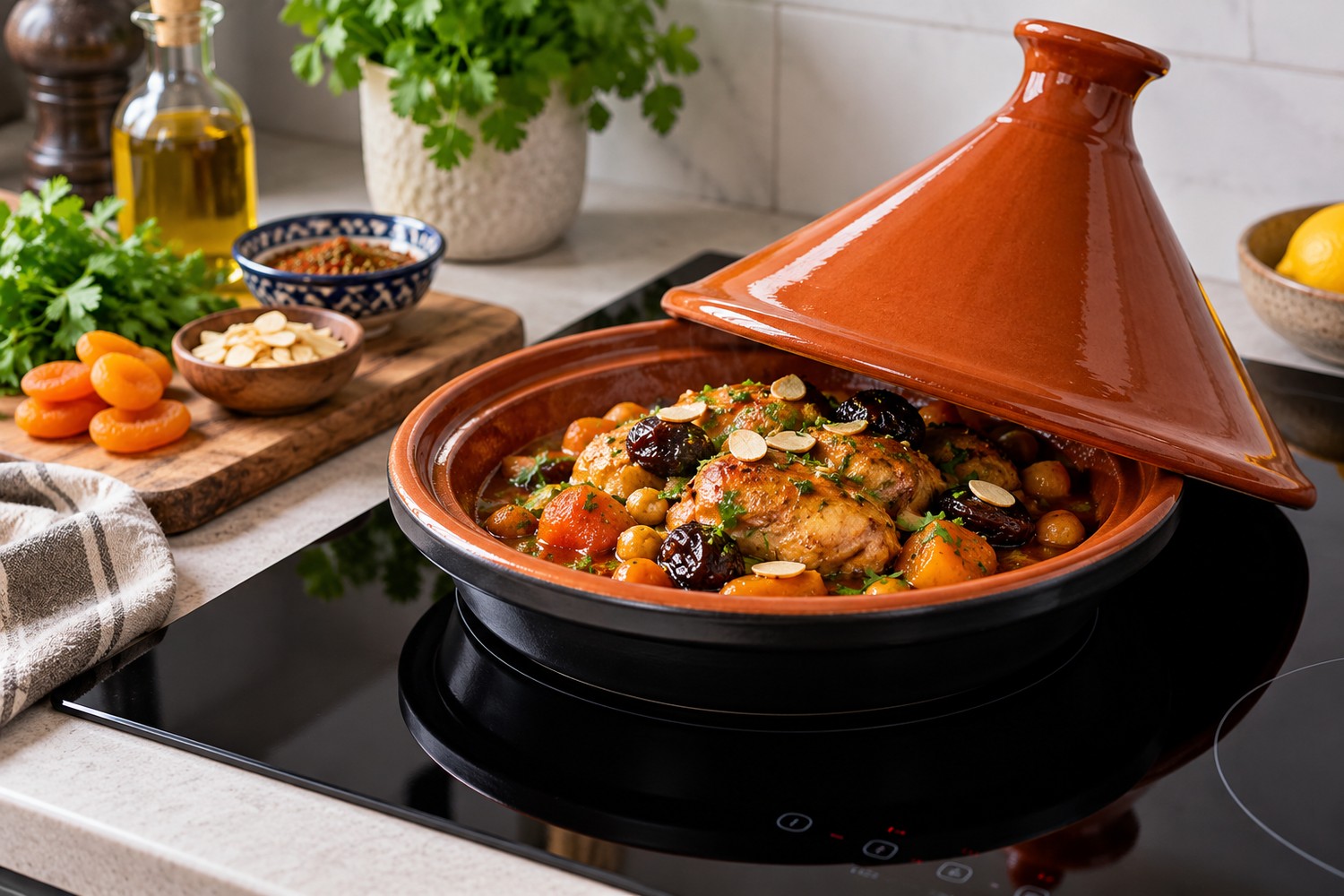
For an induction hob, buy a tagine with a flat, magnetic, induction-compatible base. An enamelled cast-iron tagine is a straightforward option, provided the exact model is labelled suitable for induction. A traditional all-clay or all-ceramic tagine won’t heat directly on a normal induction zone because its base isn’t magnetic.
This is an important distinction when shopping: a tagine can have a ceramic cone-shaped lid and still work on induction if the cooking base is suitable metal. It’s the bottom of the pot, not the material of the lid, that determines whether the hob can heat it.
Quick guide: which tagines work on induction?
| Tagine construction | Will it work directly on induction? | What to check |
|---|---|---|
| Enamelled cast-iron base with conical lid | Usually, if manufacturer-approved | Induction symbol, flat base and hob instructions |
| Bare cast-iron base with conical lid | Generally, if manufacturer-approved | Flatness, dimensions and care requirements |
| Magnetic stainless-steel base with conical lid | Possible, if explicitly rated | Induction-compatible base construction |
| Traditional unglazed clay tagine | No | Needs a different suitable heat source |
| Fully ceramic or glazed earthenware tagine | No, unless a special compatible system is specified | Don’t confuse oven-safe with induction-safe |
| Aluminium-based tagine | Only if it incorporates a suitable magnetic base | Explicit induction rating |
These are general material rules. Even a cast-iron tagine can be inappropriate for a particular hob if its base is unstable or outside the cooking zone’s supported size range. Always check the specific model’s documentation.
Why don’t traditional clay tagines work on induction?
An induction hob generates a magnetic field that heats a suitable metal pan base directly. Clay and ordinary ceramic aren’t ferromagnetic, so the hob can’t heat them in the same way.
That’s why a beautiful handmade clay tagine might be perfectly suited to an approved traditional heat source yet fail to register on an induction hob. It isn’t necessarily defective; it’s simply the wrong base material for the technology.
Bosch and Miele both list clay or earthenware as unsuitable for direct induction use, while naming cast iron and correctly constructed magnetic metal cookware as compatible. Their guidance concerns induction cookware generally, but the same base-material distinction applies to tagines.
Is a cast-iron tagine the best option?
For most induction-hob owners buying a tagine, a flat-bottomed, induction-rated cast-iron base is the simplest option. It provides the magnetic material the hob needs and is a familiar construction for slow, gentle cooking.
Many designs pair a cast-iron cooking base with a ceramic or stoneware cone-shaped lid. That combination can be appropriate because the lid isn’t the part heated directly by the induction coil. However, verify that the whole assembly can safely be used for hob cooking; a decorative serving tagine isn’t automatically cooking-safe.
Cast iron is relatively heavy and holds onto heat. Start on a low or moderate setting and follow the maker’s instructions. A sudden high-power boost may be inappropriate for a tagine, especially one with a separate ceramic lid.
What about a tagine with a ceramic lid?
A ceramic lid is not inherently a problem on induction. The hob heats the metal cooking base, and the lid helps retain and return moisture while the food simmers.
The important details are whether the ceramic lid is approved for direct cooking above the heated base, what temperature changes it can withstand and how the manufacturer tells you to handle it. Don’t put a cold ceramic lid straight onto an excessively hot base, or place a hot lid on a cold or wet surface, unless the care instructions allow it.
Can you use an induction adapter plate with a clay tagine?
An induction converter or adapter plate is a metal disc intended to be heated by the hob and transfer heat to otherwise unsuitable cookware. It can sound like an easy answer for a clay tagine, but it isn’t automatically safe or recommended.
Some hob manufacturers specifically advise against adapter plates. Bosch advises avoiding them, while NEFF guidance says not to place adapter plates between the hob and cookware. Adapter plates can become extremely hot, affect hob sensors and introduce an extra source of uneven heating.
Traditional clay tagines can also be vulnerable to thermal shock or concentrated heat. Only consider this arrangement if both your induction-hob manufacturer and the tagine manufacturer explicitly approve the specific method. For someone buying from scratch, a tagine designed for induction is a simpler choice.
How can you tell if a tagine is induction compatible?
- Look for an explicit induction rating. A product description should say it’s suitable for induction hobs, ideally with the induction symbol.
- Check the base material. Cast iron is naturally magnetic, while an aluminium or stainless-steel construction may require a special magnetic layer.
- Find the base diameter. The width across the top or lid isn’t the size the induction zone detects.
- Check that the bottom is flat. A very uneven or rounded cooking base isn’t suitable for ordinary flat induction hobs.
- Read the instructions. Confirm maximum heat, seasoning, cleaning and how to use the ceramic lid if there is one.
A fridge magnet stuck to the base can be a useful preliminary check of magnetic properties, as Miele and Which? suggest for cookware generally. But a magnet test isn’t a guarantee of good performance or manufacturer’s approval for a particular tagine.
What size tagine should you buy?
For everyday family meals, tagines advertised at around 26–30cm are common shopping options. A larger model can be helpful for more portions, but the advertised diameter may describe the cooking vessel or outside rim rather than its actual flat base.
Pay particular attention to the base diameter. Induction hobs can require a minimum magnetic area before detecting cookware, and a wide tagine with a much smaller base may not behave as expected on a large zone. Bosch, Miele and NEFF all emphasise matching pan bases to hob cooking zones.
Also check the height with the conical lid fitted. A tagine can be considerably taller than a normal casserole dish, which matters under wall cupboards or cooker hoods.
Should you choose a tagine or a casserole dish?
If you specifically want the traditional serving style and cone-shaped lid, an induction-compatible tagine is appealing. If your priority is simply to cook Moroccan-style slow braises on induction, an enamelled cast-iron casserole dish or Dutch oven can also do the job.
The casserole dish may be more versatile for soups, stews and other everyday meals. But if you’re already shopping for the distinctive cooking and presentation style of a tagine, there’s no need to abandon that idea — just buy an induction-rated version.
What can you buy for under £100?
You can browse induction-compatible cast-iron tagines on Amazon UK or compare tagines with cast-iron bases and ceramic lids. Many shoppers can find options in the roughly £30–£90 bracket, but price and stock will vary.
Check each listing carefully: ‘cast iron’, ‘ceramic lid’ and ‘suitable for all hobs’ aren’t interchangeable claims. Confirm explicit induction compatibility, the flat-base diameter, care instructions and whether the product is intended for cooking rather than display.
As an alternative, compare induction-compatible enamelled cast-iron casserole dishes if you’d prefer a multipurpose pot. These links are shopping searches rather than products we’ve independently tested.
Using an induction-compatible tagine safely
Start with the heat settings recommended for your model. Induction can raise the base temperature quickly, and the retained heat of cast iron means the pot may continue cooking after you reduce the power.
Don’t heat the tagine empty unless the manufacturer’s instructions expressly allow it. Keep the hob surface and base clean, lift the heavy cookware rather than dragging it across the glass, and use suitable oven gloves for hot handles and lids.
If the tagine has a ceramic lid, follow its washing and cooling instructions to avoid thermal shock. A cracked cooking vessel shouldn’t be used again unless the manufacturer confirms it’s safe.
Frequently asked questions about What Type of Tagine Can You Use on an Induction Hob
Can you use a Moroccan clay tagine on an induction hob?
Not directly. Traditional clay isn’t magnetic, so the induction hob won’t heat it in the usual way. Don’t assume an adapter plate is acceptable without approval from both manufacturers.
Can a cast-iron tagine go on induction?
Generally, cast iron is induction-compatible, but the exact tagine still needs a sufficiently flat base, appropriate dimensions and approval for use on your hob.
Does a ceramic cone-shaped lid stop a tagine working on induction?
No. A ceramic lid can sit above an induction-compatible metal base. The material and design of the bottom cooking vessel are what matter to induction heating.
Can you use an ordinary ceramic tagine in the oven instead?
Only if that particular tagine is marked oven-safe and you’re following its temperature and handling instructions. Decorative and some traditional clay tagines have different care requirements.
Will an induction hob detect any cast-iron base?
Not necessarily. A base can be magnetic but still be too small or an unsuitable shape for the selected cooking zone. Check the hob manual and the tagine’s actual base dimensions.
Is a 28cm tagine big enough for a family?
It may be, depending on the cooking capacity and recipe. Compare stated capacity and usable interior dimensions, not just the outer diameter of the lid.
Bottom line
The easiest type of tagine to use on induction is one with a flat, explicitly induction-compatible cast-iron or other magnetic metal base. Traditional all-clay tagines don’t work directly on induction, but a ceramic cone-shaped lid can be fine above a suitable metal cooking base. Check the product’s induction rating, base diameter and use instructions before buying, and don’t rely on an adapter plate unless both manufacturers approve it.
Sources and further reading
- Bosch UK — What pans work on an induction hob?
- NEFF UK — Which pans are suitable for an induction hob?
- Cuisine Marrakech — Cast-iron versus clay tagines
Disclosure: Progressive Housewares may earn a commission from qualifying purchases through affiliate links, at no additional cost to you.