
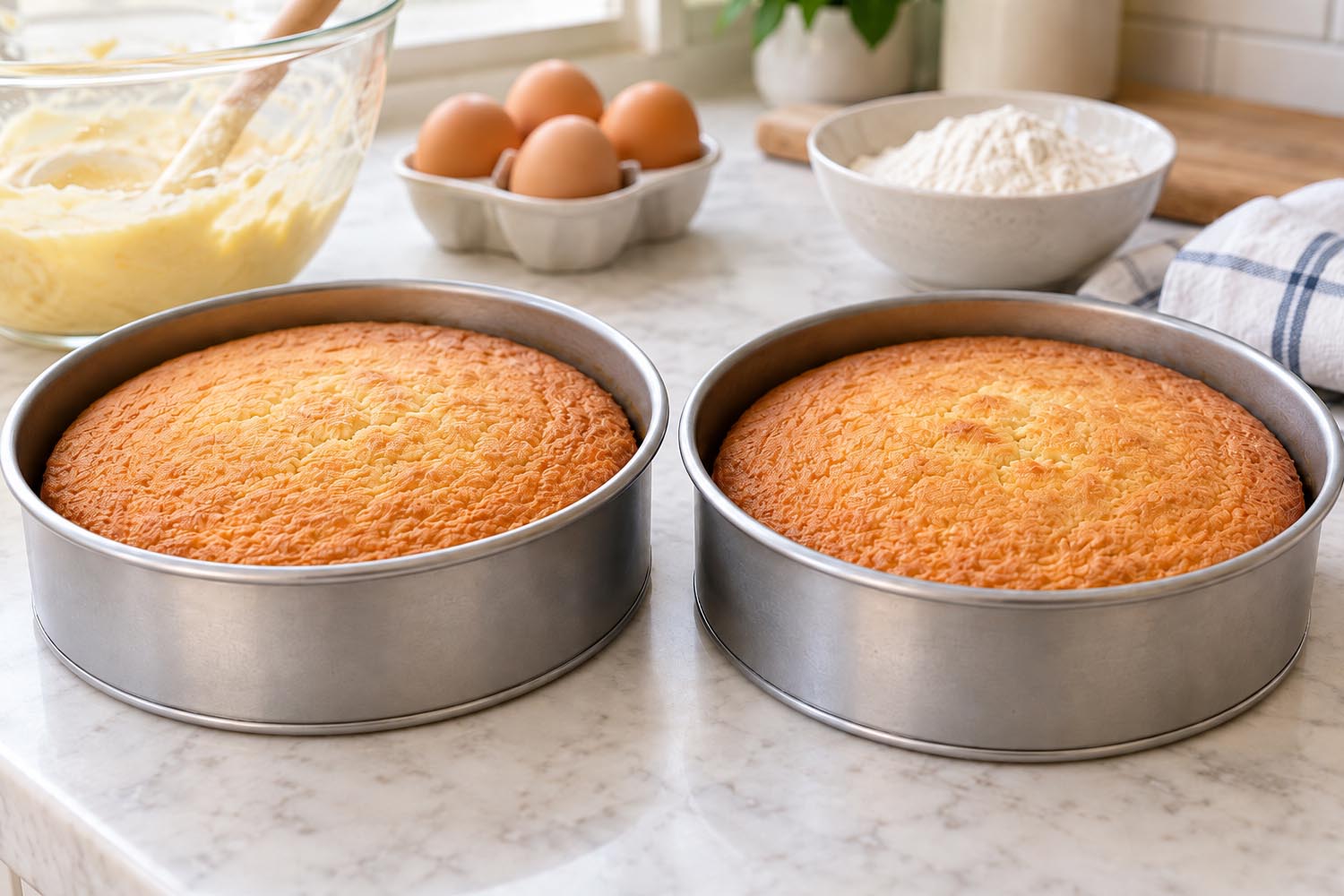
For a traditional six-egg Victoria sponge, two 23cm (9-inch) round sandwich tins are a sensible starting point. You’ll usually divide the mixture equally between them and sandwich the baked layers together with jam or cream. But the right tin depends on your particular recipe and the depth of the tins: six eggs alone don’t guarantee a fixed amount of batter.
If your recipe specifies a different size, follow that first. A six-egg mix baked as one deep cake also needs a different tin and baking method from the same mix split across two shallow tins.
Quick cake tin size guide for a six-egg sponge
| Setup | Starting point | Result to expect |
|---|---|---|
| Two round sandwich tins | 2 × 23cm (9-inch) | A conventional two-layer Victoria sandwich |
| Two 20cm (8-inch) tins | Only if sufficiently deep and the recipe allows | Thicker layers; greater risk of overfilling shallow tins |
| One deep round tin | Use a recipe written for a single deep tin | A cake you may be able to split after baking |
| Rectangular traybake | Use a recipe with matching tray dimensions | A thinner cake cut into squares or portions |
These aren’t interchangeable baking instructions. Different recipes use different egg sizes, ingredient ratios and raising agents, so the amount of mixture varies. Check how full the tins are before baking.
Why 23cm tins are a good starting point
A classic Victoria sponge often uses roughly equal weights of eggs, butter, sugar and self-raising flour. In Mary Berry’s large Victoria sandwich recipe, four large eggs and 225g each of butter, sugar and flour are divided between two 20cm tins. A six-egg mixture made with a similar ratio produces noticeably more batter, so moving up to two 23cm tins is a practical starting point if you’re scaling that kind of recipe.
This is a scaling estimate, not a guarantee. A 23cm tin has roughly 32% more surface area than a 20cm tin of the same shape, while a six-egg batch can contain around 50% more mixture than a four-egg batch. The layers may therefore be slightly deeper even with the larger tins.
Can you use two 8-inch tins for a six-egg Victoria sponge?
Possibly, but check their depth carefully. Two shallow 20cm sandwich tins may be too small for all the mixture. If you pour too much batter into each tin, it can rise over the edge before the centre cooks.
If your tins are 20cm across, use a six-egg recipe specifically designed for that size and depth. Otherwise, bake any surplus mixture separately rather than overfilling the tins. Don’t assume all tins marked “8 inch” have the same usable capacity.
How deep should Victoria sponge tins be?
For a two-layer sandwich, traditional sandwich tins are often around 3–4cm deep. Deeper loose-bottomed tins can give you more flexibility, but they don’t mean you should fill the batter to the rim.
Follow the fill level stated by the recipe or tin maker. As a general precaution, leave adequate space for the sponge to rise, and never fill a shallow sandwich tin to the very top. Batter rises differently depending on the recipe, so there isn’t one safe fill fraction for every cake.
How do you divide a six-egg mixture evenly?
- Prepare both tins first. Grease or line them as your recipe specifies, and preheat the oven.
- Weigh your mixing bowl. If possible, record the empty bowl’s weight before adding the ingredients.
- Weigh the finished batter. Subtract the bowl weight if needed, then divide by two.
- Portion into the tins. Use kitchen scales so the layers contain roughly equal amounts of mixture.
- Level gently. Spread the surface without repeatedly knocking out the air you’ve incorporated.
Even portions help the two layers bake at a similar rate and make the final sandwich easier to assemble.
Can you bake the whole six-egg sponge in one tin?
You can make single-tin sponges, but it’s best to follow a recipe developed for a deep tin. Putting a two-tin recipe into one deep pan changes how heat reaches the middle, so baking time and temperature may need adjusting. The outside can become dry before the centre is cooked.
If you’d like to slice the finished cake horizontally, choose a suitable deep cake recipe with specified tin dimensions, and check the centre is fully baked before removing it from the oven.
What happens if the tins are too big?
If you spread the same batter across a much larger surface area, the finished layers will be thinner. They may also bake more quickly, so following the timing for smaller tins could lead to a dry sponge.
As a guide, two 25cm tins have around 18% more surface area than two 23cm tins. That can make a visible difference to layer height. It’s one reason the recipe’s own tin size matters more than a generic “six eggs equals this tin” rule.
What should you look for when buying cake tins?
Check the internal diameter, depth and whether the tins will both fit on the oven shelf with adequate space around them. Matching tins help produce even layers. Solid-base sandwich tins are convenient for ordinary sponge mixtures, while loose-bottomed tins can make removal easier if properly lined and used as directed.
You can browse 23cm sandwich cake tins on Amazon UK, or compare deeper 23cm round tins. Check each product’s actual dimensions and reviews rather than relying only on the headline size.
Frequently asked questions about What Size Cake Tins Do You Need for a 6 Egg Victoria Sponge
Is a six-egg Victoria sponge a 9-inch cake?
Two 9-inch tins are a reasonable starting point for a conventional six-egg mixture, but the recipe’s ingredient weights, depth and raising agents determine the correct size.
Can I make a six-egg sponge in one 9-inch tin?
Only if your recipe is designed for a suitably deep single tin. Don’t simply combine the two layers into one shallow sandwich tin.
Should I use two tins or bake one layer at a time?
Two matching tins are usually more convenient. If you only have one, check whether your recipe can be baked in batches; batter containing raising agents may change while waiting, so a recipe written for sequential baking is preferable.
How do I know when each sponge is done?
Follow the recipe’s baking time as a guide, then check the sponge using its recommended doneness signs, such as a springy top and a skewer coming out without wet batter. Different ovens and tin sizes can change the timing.
Will 10-inch tins make a flat cake?
They’ll generally produce thinner layers than 9-inch tins with the same amount of batter. If you want to use 10-inch tins, find or scale a recipe designed for them.
Bottom line on What Size Cake Tins Do You Need for a 6 Egg Victoria Sponge
Two 23cm (9-inch) round sandwich tins are a practical starting point for a six-egg Victoria sponge. Check your recipe, the actual tin depth and how much the batter fills each tin. Those details matter more than the egg count on its own.
Sources and further reading
- BBC Food — Mary Berry’s Victoria sandwich recipe
- Mumsnet — discussion of sponge layers and cake tin sizes
Disclosure: Progressive Housewares may earn a commission from qualifying purchases through affiliate links, at no additional cost to you.