
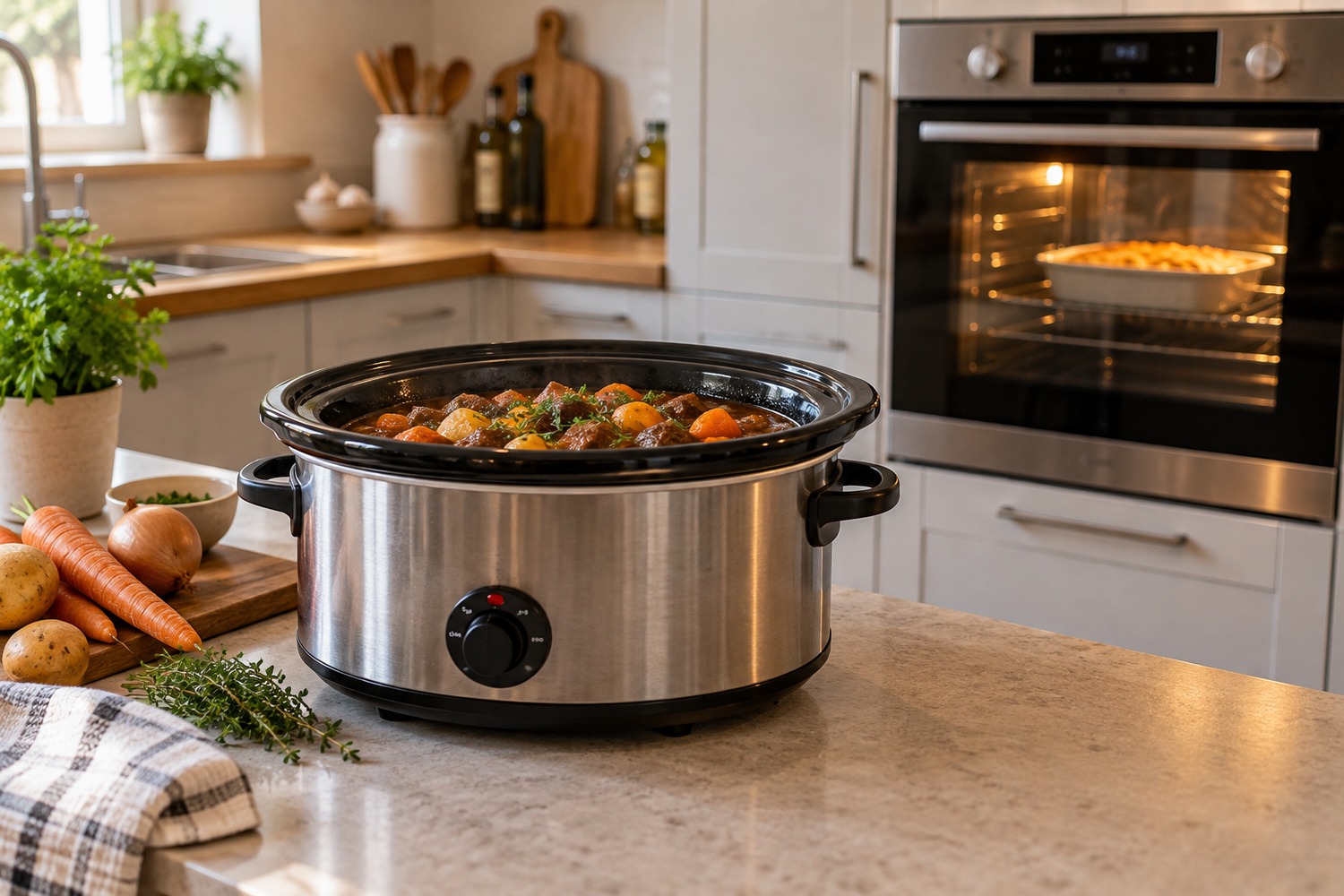
If you’re trying to cut kitchen electricity costs, you may be wondering: is a slow cooker cheaper to run than an electric oven? Often, yes, for a casserole, stew or similar long-cooked meal. A slow cooker uses relatively little power over several hours, while an electric oven generally heats a much larger space. But the cheapest option depends on what you’re cooking, the portion size, the cooking time and the electricity each appliance actually uses.
An oven is not automatically more expensive for every meal. It may be better value when you cook several dishes together, and an eight-hour slow-cooker recipe cannot be fairly compared with one hour of oven use unless both produce an equivalent meal.
Is a slow cooker cheaper to run than an electric oven?
For many stews and casseroles, a slow cooker is likely to cost less in electricity than heating a full-sized electric oven solely for that dish. However, it’s not a universal rule. Some slow cookers run at a steady power for hours, some appliances regulate their power differently, and ovens generally cycle their heating elements rather than drawing their full rated wattage continuously.
The best comparison is kilowatt-hours (kWh) used to cook the same meal, not the appliance’s wattage alone. As a guide, the Energy Saving Trust reports that cooking a 3.6kg homemade beef stew in a slow cooker cost around 34p in Great Britain in its October 2026 comparison. That is a tested example for a specified dish, not a guaranteed cost for every model.
How much does a slow cooker cost to run in the UK?
Using the October–December 2026 average Great Britain electricity price-cap unit rate of 26.32p/kWh, the table below shows the arithmetic cost of slow cookers operating continuously at different power levels for eight hours. These are illustrative full-power calculations, not measured consumption from specific products.
| Assumed continuous power | Electricity over 8 hours | Cost at 26.32p/kWh |
|---|---|---|
| 100W | 0.8kWh | 21p |
| 150W | 1.2kWh | 32p |
| 200W | 1.6kWh | 42p |
| 250W | 2.0kWh | 53p |
| 300W | 2.4kWh | 63p |
The real cost may be different. Appliance wattage, cooking setting, heating pattern and runtime all matter. For accurate figures, measure the kWh used over a complete recipe with a suitable electricity monitor.
How much does an electric oven cost to run?
Ovens commonly have higher rated power than slow cookers, but their heating elements switch on and off while maintaining the selected temperature. That means multiplying an oven’s maximum wattage by its entire cooking time can exaggerate the actual electricity used.
For illustration, if an oven uses 1.5kWh to cook a meal, it costs approximately 39p at 26.32p/kWh. If it uses 2.5kWh, it costs about 66p. Those are examples of measured energy amounts applied to a tariff, not claims about the consumption of every oven or the result of any testing we’ve conducted.
| Energy used for the meal | Illustrative cost at 26.32p/kWh |
|---|---|
| 0.8kWh | 21p |
| 1.2kWh | 32p |
| 1.5kWh | 39p |
| 2.0kWh | 53p |
| 2.5kWh | 66p |
| 3.0kWh | 79p |
These figures apply equally to any electric appliance consuming the stated kWh. They aren’t an oven-specific average. The useful question is which appliance consumes less energy for the meal you want to make.
Where do the electricity prices come from?
The rate used here comes from Ofgem’s electricity unit rates and standing charges. For 1 October to 31 December 2026, Ofgem lists an average electricity unit rate of 26.32p/kWh for default-tariff Direct Debit customers in England, Scotland and Wales. Electricity VAT is temporarily zero in this period.
Your actual rate may differ by region, supplier, fixed tariff and payment method. Northern Ireland has a different electricity market. Check the unit rate on your latest electricity bill rather than assuming everyone pays the GB average.
The daily standing charge isn’t usually added to the extra cost of cooking one meal because you would pay it whether or not you switched on the oven or slow cooker.
What does a real cooking comparison tell us?
The Energy Saving Trust’s October 2026 cooking-appliance comparison gives useful examples: cooking 3.6kg of homemade beef stew in a slow cooker cost about 34p in Great Britain, while cooking a 600g chicken breast in an electric oven cost about 20p.
Those two costs must not be treated as a head-to-head test: they’re completely different recipes and quantities. They do show why a blanket statement such as ‘every slow-cooker meal is cheaper than every oven meal’ is misleading. What matters is a like-for-like comparison of the same food and portions.
When does a slow cooker usually save money?
It’s a strong option for food that naturally benefits from several hours of moist, gentle cooking. Beef stew, lentil curry, chilli and hearty vegetable soups can all work well. If you only need to cook one covered casserole, a relatively low-powered slow cooker may avoid heating the whole oven cavity.
It can also work well for batch cooking. If one cooking session produces several useful portions, you can refrigerate or freeze the extras appropriately and spread the electricity cost across several meals.
If you’re buying for a household, choose capacity before chasing an advertised wattage. Our slow cooker size guide for a family of four
When might the electric oven be better value?
An oven can be the more sensible choice if you want roast potatoes, crisp pastry, crunchy toppings or several trays cooked simultaneously. A slow cooker doesn’t offer the same dry heat or browning. Using an oven that is already heating for another dish may be more economical than switching on a separate appliance to prepare one component.
For a very short recipe, the oven’s total energy usage may be competitive despite its higher power rating. Likewise, if a slow cooker runs much longer than needed or is unsuitable for a tiny portion, you might not make a saving.
Does leaving a slow cooker on for eight hours make it expensive?
Not necessarily. An appliance that draws relatively little power for a long time can use fewer kWh than a more powerful appliance used briefly. But don’t assume eight hours is always efficient: the heat setting, wattage and actual heating behaviour all affect the result.
If you’re cooking a large joint or batch meal, choose the setting and time recommended for that recipe. Our guide to slow cooker size for a 2kg gammon joint
How to compare your own oven and slow cooker
- Choose the same meal. Compare an equivalent number of servings rather than unrelated foods.
- Measure slow-cooker energy. If safe and compatible with the appliance, use an electricity monitor that records total kWh over the full cooking session.
- Measure oven energy if possible. Use suitable metering or reliable appliance-specific energy information; don’t treat the maximum wattage as constant consumption.
- Multiply each kWh figure by your tariff. For example, 1.2kWh at £0.2632/kWh costs about 32p.
- Account for extra appliances. Browning meat on a hob, boiling potatoes separately or using the oven for multiple dishes changes the comparison.
This gives you a far more useful answer than a single claimed pence-per-hour figure. It also means you’re comparing meals that fit your household rather than averages based on other people’s appliances.
Is it worth buying a slow cooker just to save electricity?
If you regularly make soups, casseroles, curries and stews, a slow cooker can be useful for convenience as well as running costs. If you rarely cook those meals, any electricity savings may take a long time to offset the purchase price.
A sensible starting point is to compare 3.5-litre slow cookers on Amazon UK for smaller batches. For family cooking, browse 5-litre slow cookers; if you regularly prepare bigger meals, look at 6-litre models.
Compare the stated wattage, capacity, controls and removable bowl, but don’t assume the lowest wattage always gives the cheapest completed meal. These Amazon links are general shopping searches; we haven’t tested the individual products shown.
Other ways to reduce your cooking electricity use
- Batch cook when it makes sense. Prepare portions you’ll genuinely eat instead of making food just to fill an appliance.
- Keep the lid closed. Repeatedly opening an oven or slow cooker releases heat.
- Use the appropriate appliance. A microwave may be more efficient for reheating a single portion.
- Match capacity to food quantity. Follow your slow cooker’s recommended fill range.
- Avoid cooking longer than necessary. Follow tested recipes and appliance instructions.
- Use one oven session for several items. Where cooking temperatures and food safety allow, using the available oven space can make sense.
Frequently asked questions
Is it cheaper to use a slow cooker for eight hours or an oven for two hours?
It depends on the total kWh each appliance uses. At 26.32p/kWh, a slow cooker consuming 1.2kWh costs about 32p; an oven consuming 2kWh costs about 53p. Those are arithmetic examples rather than measured averages.
Does a slow cooker use less electricity than a fan oven?
Often for long, moist-cooked dishes, but not in every situation. A fan oven may cook a suitable meal more quickly or prepare several dishes at once. Compare actual energy per meal.
Is a slow cooker cheaper if you cook for one person?
Not necessarily. For a single small portion, a microwave or hob may be better suited. A compact slow cooker can make more sense if you batch cook and use the leftovers.
Does low use less electricity than high?
Not automatically over a whole recipe. High may cook faster, while low runs longer; the total kWh depends on the individual appliance and programme.
Does a programmable slow cooker save more electricity?
A timer or automatic warming mode can help avoid leaving a dish on active cook settings longer than intended. But digital controls alone don’t guarantee lower electricity use.
Are the running costs the same throughout the UK?
No. Electricity prices vary by tariff and region. The Ofgem average cited here covers England, Scotland and Wales, not Northern Ireland’s separate electricity market.
The verdict – Is a slow cooker cheaper to run than an electric oven?
So, is a slow cooker cheaper to run than an electric oven? It often is for stews, casseroles and other meals suited to long, gentle cooking, particularly when you make several portions at once. But an oven may be the better value for quick dishes or several foods cooked together.
If you’re still asking is a slow cooker cheaper to run than an electric oven for your household, compare the same recipe and portion count using each appliance’s real kWh consumption. That is the fairest way to understand any saving rather than relying on rated wattage or headline hourly costs.
Affiliate disclosure: Progressive Housewares may earn a commission from qualifying purchases through Amazon UK links at no extra cost to you. We haven’t personally tested the products linked here.