
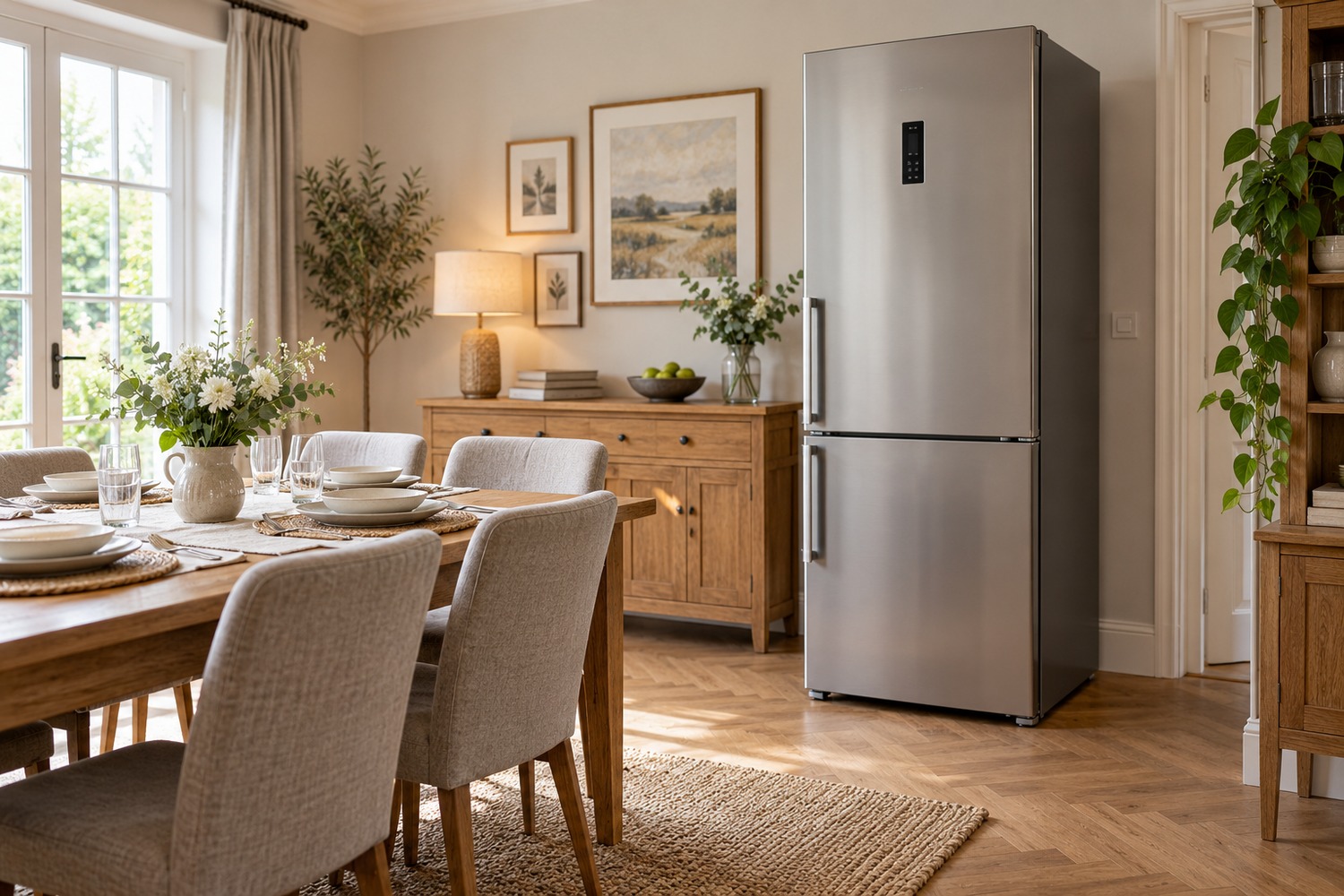
Yes, you can usually put a freestanding fridge freezer in a dining room, provided the room and the particular appliance meet its installation requirements. A fridge freezer doesn’t have to be in the kitchen. In fact, some manufacturers explicitly show dining areas as potential locations. But you still need suitable ventilation, a firm level floor, a safe electrical socket and enough room to open the doors fully.
If you’ve got a small UK kitchen, moving the fridge freezer into an adjoining dining room can free up valuable space. The biggest drawbacks are usually its appearance, compressor noise, heat and the inconvenience of walking between rooms while preparing meals.
What should you check before moving a fridge freezer into the dining room?
| Check | Why it matters |
|---|---|
| Ventilation clearance | Heat must escape from the appliance |
| Wall socket | The freezer should be connected as directed, without relying on an extension lead |
| Floor | The fully loaded appliance needs firm, level support |
| Doors and drawers | You need enough space to open the doors and remove shelves or freezer drawers |
| Room temperature | The model has a specified ambient operating range |
| Noise | Compressor sounds may be noticeable while dining or watching television |
| Delivery route | Large models must pass through the doors and hallway safely |
Is a dining room a suitable place for a fridge freezer?
For many homes, yes. A dining room is often heated, dry and reasonably close to the kitchen, making it a more practical alternative than an unheated loft or a tightly enclosed cupboard.
LG’s UK fridge-freezer installation guide even mentions dining areas among the spaces where an appropriate appliance may be installed. However, its guide says that features and requirements vary by model. Always check the exact fridge freezer’s installation manual rather than treating a general buying guide as approval for every product.
How much ventilation does it need?
A fridge freezer removes heat from its interior and releases it into the surrounding room. If you push it hard against a wall or surround it tightly with furniture, it may have difficulty releasing that heat efficiently.
The clearance depends on the model. For example, LG’s general installation guidance mentions a 5cm gap behind certain appliances, while other LG buying advice describes additional space at the sides and top. Those examples aren’t universal measurements.
Check the model’s actual installation drawing for rear, side and overhead gaps, and don’t cover ventilation grilles with curtains, tablecloths or furniture. Electrical Safety First also advises leaving room for air to circulate and keeping flammable materials away from the appliance.
Will a fridge freezer make the dining room warmer?
It will release some heat into the room as it operates. Whether you notice depends on the appliance, the size of the dining room, ventilation and the time of year. It won’t usually feel like a conventional heater, but the extra warmth can be unwelcome in a small or already hot dining area.
Keep it away from radiators, cookers and strong direct sunlight. Electrical Safety First notes that heat sources can make the appliance work harder to maintain its internal temperature.
Will it be too noisy during meals?
That depends on the model and how quiet the room is. Normal sounds can include a low compressor hum, clicking when it cycles and occasional refrigeration noises. A fairly quiet appliance might not bother you in a busy kitchen but could be noticeable in a dining room where people sit talking.
Compare the declared noise emission in decibels on the energy label or product specification. It’s a useful comparison, though it doesn’t tell you exactly how a particular hum will sound in your home.
Levelling also matters. An unstable fridge freezer can rattle against nearby objects or vibrate more than necessary. Follow the instructions for adjusting its feet and avoid placing loose ornaments or crockery against the cabinet.
Can you put a fridge freezer on a dining-room carpet?
Only if the specific model’s installation instructions permit that floor surface. Carpet may make levelling harder and could obstruct airflow beneath some appliances. Don’t assume a protective board or mat automatically solves the problem.
For laminate, wood, vinyl or tiles, check that the surface is flat and stable enough to support the loaded fridge freezer. Its adjustable feet should make proper contact without rocking. If you want to protect the floor from scuffs when moving the machine, use safe handling methods or manufacturer-compatible accessories, not a slippery mat beneath a working appliance.
Does it need a special electrical socket?
Usually it needs a suitable nearby wall socket used in accordance with its manual. Electrical Safety First recommends connecting fridge freezers directly to a wall outlet rather than using an extension lead. Keep the cable away from heat, don’t trap it under the feet or behind sharp furniture edges, and make sure you can disconnect the appliance if needed.
If there’s no conveniently located socket, ask a qualified electrician about installing one. Avoid trailing an extension cable across the dining-room floor, where it could be damaged or create a trip hazard.
Will the fridge freezer doors open properly?
This is particularly important if you’re putting a tall fridge freezer beside a sideboard or in an alcove.
Measure the full depth with the doors closed, then check how far the doors swing into the room. Some appliances require extra space on the hinge side before drawers can be fully removed. A reversible door may help, but not every model offers that feature.
Before ordering, check that the appliance won’t block dining-room doors, chairs or the normal route through the room. If the family uses the space daily, a door that repeatedly collides with dining chairs quickly becomes frustrating.
Will it look strange to have a fridge freezer in the dining room?
That’s personal, but it’s a genuine concern. In one Mumsnet discussion, a homeowner with a small flat considered moving a full-height fridge freezer into the dining room and wondered about appearance and resale value.
A slim freestanding model can look less intrusive than a large American-style fridge freezer. Positioning it on an unobstructed wall, choosing a finish that suits the room and leaving enough space around it can help. But don’t build a close-fitting decorative surround that blocks ventilation, or place it inside an ordinary cupboard unless the manufacturer explicitly permits that installation.
Could it affect the value of your house?
There’s no reliable blanket answer. Some buyers might appreciate extra kitchen space, while others may dislike having a large appliance in the dining room. If the appliance is freestanding, the arrangement can often be reversed without major building work, which may make it less consequential than a permanent kitchen alteration.
Don’t assume that moving a fridge freezer will either increase or decrease resale value by a particular amount. Think primarily about whether it improves how your own household uses the space.
Is an American-style fridge freezer practical in a dining room?
It can be, especially in an open-plan kitchen-diner, but measure carefully. Large models need wider delivery routes, significant door-opening space and sometimes a water supply for ice or chilled-water dispensers.
If the appliance requires plumbing, the dining-room location may be more complicated than a basic freestanding fridge freezer. An unplumbed model may be simpler, provided it meets the ventilation and electrical requirements.
How to choose a fridge freezer for a dining room
- Measure the available position. Include skirting boards, radiators, wall features and the manufacturer’s required clearances.
- Check the delivery route. Measure doors, hallways, turns and thresholds, not just the final space.
- Compare noise levels. Look at the model’s declared decibel rating, especially if you eat or relax nearby.
- Check the climate class. Make sure the room’s temperatures remain inside the permitted range.
- Plan everyday access. The doors must open far enough to remove drawers and shelves.
- Check the socket location. Avoid needing an extension lead.
- Read the installation manual. This is the final authority for the appliance you’re considering.
What can you buy for this setup?
If a full-size appliance dominates the space, you can browse slim fridge freezers on Amazon UK or compare models advertised as quiet. Confirm actual dimensions, noise specifications and installation instructions before purchasing.
A fridge/freezer thermometer may also be useful for checking food-storage temperatures. These are general shopping searches rather than recommendations of products we’ve tested.
Frequently asked questions on can you put a fridge freezer in a dining room
Does a fridge freezer have to be in the kitchen?
No. A freestanding fridge freezer can be located elsewhere in the home if its installation requirements are met and the position is safe and practical.
Can a fridge freezer stand next to a dining-room radiator?
It’s better to avoid nearby heat sources. Electrical Safety First advises keeping fridge freezers away from radiators and direct sunlight because extra heat makes them work harder.
Can you hide a fridge freezer inside a dining-room cabinet?
Only if the appliance is designed or expressly approved for that installation and the correct ventilation arrangement is provided. Don’t put a normal freestanding model into a tightly enclosed cabinet just to hide it.
Will a fridge freezer damage a wooden floor?
It shouldn’t in a properly supported installation, but dragging it across the floor can cause scratches, while leaks or condensation could damage some finishes. Check the flooring and appliance instructions and move heavy appliances safely.
Is it safe to sleep in a room next to a fridge freezer?
The presence of a correctly installed appliance in a neighbouring room isn’t automatically unsafe, but keep its ventilation and electrical arrangements compliant. Compressor noise may be noticeable through the wall.
Can I put a fridge freezer in an open-plan living and dining room?
Often, yes, if the room provides suitable airflow, temperatures, socket access and enough space to open its doors. Noise and appearance may matter more in a shared living space.
Bottom line
A dining room can be a sensible place for a fridge freezer when the kitchen is short of space. So if you want to know can you put a fridge freezer in a dining room – make sure it has a suitable wall socket, the model’s required ventilation clearances, a firm level floor and enough room for its doors. Then consider everyday convenience, noise and how it looks in the room. A freestanding appliance doesn’t need to be confined to the kitchen.
Sources and further reading
Disclosure: Progressive Housewares may earn a commission from qualifying purchases through affiliate links, at no additional cost to you. We haven’t tested the products linked in this article.