
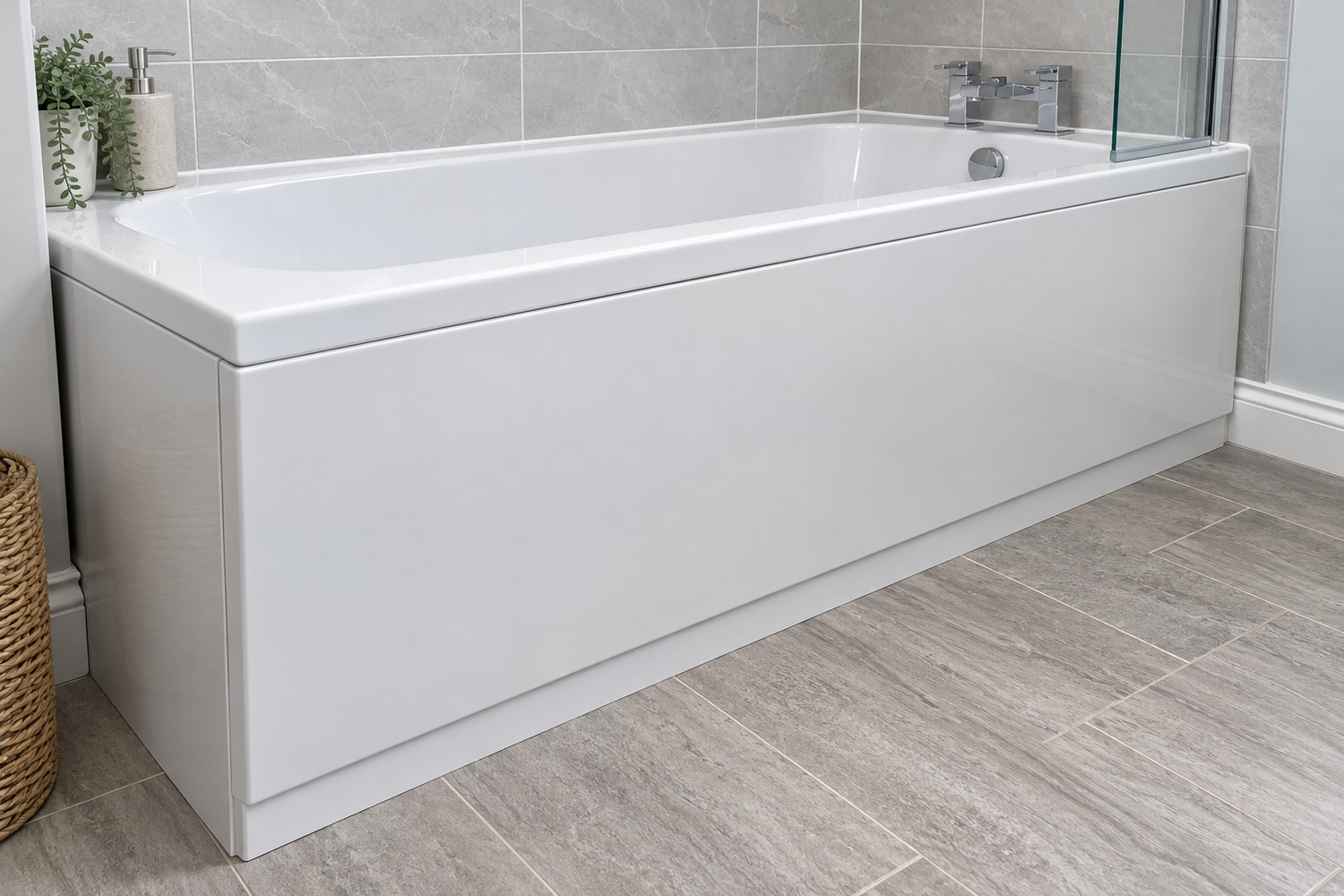
Yes, a 1700mm bath panel can often be made to fit a 1680mm bath opening by trimming 20mm from its length — but only if the specific panel is designed to be cut. Flat MDF and some plastic panels can be shortened, while certain shaped acrylic, reinforced or model-specific panels may not be suitable. Check the panel manufacturer’s instructions before ordering or cutting.
This is a common UK bathroom problem: a replacement panel is advertised as 1700mm, but the gap between the finished walls is only 1680mm. The good news is that a 20mm difference isn’t unusual. The important part is understanding what you’re measuring and whether removing that material would damage the panel.
1700mm panel and 1680mm opening: quick compatibility guide
| Panel type | Could 20mm be trimmed? | Important consideration |
|---|---|---|
| Flat MDF bath panel | Often, if the product permits it | Seal every newly cut edge against moisture |
| Flat timber bath panel | Often, if approved | Protect cut edges and check decorative detailing |
| Plain PVC panel | Sometimes | Check construction, end profile and cutting guidance |
| Moulded acrylic panel | Depends on the model | End lips or strengthening ribs can complicate cuts |
| Shaped P- or L-shaped bath panel | Don’t assume so | Usually requires model-specific compatibility |
| Made-to-measure 1680mm panel | No trimming usually needed | Verify exact height and fixing system too |
These are general tendencies, not blanket approval to cut a particular product. For example, QS Supplies answers a customer question about a Hudson Reed Fusion 1700mm MDF panel needing to fit a 1680mm opening by confirming that specific panel can be shortened. That doesn’t automatically apply to every 1700mm panel.
First, check whether your bath is really 1680mm long
The measurement you need is usually the space the finished front panel must occupy, rather than just the nominal bath length on an old invoice. A bath sold as 1700mm may appear to have less exposed space after wall tiles, plaster or an awkward end return.
Measure between the finished walls or other solid boundaries where the panel will sit. Don’t measure only along the top lip: compare the opening at the top, middle and bottom because walls and skirting aren’t always perfectly square.
- Remove or inspect the existing panel carefully. Check how it is held in place before pulling it away, and avoid damaging the bath’s supports.
- Measure the finished opening. Record the clear length at several heights.
- Measure the height. Check from the underside of the bath lip or the intended retaining channel to the finished floor.
- Note obstructions. Look for pipes, bath legs, framing, tile edges and skirting that might change how the panel sits.
- Compare the product’s actual dimensions. Look for tolerances, plinth adjustments and manufacturer instructions, not only the advertised ‘1700mm’ label.
If your measurements vary — say, 1678mm near the floor but 1682mm higher up — the panel may need to be scribed to match the opening. Don’t assume a single straight 20mm cut will give a neat fit.
Is it normal to cut 20mm off a bath panel?
For a suitable flat panel, yes. UK fitting guides from Screwfix and DIY Doctor describe measuring and trimming bath panels to fit bathrooms where standard-size panels don’t match the space exactly. However, the instructions supplied with the particular panel take priority. Screwfix’s bath-panel cutting guide explains how tools and edge treatment differ by material.
Twenty millimetres is a relatively small adjustment, but it can still remove an important lip, fixing point or decorative edge. Before cutting, look closely at the back of the panel and check whether one end has a special shape or reinforcement.
Can you shorten an MDF bath panel?
Many flat MDF panels can be shortened if the manufacturer permits trimming. Check for an end cap, pre-drilled fitting points, grooves or decorative details that might be affected. When making an approved cut, measure carefully and use a suitable fine-toothed blade with proper support.
MDF is particularly vulnerable where its core is exposed. A freshly cut edge can absorb moisture from splashes or a damp bathroom, causing swelling and damage to the finish. Screwfix advises sealing cut MDF edges with an appropriate protective primer, glue or varnish, following the fitting instructions.
Let the coating cure as directed before fitting the panel. Don’t rely solely on a bead of silicone along the visible front to protect an unsealed cut edge hidden against the wall.
What if the 1700mm panel is acrylic or plastic?
Some acrylic panels can be trimmed, but not all are simple flat sheets. They may have moulded return edges, fixing lips or internal ribs that help them hold their shape. Cutting through these can weaken the panel or leave an untidy edge.
DIY Doctor describes trimming some acrylic panels with a suitable hacksaw and carefully smoothing the edge. That is general fitting advice, not permission to cut a specific moulded replacement. If the manufacturer doesn’t explain whether the product is cuttable, ask before buying.
Be especially wary of shaped shower-bath panels. A P-shaped, L-shaped or curved panel may need to match the bath model precisely. A standard 1700mm straight panel isn’t an appropriate substitute simply because its advertised length matches.
Does an adjustable bath panel solve the problem?
Not necessarily. ‘Adjustable’ often refers to height, not length. Two-piece bath panels with an adjustable plinth can help when the floor-to-bath height differs, but the front panel may still be a fixed 1700mm long.
Before ordering, check whether the listing explicitly says ‘cut to size’, ‘trim to length’, ‘length adjustable’ or only ‘height adjustable’. If the product gives a height range but no length-adjustment allowance, ask the seller which parts can be cut.
Could you just buy a 1680mm bath panel instead?
Yes. Although 1700mm is a common standard size, some retailers offer 1680mm and even 1675mm alternatives, along with made-to-measure panels. These may be worth considering if you want to avoid cutting a finished panel or have a decorative style that won’t trim neatly.
Compare the full cost, not just the headline price. A made-to-measure panel might cost more, but cutting a delicate panel incorrectly could be more expensive if you have to replace it. For a simple flat panel, trimming may still be the better value.
How to trim an approved panel by 20mm
Only follow these steps if the product’s instructions allow length trimming and you’re confident using the required tools. Wear suitable eye and respiratory protection, manage dust properly and use the cutting guidance supplied with the blade and material.
- Check your final measurements twice. Measure the intended fitted opening rather than relying on the nominal bath size.
- Choose the correct end. Follow instructions on where trimming is permitted; avoid removing a necessary lip or fixing point.
- Mark the cut accurately. Use a straightedge and follow the manufacturer’s advice about protecting the finished face with tape.
- Support and secure the panel. Use a stable work surface and appropriate clamps so the panel can’t move while cutting.
- Use the right blade for the material. Cut steadily, keeping the panel supported to minimise splitting or chipping.
- Test-fit before final installation. Check length, height and access to pipework, and avoid forcing the panel into place.
- Protect the cut edge. Seal MDF or timber as directed and finish plastic edges in accordance with the manual.
It’s much easier to remove a little more material than to repair a panel you’ve cut too short. If you’re unsure about a shaped or expensive panel, ask a bathroom fitter rather than experimenting.
What about the panel height?
Length isn’t the only measurement that matters. The gap from the bath lip to the floor might vary because of adjustable bath legs, floor tiles or a separate panel plinth. A 1700mm-long panel could be the right length after trimming but still be too tall or too short.
Measure the required height at both ends and in the middle. If the product has a separate height-adjustable plinth, check its stated range. Don’t cut away fixing features unless the installation instructions allow that adjustment.
Do you need to seal around the bath panel?
Follow the specific fitting system. Moisture-resistant finishes and sealed cut edges are especially important for MDF and timber. Some panels need silicone at particular wall junctions; others use removable retaining strips or clips so you can access plumbing beneath the bath.
Don’t permanently seal an access panel in a way that prevents necessary inspection or repair. If you discover wet flooring, dripping pipes or a damp wall while replacing the panel, address the cause before covering it up.
Where can you buy a suitable replacement?
If your existing opening is 1680mm, you can browse 1700mm cut-to-size bath panels on Amazon UK or search for exact-size 1680mm panels. Check whether the listing refers to front or end panels, the material, height, fixing system and explicit permission to shorten it.
If the product instructions are missing, contact the seller before ordering. These are general shopping links, not endorsements of individual panels we’ve tested.
Frequently asked questions on will a 1700mm bath panel fit a 1680mm bath
Can you cut 20mm off a 1700mm bath panel?
Often, if it’s a trim-compatible flat panel. But some moulded or reinforced designs shouldn’t be altered. Follow the exact product’s instructions.
Will a 1700mm panel fit a 1675mm opening?
It may, if the panel is approved for trimming by the necessary amount. Some suppliers also offer 1675mm panels, so compare your options before cutting.
Are all 1700mm bath panels the same height?
No. Height, plinth design and fixing methods vary considerably. Measure the opening vertically as well as horizontally.
Can I cut a gloss MDF bath panel without ruining the finish?
An approved panel may be cut with the right technique and blade, but decorative finishes can chip. Protect the surface as directed, work carefully and seal the exposed core afterwards.
Are adjustable bath panels adjustable in length?
Not always. Many adjustable panels change height using a separate plinth, so confirm which dimension adjusts before buying.
Do I need a special panel for a P-shaped bath?
Usually you’ll need a panel designed for that bath shape and often its specific model. A standard straight panel won’t normally follow the curved end.
Bottom line
A 1700mm bath panel can often fit a 1680mm opening if 20mm can safely be trimmed off. Check the exact model and construction first, measure the real gap at several points, and reseal any exposed MDF or timber. If the panel is moulded, reinforced or unsuitable for shortening, look for a 1680mm or made-to-measure replacement instead.
Sources and further reading
- DIY Doctor — How to fit an acrylic bath panel
- Plumbworld — How to fit a bath panel
- Bath Panel Store — Bath panel sizes and measuring
Disclosure: Progressive Housewares may earn a commission from qualifying purchases through affiliate links at no additional cost to you. We haven’t tested the products linked in this article.