
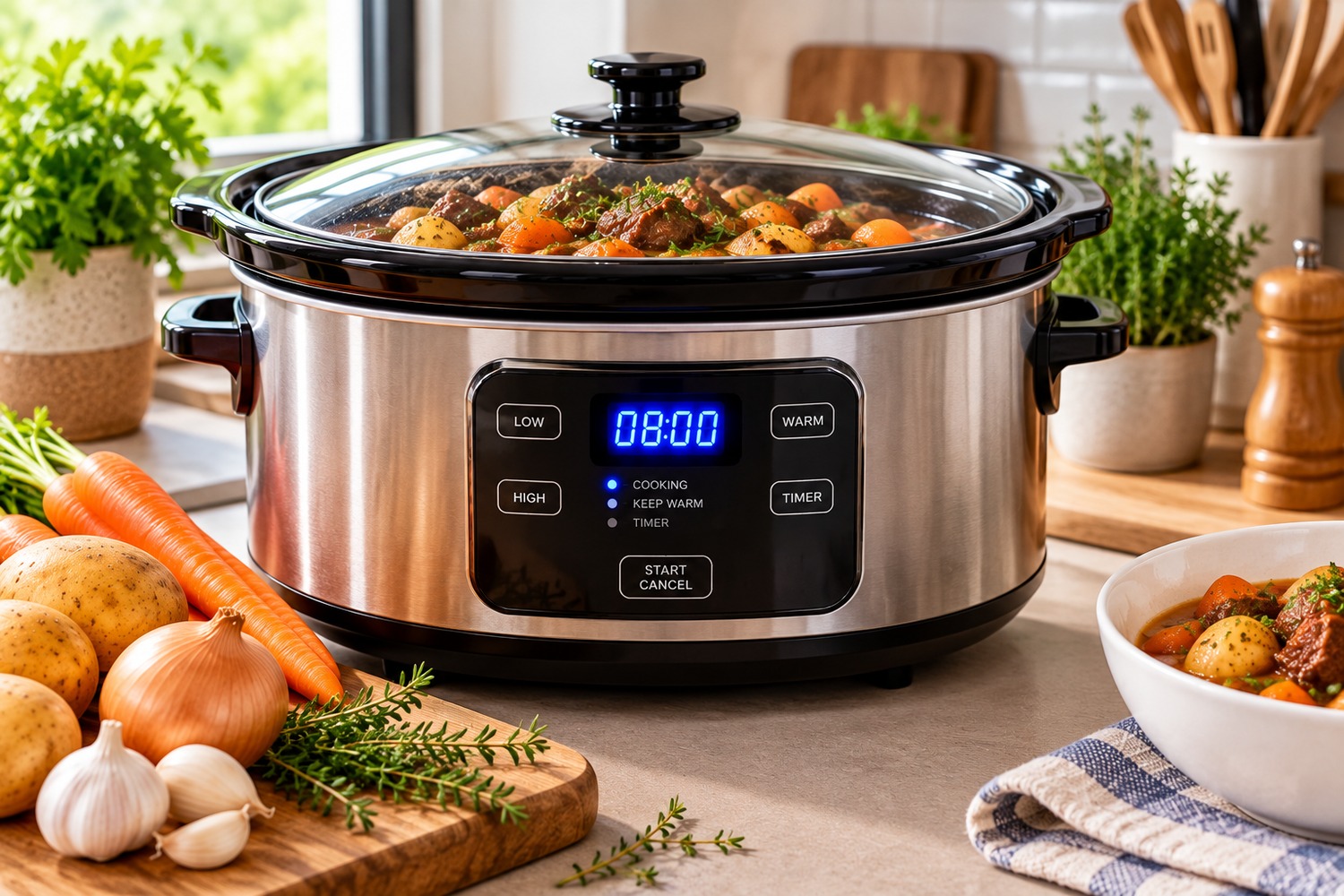
If you’re comparing a basic dial-controlled model with a digital one, you might be wondering: are programmable slow cookers worth it, or are you paying extra for a display and a few buttons? They’re worth considering if you regularly cook dishes that need a set cooking time and appreciate an automatic switch to keep-warm afterwards. But a straightforward manual slow cooker can make equally good stews, curries and casseroles for less money.
The most important difference isn’t how the food tastes. It’s what happens when the cooking programme finishes. Some digital slow cookers automatically move to a warming mode; basic models may simply keep running at the chosen setting until you turn them off. That’s useful convenience, although it doesn’t remove the need to follow food-safety guidance.
Are programmable slow cookers worth it for everyday cooking?
Yes, if the timer and automatic keep-warm function fit your routine. They’re particularly useful when you cook several times a week, follow recipes with different cooking durations or want the machine to change modes without manually turning its dial.
If you mostly make one familiar casserole on a weekend, stay nearby and don’t mind switching the cooker off yourself, you may be happier with a cheaper manual model. Both types generally use the same principle: food cooks slowly at controlled temperatures over several hours.
Manual versus programmable slow cookers
| Feature | Manual slow cooker | Programmable slow cooker |
|---|---|---|
| Low and high settings | Usually | Usually |
| Cooking timer | Usually not built in | Common |
| Automatically switches to keep-warm | Not on most basic models | Available on many models |
| Automatic power-off | Often requires manual intervention | Depends on the particular model |
| Controls | Simple dial | Buttons and digital display |
| Price | Often lower | Often higher |
| Cooking results | Good when used correctly | Good when used correctly |
The wording on the box matters. A ‘digital’ model may have a display without every scheduling feature you expect, while ‘programmable’ doesn’t automatically mean it offers delayed start, remote control or automatic shut-off. Read the exact product specification.
What does a programmable slow cooker actually do?
On many models, you select a cooking setting and duration — for example, several hours on low or high. When the timer ends, the cooker may switch automatically to keep-warm. Other designs stop heating or sound an alert instead. The available programmes and maximum keep-warm time vary.
That automatic change can be handy if dinner finishes cooking before you’re ready to serve. However, keep-warm isn’t the same as refrigeration and it isn’t intended for unlimited storage. Check that the model maintains a food-safe temperature, and follow the manufacturer’s stated warming-time limit.
Is the timer the same as a delayed-start function?
No. This is one of the biggest sources of confusion when shopping. A cooking timer counts down how long the food will cook. A delayed-start function waits before cooking begins. Many slow cookers provide the first feature but not the second.
Be careful with the idea of leaving raw meat or other perishable ingredients at room temperature for hours before heating begins. That can create a food-safety risk. Don’t use an external plug-in timer to delay the start of an ordinary slow cooker. Follow food-safety guidance and the appliance’s own instructions instead.
Is automatic keep-warm genuinely useful?
It can be, particularly if you want a meal ready when you return home or if family members eat at slightly different times. You don’t have to be standing by the cooker at the precise minute the main programme finishes.
But it helps most when your recipe tolerates a little extra time at a safe holding temperature. Some dishes, including delicate vegetables and pasta, may become too soft even while being kept warm. Also, not every product maintains the same temperature or permits the same duration.
Use the machine’s approved keep-warm setting only for food that’s been fully cooked, and follow the manufacturer’s instructions for serving, storing and reheating leftovers. Don’t assume that ‘warm’ is suitable for cooking raw food.
Will a programmable slow cooker save electricity?
Not automatically. A digital display doesn’t make a slow cooker more energy-efficient, and electricity use varies by wattage, insulation, programme, recipe and total running time.
An automatic finish or switch to warming may help you avoid unnecessary hours of active cooking, but it isn’t a guaranteed saving. The Energy Saving Trust’s comparison of cooking appliances notes that slow cookers can be economical for batch cooking, while also advising against leaving them running longer than necessary. Its example costs are for particular recipes, not promises about every model.
If running costs are your main concern, prioritise an appropriate capacity and the meals you’ll actually cook. Making four usable portions in a correctly filled appliance can be more worthwhile than heating a large cooker for one small serving.
How much more should you pay for a programmable model?
Rather than choosing by a fixed price difference, ask whether the extra feature solves something you regularly find frustrating. If you often wish a manual cooker could change to warming automatically, paying a little more can be sensible. If you don’t need it, that money may be better spent on a well-made removable pot, an easier-to-clean design or a more suitable size.
You can find slow cookers of both types below £100. Prices change, so compare the actual features before assuming a higher price guarantees more useful programming or longer service life.
What size programmable slow cooker should you buy?
| Household or cooking habit | Capacity to compare | Reason |
|---|---|---|
| One person, modest batches | Approximately 1.5–2.5 litres | Less space needed for smaller meals |
| Couple or regular solo batch cooking | Approximately 3–3.5 litres | Room for several portions |
| Family meals | Approximately 4.5–5.5 litres | More room for stews and casseroles |
| Larger batches | 6 litres or more | Only useful if you regularly cook that much |
Capacity ranges are a starting point, not exact serving guarantees. Always respect the appliance’s minimum and maximum fill lines and the specific recipe. Our slow cooker sizing guide for a family of four explains why the advertised volume isn’t the only measurement that matters.
If you cook mostly for yourself, you may prefer a compact model instead. Our guide to whether a slow cooker is worth buying for one person considers storage, leftovers and batch cooking in more detail.
What features are worth looking for before buying?
- Clear cooking timer: easy to set and adjust without repeatedly consulting the manual.
- Automatic keep-warm: useful if it follows cooking without requiring another button press.
- Clearly described finish behaviour: check whether the cooker switches modes, switches off or sounds an alert.
- Removable cooking pot: easier to clean than a fixed pot, with dishwasher suitability checked in the manual.
- Suitable capacity: a model you can fill correctly for your normal recipes.
- Good-fitting lid and practical handles: useful for moving and serving safely.
- Simple display: controls you can read and operate without frustration.
If you often cook vegetarian stews, curries or lentil dishes, you’ll benefit more from a slow cooker that handles your normal recipes well than from lots of seldom-used programmes. Our article on whether slow cookers are worth it for vegetarians looks at those meal types and their limits.
Where to compare programmable slow cookers on Amazon UK
If you want an automatic cooking timer and warming mode, browse programmable slow cookers with automatic keep-warm on Amazon UK. For a typical household, compare 3.5-litre digital slow cookers, or look at 5-litre programmable models if you need more capacity.
Check the individual listing and downloadable manual. Not every result in a shopping search has the same timer, warm setting or automatic finish behaviour. These are general shopping links; we haven’t tested the products shown.
Are programmable slow cookers safe to use when you’re out?
The presence of a timer doesn’t automatically make an appliance safe for every unattended situation. Follow the manufacturer’s instructions for placement, clearance, cooking mode and whether it permits operation while you’re out. Place the cooker on a stable, heat-resistant surface and keep its cord clear of hot areas.
Electrical Safety First’s slow-cooker safety advice recommends following the maker’s instructions, checking plugs and cables, using a heat-resistant surface and choosing the low setting if leaving the house while the cooker runs. Don’t use an appliance with visible electrical damage or unusual smells.
Register the appliance with the manufacturer for recall information, and don’t rely on a smart plug or external timer to override the cooker’s normal safety functions.
When a basic manual slow cooker is the better buy
A manual slow cooker makes more sense if you have a simple cooking routine, rarely need precise finishing times and value reliability and straightforward controls. A dial with low, high and warm settings can be entirely adequate for many stews and casseroles.
It can also be a sensible budget choice for someone trying slow cooking for the first time. If you later discover you use it several times every week, you’ll know whether a timer would genuinely improve your routine rather than paying extra on the assumption that you’ll need one.
Frequently asked questions
Do programmable slow cookers cook better than manual ones?
Not inherently. Good results depend on the recipe, correct filling, temperature setting and cooking duration. Programmable controls mainly make scheduling and finishing more convenient.
Do all programmable slow cookers switch to keep-warm automatically?
No. Some do, others switch off or sound an alert. Check the exact model’s description and manual before buying.
Can I set a programmable slow cooker to start later?
Only if the model explicitly supports delayed start, and only when the ingredients and manufacturer’s food-safety instructions make it appropriate. Don’t leave perishable ingredients waiting unrefrigerated for hours.
Can I leave food in keep-warm overnight?
Don’t assume that’s safe. Warm-holding temperatures and maximum times vary by cooker. Follow the specific appliance’s guidance, and refrigerate leftovers promptly instead of using keep-warm as long-term storage.
Are digital slow cookers harder to clean?
Not necessarily. Cleaning depends more on the removable pot, lid and construction than on the controls. Keep the electrical base dry and follow the cleaning instructions.
Is a programmable slow cooker worth it for one person?
It can be if you batch cook and value an automatic finish. If you only use a small slow cooker occasionally, you may not need the extra controls.
The verdict
Programmable slow cookers are worth the extra money if a cooking timer and automatic keep-warm setting make meals easier to fit around your day. They don’t automatically cook better or save electricity compared with a manual model. Choose the right capacity first, check exactly what happens when the timer ends, and pay extra only for functions you’ll actually use.
Affiliate disclosure: Progressive Housewares may earn a commission from qualifying purchases through Amazon UK links, at no extra cost to you. We haven’t tested the products linked in this article.