
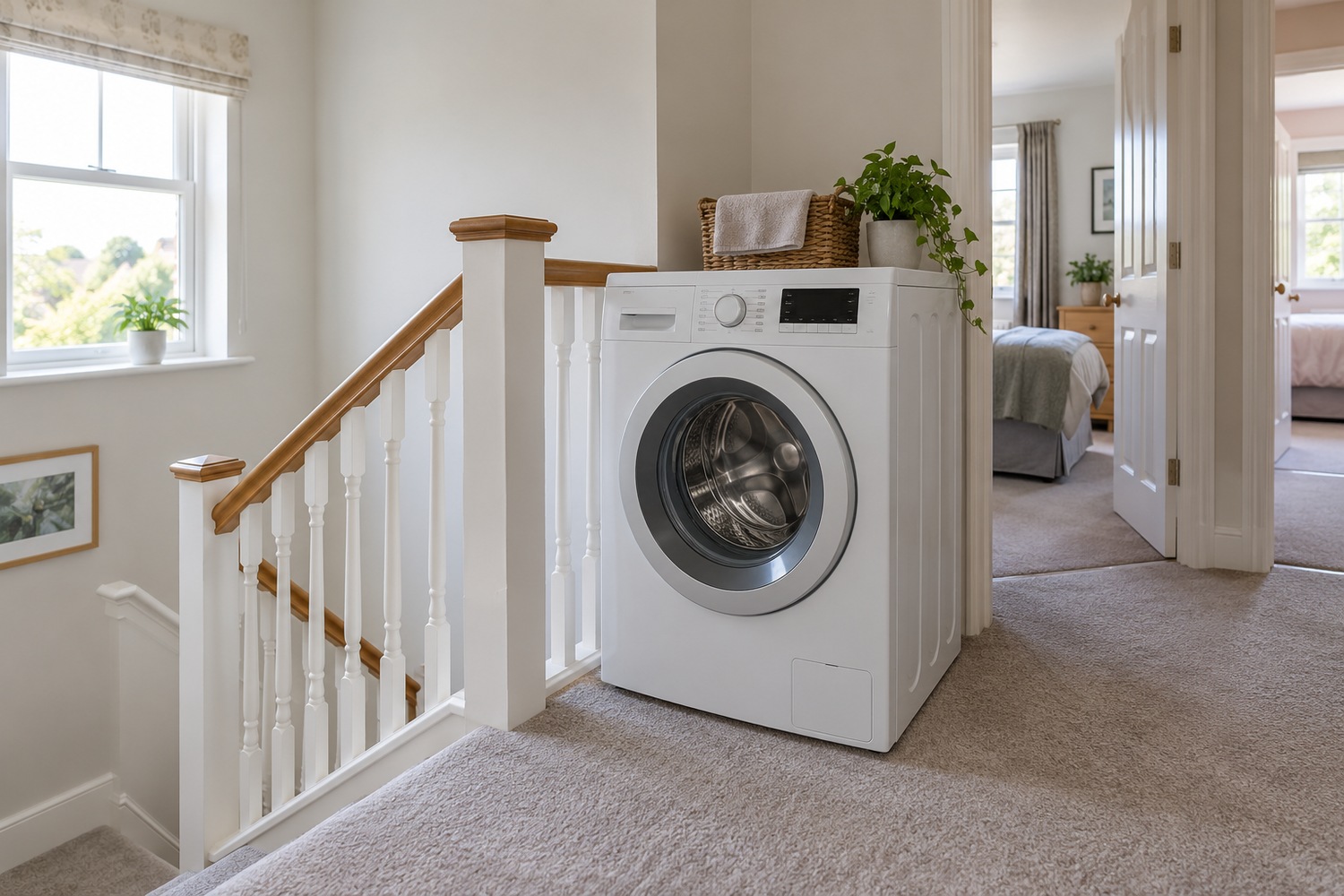
Yes, you can put a washing machine upstairs. There’s no general rule that a domestic washing machine must stay on the ground floor. But if you’re thinking can you put a washing machine upstairs, then be aware that an upstairs installation needs careful planning: the room and floor must safely support the machine, it needs a suitable water supply and wastewater connection, and you’ll want to minimise vibration, noise and the risk of leaks damaging the rooms below.
Whether you’re thinking of converting a spare bedroom into a utility room or putting a machine near an upstairs bathroom, the important question is can this particular location be installed safely? Don’t order an appliance until you’ve checked the plumbing, drainage, electrical supply, access and building requirements.
What should you check before installing a washing machine upstairs?
| Issue | What to establish | Who may need to help |
|---|---|---|
| Floor support | Can the floor safely carry the appliance and withstand vibration during spinning? | Builder or structural engineer if uncertain |
| Water supply | Is there an appropriate cold-water connection and accessible isolating valve? | Qualified plumber |
| Drainage | Can wastewater discharge correctly, within the machine’s hose-height limits? | Qualified plumber |
| Electrical supply | Is there a suitable socket and safe cable route? | Qualified electrician where work is required |
| Noise and vibration | Will the spin cycle disturb bedrooms or people in rooms below? | Appliance installer; builder if necessary |
| Leak damage | Can connections be inspected and leaks detected quickly? | Installer or plumber |
| Access | Can the machine be delivered, moved upstairs and serviced safely? | Delivery team or installer |
Will an upstairs floor support the weight of a washing machine?
Many homes can accommodate a suitably installed upstairs washing machine, but you can’t assess floor suitability from the appliance’s weight alone. The machine creates changing forces as the drum spins, particularly if the load becomes unbalanced.
The floor construction and condition matter, whether it’s timber, concrete or another system. You don’t need to become an expert in flooring materials, but you do need a firm, level surface that complies with the appliance’s instructions. If the floor has noticeable bounce, movement, existing damage or uncertain structural capacity, ask a competent builder or structural engineer to assess it.
Don’t assume a piece of plywood or a rubber mat will automatically make an unsuitable floor safe. Modifying joists or fixing supports into a floor without understanding the construction can create additional problems.
Will a washing machine be noisier upstairs?
It can be. Spin-cycle vibrations and the sound of water moving through pipes can travel through the floor and walls. This may be especially noticeable in a room directly above a bedroom, lounge or study.
A properly levelled washing machine on a firm floor is often quieter than one that rocks or knocks. Check that all transit bolts have been removed during installation, the feet are adjusted correctly and their locknuts are tightened as the manual directs. Uneven loads can cause vibration even with a correctly installed machine.
For a new upstairs utility room, consider the location of bedrooms below and alongside it. A poorly chosen position could make night-time wash cycles particularly disruptive.
Does a washing machine upstairs need special plumbing?
It needs a suitable water connection and a correctly designed wastewater route, not necessarily special upstairs-only equipment. An existing bathroom nearby may make a connection more practical, but proximity to a pipe doesn’t automatically mean it can be used.
A plumber should check water pressure, pipe routing, accessible isolation and how the drain will connect to the home’s foul-water system. Wastewater from a washing machine must not simply be discharged into a rainwater downpipe or onto the ground.
The washing machine’s manual specifies how its drain hose should be installed and how high the outlet may be. Incorrect heights or poor pipe routing can lead to pumping problems, siphoning or leaks. Don’t copy measurements from another model.
In England, drainage work must meet the applicable requirements, with Approved Document H providing relevant guidance. Requirements elsewhere in the UK vary, so ask your installer or local building-control body about the work you’re planning.
What about leaks causing damage downstairs?
This is one of the strongest reasons to plan an upstairs installation carefully. A loose inlet connection, overflowing standpipe or damaged hose could allow water through the floor and into the ceiling below before you notice.
Practical precautions include:
- Having water and drainage connections installed and tested properly.
- Keeping the isolation valve accessible.
- Checking hoses and joints periodically for dampness or damage.
- Considering a water-leak alarm near likely leak points.
- Keeping the machine accessible enough to inspect rather than sealing it permanently behind cabinetry.
A drip tray may catch a small amount of water, depending on its design, but it can’t be relied on to contain a significant hose failure or overflowing drain. A battery-operated leak alarm may provide early warning but won’t prevent the leak itself unless connected to a suitable automatic shut-off system.
Can you put a washing machine in an upstairs bedroom?
Potentially, yes, if the room can be adapted for the installation. Turning a spare bedroom into a laundry space raises practical questions about water and waste pipes, electrical work, ventilation, sound transmission and access.
Think about whether you’ll also dry clothes in the room. Indoor laundry adds moisture to the air; suitable ventilation matters to avoid persistent condensation and mould. If you’re making substantial plumbing, electrical or structural changes, check whether building regulations approval or landlord/freeholder permission is needed.
In a leasehold flat or rented home, you may need consent even if the building could physically accommodate the machine. Check your agreement and speak to the relevant person before work begins.
Is it easier to install a washing machine near an upstairs bathroom?
Often, existing pipework makes it worth investigating. However, the bathroom’s supply and drainage arrangement might not be appropriate for a washing machine without alterations. Drain sizing, traps, hose heights and access must all be checked.
Also remember that electrical rules are stricter in bathrooms and rooms containing a bath or shower. Don’t install a washing machine or new socket in one of those spaces without checking the applicable electrical requirements and obtaining qualified advice.
Will anti-vibration feet solve the problem?
Not necessarily. Manufacturer-approved vibration-reduction accessories might help reduce transmitted noise in some situations, but soft pads can make an unstable machine move more. They don’t fix incorrect levelling, shipping bolts, poor floor support or a mechanical fault.
Start with a sound installation and the exact machine’s instructions. If the appliance moves or bangs during spinning, have it checked before experimenting with accessories.
For a related issue, see our guide Can You Put a Washing Machine on Laminate Flooring?, which looks more closely at the supporting surface beneath the machine.
What about getting the washing machine upstairs?
A washing machine is heavy and awkward to carry. Check the stair width, tight corners, landings and doorway dimensions before delivery. Don’t attempt to lift one upstairs alone.
Tell the retailer or delivery company about the stairs before ordering. Some services place appliances upstairs only when the access is suitable; installation, old-appliance removal and connection may be separate services. Ask what is included and what they’ll refuse to do.
Do you need building regulations approval?
Simply moving an appliance doesn’t necessarily require a separate application, but associated building work might. New or altered plumbing, drainage, electrics and structural work can be subject to rules depending on the location and circumstances.
GOV.UK advises checking whether building regulations approval is needed for alterations, including some plumbing and electrical projects. If your work is substantial or you’re uncertain, check with the relevant building-control body before starting. Scotland, Wales and Northern Ireland have their own applicable frameworks.
Useful accessories for an upstairs laundry area
You don’t need a trolley full of accessories to make an upstairs installation successful. A simple battery-powered water-leak alarm may be worth considering near the connections, and a spirit level is useful for checking alignment during setup. You can also compare washing-machine drip trays, while remembering that tray capacity and compatibility vary.
These are general Amazon UK shopping searches, not products we’ve tested. An accessory should supplement, not replace, correct installation.
Frequently asked questions about can you put a washing machine upstairs
Is it safe to have a washing machine on the first floor?
It can be, provided the floor is suitable and the machine has correctly installed water, drainage and electrical connections. Have the location assessed if you have doubts about support, vibration or leaks.
Can you put a washing machine in a second-floor flat?
Potentially, but check the building’s suitability, your lease or tenancy conditions and any relevant permissions. Water damage to a flat below makes proper installation and leak precautions particularly important.
Does a washing machine upstairs need a concrete floor?
No universal requirement says every upstairs washing machine must sit on concrete. The relevant question is whether the particular floor is sufficiently firm, level and structurally suitable for the appliance.
Can you put a tumble dryer upstairs as well?
Possibly, but its ventilation or condensation-management requirements, electrical load, clearances and weight also matter. Don’t assume the room is suitable for both machines without checking each appliance.
Will an upstairs washing machine damage the ceiling below?
Not in a correctly planned installation simply because it’s upstairs. However, excessive vibration, unsuitable support or a water leak can cause damage. Investigate unusual movement and fit water connections properly.
Should you run an upstairs washing machine overnight?
Consider noise for other occupants and neighbours. More importantly, follow the appliance manufacturer’s instructions regarding unattended operation and fire safety. Don’t leave a machine running when a fault or leak is suspected.
Bottom line
You can put a washing machine upstairs if the space is suitable for it. The big decisions are structural support, safe plumbing and drainage, electrical access, vibration and leak protection. An upstairs laundry room can be convenient, but the installation should be planned as a proper utility space rather than treating the machine as furniture that can be placed anywhere.
Sources and further reading
- GOV.UK — When building regulations approval may be needed
- GOV.UK — Approved Document H: drainage and waste disposal
- RICS — Drainage compliance
Disclosure: Progressive Housewares may earn a commission from qualifying purchases through affiliate links, at no extra cost to you. We haven’t tested the products linked here.