
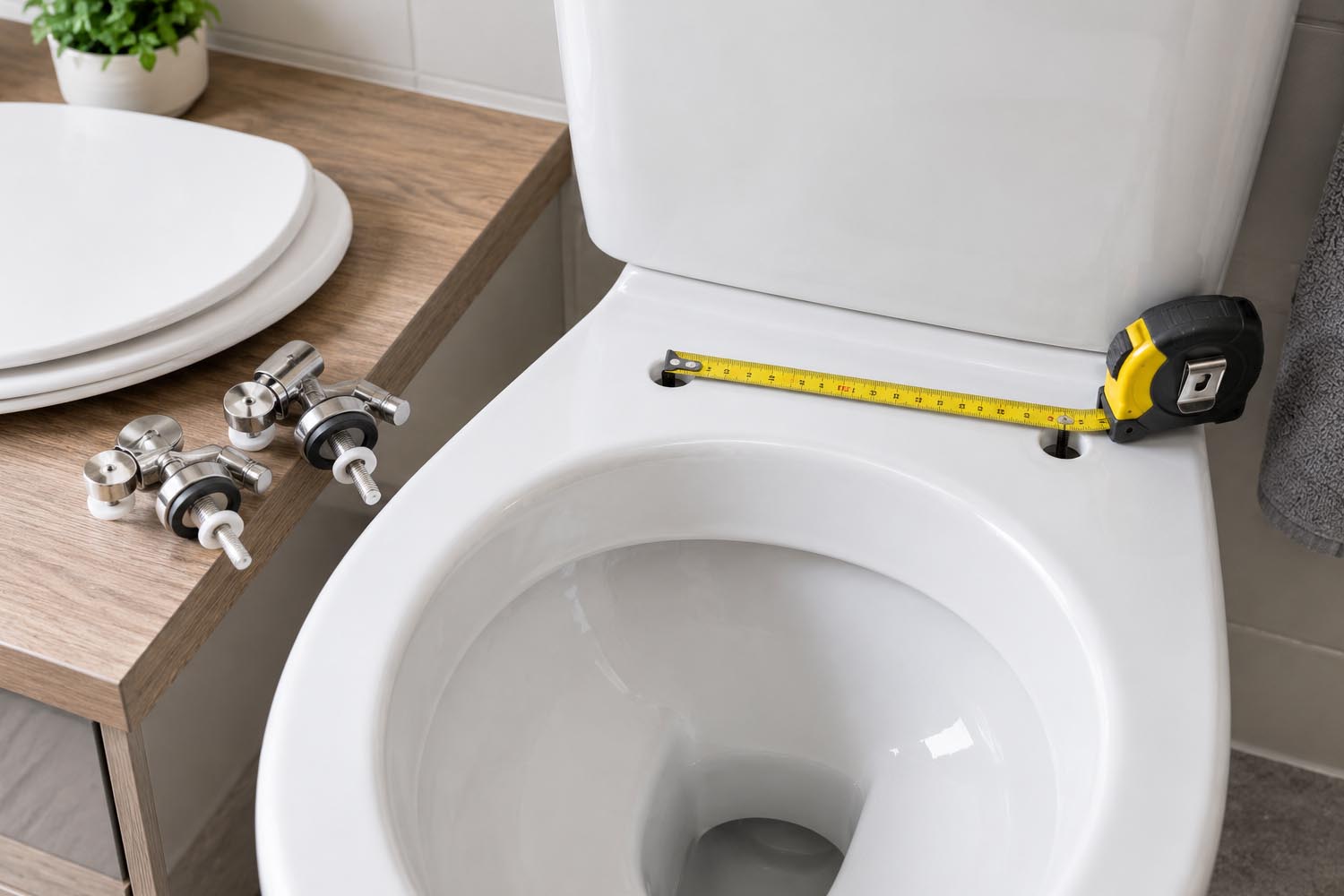
If your toilet’s fixing holes are 160mm apart, look for a replacement toilet seat with hinge centres adjustable to 160mm. For example, a seat advertised with a 140–180mm fixing range should accommodate that spacing, provided the adjustment is measured centre to centre. But matching the two holes isn’t enough: you must also check the toilet pan’s shape, width, front-to-hole length and whether it needs top-fix or bottom-fix fittings.
A broken toilet seat is usually an urgent, straightforward replacement purchase. Taking three accurate measurements now can save you ordering something that bolts on but overhangs the pan, sits too far back or can’t be tightened.
Quick answer: which fixing ranges fit 160mm?
| Advertised hinge-centre spacing | Will it cover 160mm? | Why |
|---|---|---|
| Fixed at 160mm | Yes, for the holes | Still check the seat shape and projection |
| Adjustable 140–180mm | Yes | 160mm is within the stated range |
| Adjustable 150–180mm | Yes | 160mm is within the stated range |
| Adjustable 120–220mm | Yes | Confirm the range is for hinge centres, not another dimension |
| Adjustable 100–150mm | No | Stops short of 160mm |
| Fixed at 115mm | No | Holes won’t line up |
The table is a compatibility calculation, not a recommendation of a particular brand. Always check the product’s fitting diagram and the actual adjustment range. A retailer description such as ‘universal’ doesn’t guarantee a seat fits every toilet.
How do you measure 160mm fixing holes correctly?
Measure from the centre of one fixing hole to the centre of the other on the toilet pan. Don’t measure between the outside edges of the existing hinge covers, which can be wider than the actual hole spacing.
- Lift or remove the old seat if it’s safe to do so. That makes the ceramic fixing holes easier to see.
- Locate each hole’s centre. Measure horizontally across the back of the toilet pan.
- Read the result in millimetres. Sixteen centimetres equals 160mm.
- Repeat the measurement. If you’re getting 155mm on one attempt and 160mm on another, check where you’ve positioned the tape.
- Take a photo. A clear picture of the pan and its fixings helps when comparing replacement seats.
B&Q’s measuring guide recommends measuring the ceramic pan, rather than relying on the existing seat, because the old seat might not be the correct size in the first place.
What else do you need to measure?
Even if a seat’s hinges accommodate 160mm, it can still be the wrong size. Record these measurements before ordering:
| Measurement | How to take it | Why it matters |
|---|---|---|
| Fixing centres | Middle of one fixing hole to the middle of the other | Determines whether the hinges reach the holes |
| Pan length (projection) | From the line of fixing centres to the front outside edge of the pan | Helps prevent a seat that’s too short or overhangs |
| Pan width | Across the widest outside edges | Helps the seat cover the rim correctly |
| Pan outline | Look directly down from above | Round, D-shaped and square designs aren’t always interchangeable |
| Fixing access | Check whether you can reach beneath the holes | Determines whether top or bottom fittings are needed |
Compare your figures with the replacement seat’s actual specification. Don’t pick a toilet seat solely because an image looks similar.
Do you need a top-fix or bottom-fix toilet seat?
Top-fix fittings are installed and tightened from above. They’re particularly useful for back-to-wall or shrouded toilet pans where the underside of the hinge holes can’t be reached. The fittings may use expanding inserts or another approved fixing system.
Bottom-fix fittings use bolts and nuts tightened from below the pan. They need access under the fixing holes. If your toilet is fully enclosed and you can’t reach beneath them, buying a bottom-fix-only seat is likely to be a mistake.
Some replacement seats include both fitting systems, but you must confirm the package contains the correct parts and that the seat is approved for your pan’s arrangement. Don’t confuse a seat with adjustable hinges with one that can be fitted from either direction: they’re separate features.
Will any universal toilet seat fit 160mm centres?
Not necessarily. ‘Universal’ often means a seat has some adjustable hinge travel or works with several toilet shapes. It doesn’t mean every combination of hole spacing, pan length and fixing style is covered.
For instance, a product with a 120–220mm centre-to-centre range includes 160mm, but a shorter oval seat may still look wrong on a long D-shaped toilet. The hinges might line up while the seat overhangs at the sides or leaves part of the pan exposed at the front.
How do you know if the pan is D-shaped or round?
Look straight down at the toilet from above. A D-shaped pan usually has a flatter back with a rounded front, while a traditional rounded pan has a more continuously curved outline. Some modern toilets have squarer fronts or unusual proprietary shapes.
Match the outline as closely as possible, then check the measured width and projection. Photograph the ceramic rim without the old seat where you can. If you know the toilet’s exact make and model, a purpose-made seat may provide a more reliable match than a generic option.
What if the fixing centres measure 155mm instead?
That’s not unusual. Check the measurement again because the distinction between 155mm and 160mm can be hard to judge through large decorative hinge covers. A seat whose adjustment range includes both measurements can make choosing easier, provided its other dimensions are correct.
Don’t try to force a fixed-centre seat into holes that are too far apart. If the hinge is not designed to adjust to the required spacing, choose another product.
Are replacement hinges enough if the seat itself is fine?
Sometimes. If only a hinge has failed and you can identify a compatible replacement fixing set, you may not need a new seat. But hinges vary by the spacing of posts, the diameter of their fittings, the mounting design and the way the seat clips on.
A generic hinge kit shouldn’t be assumed to work with every soft-close or quick-release seat. Look for the manufacturer’s part number or confirm the measurements and mounting arrangement before ordering.
What should you look for in an Amazon listing?
To avoid buying the wrong seat, check whether the listing gives all of the following: an adjustable hinge-centre range that includes 160mm, the complete seat length and width, a picture of the pan shape it fits, and the included top-fix or bottom-fix hardware.
You can browse adjustable-hinge toilet seats for 160mm centres on Amazon UK or compare top-fix soft-close toilet seats. Don’t rely solely on the search terms: examine the specifications of each exact product.
If you’re replacing just the fittings, you can also search for top-fix replacement hinges, but verify that their mounting mechanism matches your existing seat.
How do you fit a replacement seat without damaging the pan?
- Remove the old fixings according to their design. Some top-fix seats release from above; bottom-fix versions need access underneath.
- Clean the ceramic around the holes. Remove limescale and dirt before fitting the new parts.
- Fit the supplied hinges loosely. Follow the new seat’s instructions so the adjustment can still move.
- Line up the new seat. Check its position over the rim and whether the lid opens and closes without hitting the cistern.
- Tighten only as instructed. Overtightening fittings against ceramic can cause damage.
- Check stability. Make sure the seat doesn’t slide from side to side when used.
If old fixings are badly corroded, seized or inaccessible, avoid levering against the ceramic pan. A plumber or bathroom fitter may be the safest option.
Frequently asked questions about what toilet seat fits 160mm fixing holes
Is 160mm standard toilet seat fixing spacing?
It’s a spacing found on some UK toilets, but there isn’t a single centre measurement that fits every pan. Replacement hinges are often adjustable, which is why checking the specified range is more useful than relying on a ‘standard’ label.
Will a seat with 150–180mm adjustable hinges fit 160mm?
Yes, for hole spacing, because 160mm falls within that adjustment range. The seat must also match the pan’s shape, length, width and fixing method.
Do I measure 160mm between the holes or between the bolts?
Measure centre to centre between the fixing holes in the ceramic. Don’t use the outside edges of bolt heads or hinge covers.
Can I use a top-fix toilet seat when the holes are 160mm apart?
Yes, if the seat’s specified fixing range includes 160mm and its top-fix hardware is suitable for the toilet pan. The fixing method and the hinge spacing are separate compatibility checks.
Will a D-shaped toilet seat fit a round toilet?
Not necessarily. Even with matching fixing centres, the seat may overhang or leave part of the rim uncovered. Compare the outline and pan measurements.
What if my new toilet seat wobbles after fitting?
Check the manufacturer’s installation instructions, hinge alignment and whether the correct fixings were used. Don’t keep tightening a fitting that spins or won’t grip: it may be the wrong anchor or a damaged part.
Bottom line
For toilet fixing holes 160mm apart, choose a seat with fixed 160mm centres or an adjustable hinge range that includes 160mm. Before buying, measure the pan’s length and width, identify its shape and check whether you need top-fix or bottom-fix fittings. Those extra checks are what turn a plausible replacement into one that’s likely to fit properly.
Sources and further reading
- Checkatrade — Top-fix versus bottom-fix replacements
- Screwfix — Example seat specification listing 160mm fixing compatibility
Disclosure: Progressive Housewares may earn a commission from qualifying purchases through affiliate links, at no extra cost to you. We haven’t tested the products linked in this article.