
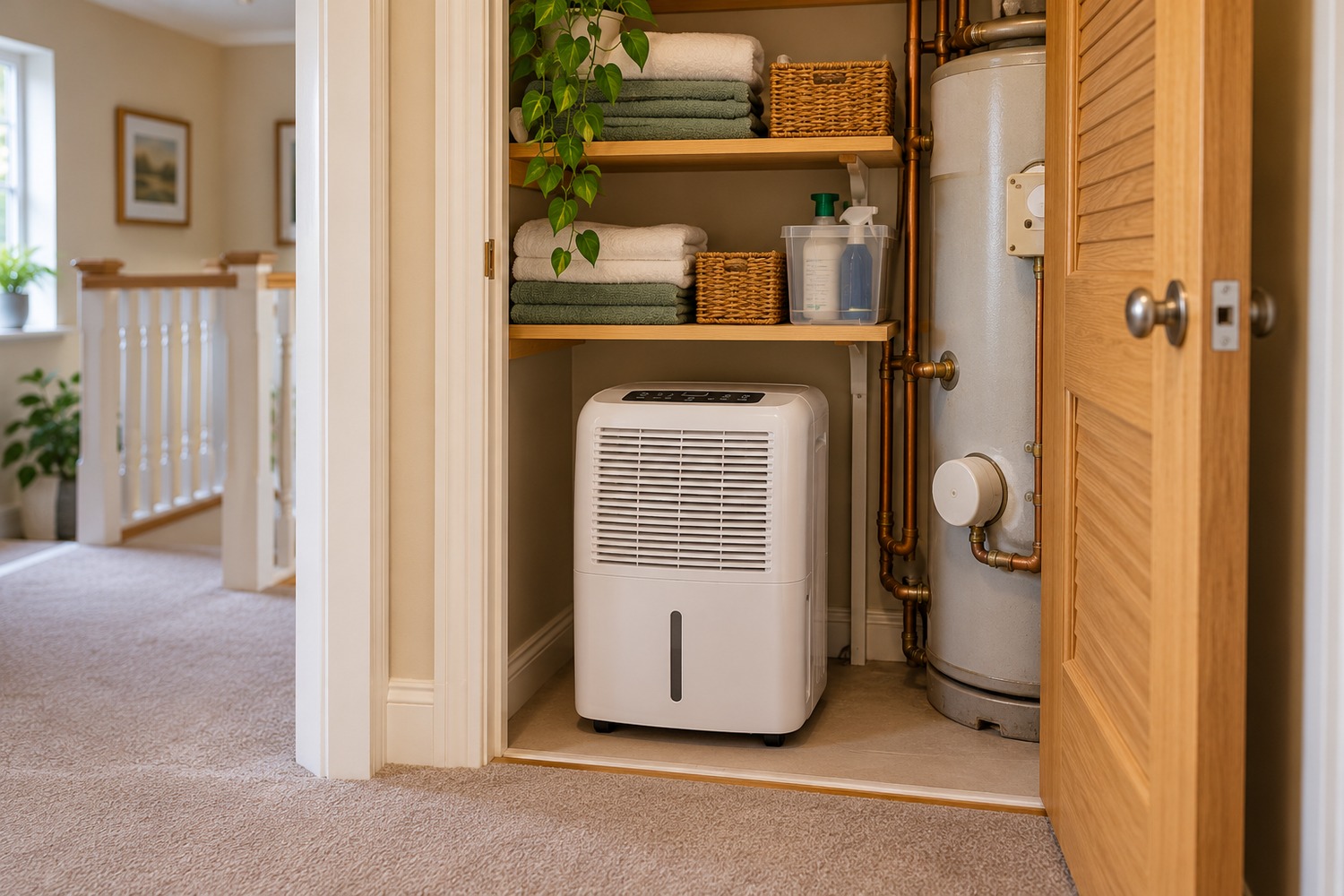
Usually, you shouldn’t run an ordinary room dehumidifier inside a small, closed airing cupboard. So if you’re wondering whether you can put a dehumidifier in an airing cupboard and safely run it, understand that most need free airflow around their inlet and outlet, and some manufacturers specifically prohibit use in broom cupboards, boiler rooms or other confined spaces. An airing cupboard containing a hot-water cylinder can also be warmer than the appliance’s permitted operating conditions.
That doesn’t mean every moisture-control product is unsuitable for every cupboard. The answer depends on the exact model, the size and ventilation of the space, nearby heat sources and its installation instructions. Don’t assume that a small dehumidifier is automatically safe in a small cupboard.
Quick answer: what kind of setup is it?
| Setup | Practical advice |
|---|---|
| Full-size dehumidifier in a shut, unventilated airing cupboard | Avoid. Airflow and heat build-up are major concerns. |
| Room dehumidifier close to a hot-water cylinder | Check the manual; many models prohibit proximity to heat sources. |
| Dehumidifier outside the cupboard, with the door open | Often a more sensible arrangement, subject to the model’s clearance instructions. |
| Specialist compact unit advertised for cupboards | Only use as specifically permitted by its instructions, including ventilation, electrical and room-size requirements. |
| Passive moisture absorber inside a cupboard | May suit minor dampness, but won’t match a powered room dehumidifier’s moisture-removal ability. |
Why can a dehumidifier be unsafe inside an airing cupboard?
A powered dehumidifier draws in moist air, processes it and releases drier air. It also produces heat during operation. If the air inlet or outlet is too close to clothes, shelves, walls or a closed door, the unit may not be able to circulate air as designed.
Electrical Safety First advises allowing free circulation around dehumidifiers, keeping their vents clear and following the manufacturer’s instructions. Its advice also warns against leaving a unit running unattended or overnight unless the maker explicitly says this is safe.
The instructions for some EcoAir dehumidifiers expressly say not to use them in confined locations such as broom cupboards, boiler rooms and unventilated areas. One EcoAir DD128 manual, for example, shows 40cm clearances around the appliance and warns against small confined spaces. Those measurements apply to that model, not to every dehumidifier.
What if the airing cupboard contains a hot-water cylinder?
A traditional airing cupboard may be warmed by a hot-water cylinder or associated pipework. That can make it useful for storing towels, but it isn’t necessarily a good environment for an electrical dehumidifier.
Many dehumidifiers have specified maximum operating temperatures. Placing one near a cylinder or pipework could expose it to extra heat, while shelves and stored laundry may restrict airflow. Some models expressly say to avoid heat sources.
Use a simple room thermometer to check the ambient temperature if you’re unsure. Even if the cupboard temperature falls within the appliance’s stated range, that alone doesn’t make an enclosed installation safe; clearance, ventilation and the manufacturer’s location restrictions still apply.
Can you leave the cupboard door open?
Opening the door may help air move between the cupboard and the room, but it’s not a substitute for following the manual. A room dehumidifier may still be too close to shelving or the hot-water cylinder, and an appliance standing among hanging towels can have its vents blocked.
A more practical option is often to position the dehumidifier in the adjacent room with enough clearance on every side and leave the airing-cupboard door open where appropriate. That allows moisture to move towards the appliance without squeezing it into a hot, confined space. Its effectiveness depends on the amount of airflow and where the moisture is coming from.
Will a dehumidifier dry washing inside an airing cupboard?
It might help in a setup expressly approved by the manufacturer, but a sealed airing cupboard isn’t automatically an efficient mini drying room. A dehumidifier needs circulating air, and wet clothes mustn’t obstruct the appliance or drip onto it.
If your aim is to dry washing indoors, a better option is often a clothes airer in a suitable room with the dehumidifier positioned nearby according to its instructions. Keep clothes a safe distance from the unit’s inlets and outlets, and don’t drape items over it.
Some room dehumidifiers have a laundry mode, but this changes how they operate; it doesn’t remove their ventilation or clearance requirements. A laundry setting doesn’t make the appliance suitable for a closed cupboard.
Would a small or mini dehumidifier be better?
Not necessarily. “Mini” describes size, not permission to operate in a closed space. Compact electric models still need the airflow and operating environment stated in their manuals.
Also consider the amount of moisture involved. A small electric unit may remove far less water than a typical household compressor or desiccant model. If you’re trying to dry a full load of wet washing, check the appliance’s actual extraction rating and permitted use rather than relying on its marketing name.
Passive moisture absorbers don’t need a mains connection, although they generally suit small-scale humidity problems rather than drying laundry. Follow their instructions and keep any chemicals or collected liquid away from children, pets and fabrics.
Does a compressor or desiccant model make a difference?
Yes, in terms of performance at different temperatures. Compressor or refrigerant dehumidifiers tend to work well in warmer conditions, while desiccant designs can perform better in cooler environments. However, desiccant machines also use heat in their drying process.
Neither type is automatically safe inside a cramped airing cupboard. The installation manual matters more than the dehumidifier technology. Electrical Safety First explains the two main types and recommends keeping air circulation unobstructed whichever you use.
How to decide whether your cupboard needs a dehumidifier
- Identify the moisture problem. Is the cupboard damp because of wet laundry, condensation, a leak or insufficient ventilation?
- Check for leaks first. Inspect visible pipework and the cylinder area safely; contact a plumber if there’s persistent water or unexplained dampness.
- Read the exact appliance manual. Look for restrictions on confined spaces, heat sources, minimum room size and required clearances.
- Measure the environment. Note the available floor space, temperature and whether shelves or clothes block airflow.
- Consider placement outside the cupboard. Where suitable, a room dehumidifier with open airflow may help manage moisture in adjoining spaces.
- Monitor humidity. A hygrometer can help establish whether the room is actually too humid and whether your approach is working.
If damp patches or mould persist, deal with the underlying cause. A dehumidifier can control moisture in the air, but it won’t repair a leaking pipe or stop water entering the building.
Electrical safety in a small cupboard
Never trap a dehumidifier’s power cable beneath furniture or use an unsuitable adaptor to reach a distant socket. Keep the unit stable and level, with its tank correctly fitted and enough space to remove it safely. Don’t put wet laundry over the appliance or allow water to drip into its vents.
Electrical Safety First recommends checking for damaged plugs, unusual heat, burning smells or repeated tripping. If any of those occur, switch the appliance off safely and have it checked. Its guidance also recommends RCD protection and keeping filters clean.
What should you buy instead?
If you’re trying to understand the moisture level, you can compare indoor hygrometers and thermometers on Amazon UK. If you want to dry clothes in an appropriate room, you can browse indoor clothes airers or look at dehumidifiers with laundry settings.
These are general shopping searches, not tested recommendations. Don’t buy a particular dehumidifier for enclosed-cupboard use unless its own instructions expressly approve your planned installation.
Frequently asked questions about Can you put a dehumidifier in an airing cupboard and safely run it.
Can I put a dehumidifier in an airing cupboard with the door shut?
For most ordinary room dehumidifiers, that’s a poor idea. A closed cupboard may restrict the airflow the unit needs and allow heat to build up. Only proceed if the specific product’s instructions clearly permit that setup.
Can I put a desiccant dehumidifier in the airing cupboard?
Being a desiccant model doesn’t make it suitable for an enclosed space. Check its manual for minimum room sizes, clearances and warnings about heat sources.
Will a dehumidifier stop towels smelling musty?
Reducing excessive humidity may help, but damp towels also need proper drying and the cupboard needs adequate ventilation. Wash affected items as appropriate and investigate leaks or persistent mould.
Can I put a mini dehumidifier on a shelf?
Only if the unit’s manufacturer approves shelf placement, the surface is stable and its clearance, drainage and electrical requirements are met. Don’t balance powered appliances above stored fabrics.
Should I use a dehumidifier overnight in the cupboard?
Electrical Safety First advises against running a dehumidifier overnight or while away unless its manufacturer states that unattended operation is safe. That caution is even more important if the location itself isn’t approved.
What humidity should an airing cupboard be?
There isn’t one universal target specifically for airing cupboards. For general indoor conditions, many households aim to control persistent high humidity, but readings vary with temperature and how the space is used. A hygrometer can help you judge the situation; investigate condensation or damp sources rather than chasing one number.
Bottom line
Don’t run a conventional dehumidifier in a small, closed airing cupboard unless the manufacturer explicitly permits it. Heat from the cylinder, obstructed vents and restricted air circulation make that setup problematic for many models. For drying washing, a suitable room with a clothes airer and properly positioned dehumidifier is usually more practical. If your cupboard stays damp, investigate the underlying cause as well.
Sources and further reading
- Electrical Safety First — Dehumidifier electrical safety advice
- EcoAir — DD128 dehumidifier manual (PDF), including restricted-space warnings
- Meaco — Dehumidifier positioning and household airflow
- DIYnot — Homeowner discussion about drying clothes in a cupboard
Disclosure: Progressive Housewares may earn a commission from qualifying purchases through affiliate links, at no additional cost to you. We haven’t tested the products linked in this article.