
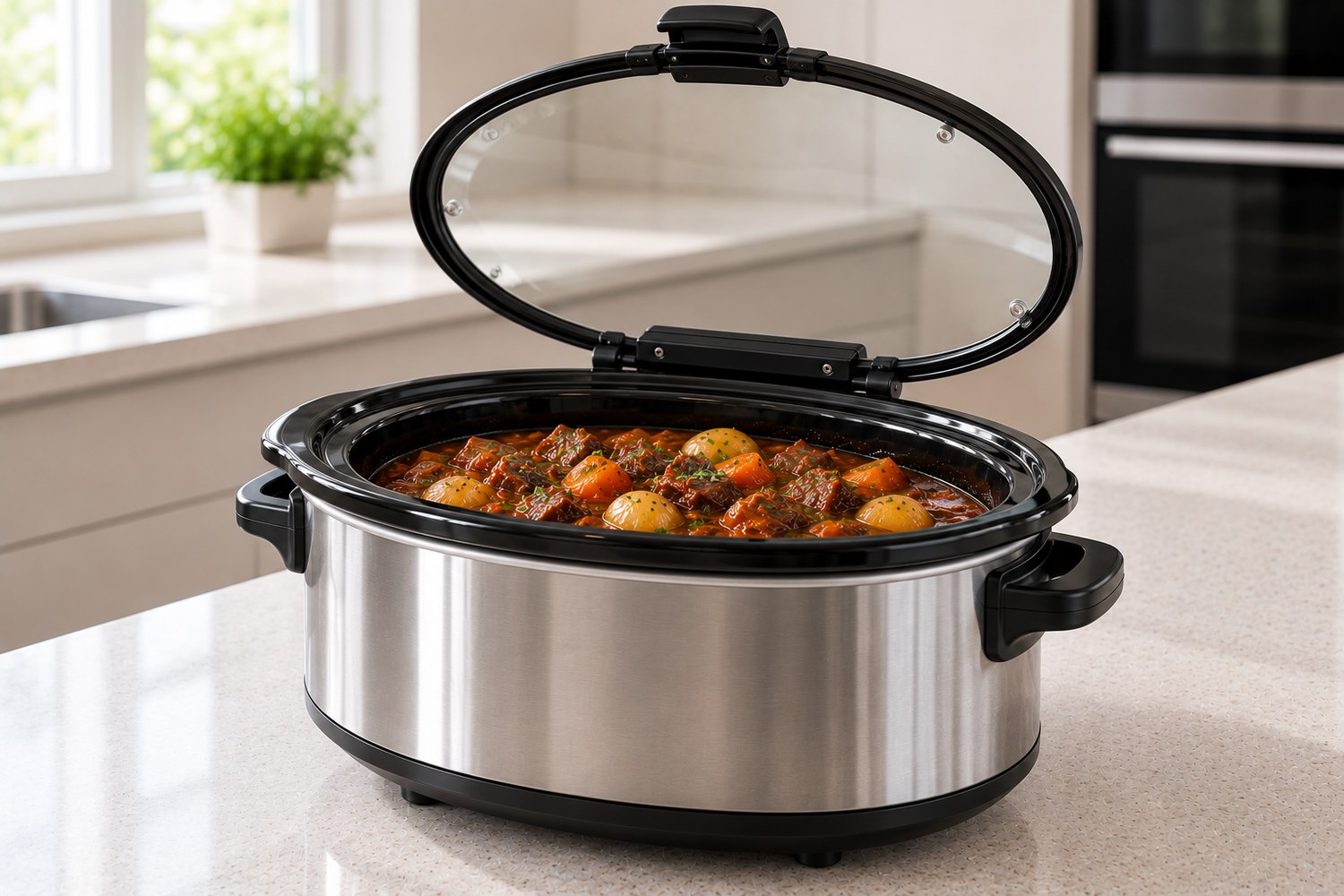
Are hinged lid slow cookers any good? They can be a smart choice if you regularly lift the lid to serve casseroles, soups or stews and want to avoid putting a wet glass lid on the worktop. A hinge holds the lid open, and on some models condensation runs back into the bowl. However, hinged lids can make cleaning and removing the insert more awkward, and they do not automatically make a cooker leakproof or better at cooking.
The best option depends on your kitchen space, whether you travel with food, and how often you serve straight from the appliance. This UK guide compares hinged, loose, sealed and lockable lids without confusing their different purposes.
What Is a Hinged Lid Slow Cooker?
A hinged slow cooker has a lid attached to a pivot or bracket, so it opens upwards and stays supported instead of being lifted away and placed elsewhere. Some hinges attach to the cooker housing, while others form part of a lid-and-bowl arrangement. Many designs still allow removal for washing, but that depends on the model.
A traditional slow cooker has a loose glass lid that simply rests on the rim. Both types are designed for moist, gentle cooking. The hinge primarily changes serving convenience, not the fundamental cooking method or food temperature.
Are Hinged Lid Slow Cookers Any Good for Everyday Meals?
The strongest argument for a hinge is that it frees a hand while you ladle out dinner and prevents a wet lid being left on a crowded worktop. This is useful when serving directly from the crock, especially if guests or children are gathering around the table.
UK reviewers have noticed the same trade-off. BBC Good Food’s Crock-Pot Lift & Serve review praised the hinged lid for returning condensation to the bowl but noted a burst of steam on opening and the fiddly process of reconnecting the removable lid. It is a convenience feature rather than an essential requirement for a good stew.
A hinge is less helpful if you always transfer food to plates in the kitchen and put the removable bowl in the sink immediately afterwards. For general buying priorities, our UK slow cooker buying guide covers capacity, controls, materials and cleaning.
What Slow Cookers Have Hinged Lids?
Crock-Pot is one of the best-known examples in the UK. Its 5.7-litre hinged-lid model CSC031 is presented by the manufacturer as a family and entertaining cooker, with a removable dishwasher-safe pot and Low, High and Keep Warm settings. The hinged lid stays raised for serving.
Another example is the Crock-Pot CSC038 DuraCeramic Sauté with Hinged Lid. Its manufacturer describes a 4.5-litre bowl with a coating and hob compatibility, including induction, plus a hinged lid. The commonly reviewed 4.7-litre Lift & Serve digital model is another example, although availability and specifications can change.
These illustrate different combinations of features rather than a ranking or an assurance that each is currently stocked. Compare the precise model code, lid mechanism, capacity and current manual, as similarly named products can have different controls.
Is a Slow Cooker With Hinged Lid Better?
It is better for convenience if the hinge works smoothly, has room to open and does not get in the way of handling the pot. It is not necessarily better for a small kitchen with low overhead cupboards or for someone who prefers an entirely detachable lid.
A hinge also adds a fitting to clean and potentially another component that can wear or break. Mumsnet’s UK hands-on review identifies the Lift & Serve lid as useful but a little awkward when removing the bowl; the lid also increases the appliance’s height while open.
When deciding, measure the clearance above your worktop with the lid fully upright, not just the closed height listed on the box. A regular glass lid may be easier to store flat or replace if it becomes damaged.
Which Slow Cookers Have a Secure Lid?
The phrase secure lid is vague. It can mean a hinged lid that stays attached during serving, a heavy glass lid that sits steadily on the rim, or a latching lid designed to reduce spillage during transport. Those are different features.
For normal countertop cooking, a well-fitting removable lid may be all you need. If you carry cooked meals to a family gathering, investigate models specifically described as having a travel or locking lid. Read the manufacturer’s directions on when the latch can be used: a transport latch should not be assumed suitable for locking during heating.
What Slow Cooker Has a Sealed Lid?
Most ordinary slow cookers are not hermetically sealed, even when their lids appear to fit closely. They cook at normal atmospheric pressure and allow some steam to escape. Condensation gathering under the lid is expected, and it is not evidence of a pressure-tight seal.
A gasket or silicone edge may help reduce splashes or leakage, especially in transport-oriented designs, but it does not turn a conventional slow cooker into a pressure cooker. If a product claims a sealed lid, examine what exactly is sealed, whether the seal is for storage or cooking, and how it should be cleaned.
What Slow Cooker Has a Lockable Lid?
Some travel-oriented slow cookers have clips or latches that secure the lid to the bowl. Others use hinged lids without a locking mechanism. The words hinged and lockable are not synonyms, so check the photos and instructions rather than assuming one feature includes the other.
A lid lock can be helpful when transporting cooled food in an appropriate container or carrying a properly handled cooker, but it is not a substitute for food safety or careful movement. Never carry a full hot cooker by its lid handle unless the manufacturer explicitly designs it for that purpose. Follow its transport and cooling instructions.
Why Put a Tea Towel Under the Lid of a Slow Cooker?
Some home cooks place a clean tea towel between the lid and bowl in an attempt to absorb condensation, often when preparing cakes or bread. The idea is that steam condenses on the lid, and moisture dripping back down can leave the top of a baked item soggy.
However, putting cloth near a heated electrical appliance introduces a fire and handling concern, particularly if fabric extends over the exterior, touches a hot element or interferes with lid closure. Do not improvise this method unless your manufacturer’s instructions explicitly permit it and explain how to do it safely. Electrical Safety First’s UK slow cooker guidance emphasises using a heat-proof surface, leaving clearance and following the manufacturer’s instructions.
A hinged lid already helps manage drips when opened, but it does not prevent all condensation during cooking. For a wetter-than-expected bake, use a recipe developed for your cooker and its approved cooking method instead of inserting fabric beneath the lid.
What to Use Instead of a Slow Cooker Lid?
If the original lid is broken or missing, the safest choice is a manufacturer-approved replacement made for that exact slow cooker model. It needs to fit correctly so cooking heat and moisture behave as the recipe expects. A random saucepan lid might not sit securely or match the necessary dimensions.
Avoid substituting cling film, tea towels, foil tied around the housing or any improvised item that could touch electrical parts or cause a burn. If no compatible lid is available, ask the manufacturer about replacement options or replace the appliance. Do not run it routinely with the lid missing, since cooking performance can change significantly.
Are Hinged Lids Easier to Clean?
They can reduce mess during serving, but the hinge may trap drips or food residue. Check whether the glass lid detaches easily and whether both the lid and insert are dishwasher-safe. A dishwasher-safe bowl does not mean the electric base or hinge assembly belongs in the dishwasher.
Allow all parts to cool before washing and inspect any silicone seals for residue. The manufacturer’s instructions take priority over general advice. Our guide to dishwasher-safe slow cooker parts explains why lids, inserts and powered housings require different care.
Does the Lid Shape Change Cooking Results?
A properly fitting lid helps retain moisture and heat, whether it is hinged or loose. Opening either design releases steam, and frequent lifting can lengthen cooking time. Hinges may channel condensate back to the dish when opened, but that does not guarantee a more tender joint or a thicker sauce.
Capacity, heating performance, ingredient size and cooking duration still matter more. Our oval versus round slow cooker guide explains how bowl shape affects ingredient fit without confusing it with lid design.
Is a Hinged Lid Worth It for Family Meals?
If several people serve themselves from the cooker, the supported lid is convenient and reduces the need to find somewhere to put hot, wet glass. Families who batch cook may also appreciate a large removable bowl, but larger ceramic inserts can be heavy to lift and wash.
Look for practical capacity before prioritising the lid. A compact hinged cooker cannot magically feed six people, and a family-size cooker may take more storage space than you expect. Check our standard UK slow cooker size guide for capacity comparisons.
Frequently Asked Questions
Does a Hinged Lid Make a Slow Cooker Safer?
It can make serving more convenient by keeping the lid attached, but steam and hot glass still present burn risks. It does not replace supervision, safe placement, or the manufacturer’s instructions.
Can a Hinged Lid Slow Cooker Go Under Kitchen Cupboards?
Only when the manufacturer allows suitable clearance, including enough space for the lid to open fully. Steam must not be directed onto cupboards or people. Move the cooker to an appropriate worktop position before use.
Can You Replace a Broken Hinged Slow Cooker Lid?
Sometimes. Check the exact model number and ask the manufacturer for a compatible replacement assembly. Do not force a different hinge or lid onto the housing.
Is a Locking Lid the Same as a Hinged Lid?
No. A hinge holds the lid while it opens; a lock secures it shut. Some models have both, but many have only one of these features.
Final Verdict: Are Hinged Lid Slow Cookers Any Good?
So, are hinged lid slow cookers any good? Yes, particularly if you are tired of finding somewhere to put a dripping lid. The design can make serving neater and easier, especially for family dinners, but it is not essential for good slow-cooked food. Choose a hinged model if you value tidy serving and have enough space for the lid to open; otherwise a conventional removable lid remains a practical option.