
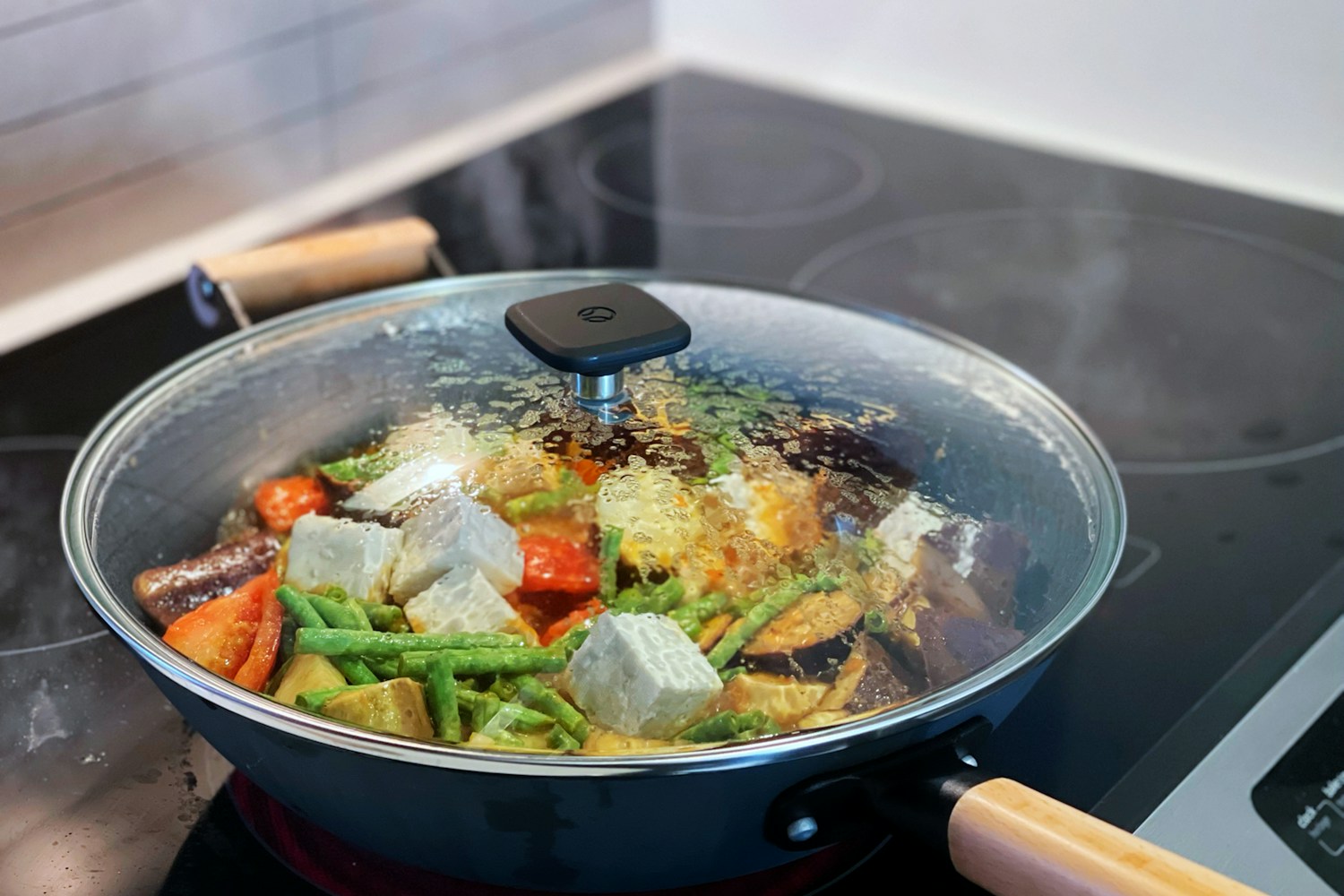
A flat-bottomed wok with a smooth, stable cooking base is the best choice for a conventional electric ceramic hob. A good flat-bottomed carbon-steel wok can work, provided its maker approves it for glass-ceramic hobs. A heavy-based, ceramic-hob-compatible non-stick stir-fry pan is another practical option if you want easier maintenance. Avoid traditional round-bottomed woks and wok rings: they don’t make proper contact with a flat ceramic heating zone.
If you’re buying your first wok for a ceramic hob, the detail to look for isn’t simply ’30cm wok’. It’s the diameter and flatness of the actual cooking base, plus an explicit statement that the wok is suitable for ceramic hobs.
Which type of wok should you buy?
| Type of wok | Suitable for a ceramic hob? | Main consideration |
|---|---|---|
| Flat-bottomed carbon steel | Often, if the manufacturer approves it | Good wok shape, but usually needs seasoning and careful drying |
| Flat-bottomed coated non-stick wok | Yes, when labelled ceramic-hob compatible | Easy cleaning, but coating temperature limits apply |
| Heavy-based stainless steel stir-fry pan | Usually, if suitable for ceramic hobs | Durable; check how well the base distributes heat |
| Enamelled cast iron wok | May be suitable if approved | Heavy and potentially awkward on glass; lift rather than slide |
| Round-bottomed traditional wok | Not suitable for a flat ceramic hob | Very little contact with the heating element |
| Round-bottomed wok on a support ring | Not recommended | Unsafe or inefficient on a glass-ceramic surface |
These are material and shape guidelines, not promises about individual products. Beko’s ceramic-hob guidance recommends thick, smooth cookware bases and warns that exposed aluminium or copper can leave marks on glass-ceramic surfaces. Always check your own hob’s manual because accepted materials and sizes vary.
Why does a ceramic hob need a flat-bottomed wok?
A conventional electric ceramic hob heats the cooking zone underneath the glass. Heat then passes into the cookware where its base contacts the surface. A traditional rounded wok touches the glass across only a small area, so it won’t take up heat evenly or efficiently.
A flat-bottomed wok offers a broad area of contact and stands securely without extra equipment. Rangemaster’s guidance for ceramic hobs specifically calls for thick, smooth, flat cookware bottoms and says not to use a round-bottomed wok, even with a stand. Rangemaster’s ceramic cooker instructions explain that point.
A wok ring that’s designed for a gas burner isn’t a workaround. Resting a round-bottomed wok above a flat ceramic zone gives poor heat transfer and may create stability or overheating problems.
Is carbon steel the best wok material for a ceramic hob?
Flat-bottomed carbon steel is an appealing choice if you want traditional wok handling and don’t mind maintaining the seasoning. It’s generally lighter than cast iron and responds more readily to changes in heat than a very heavy pot. However, that doesn’t make every carbon-steel wok suitable for every ceramic hob.
Look for a broad, flat base, a level finish and explicit compatibility with a glass-ceramic hob. Some inexpensive carbon-steel woks have relatively small flat bases or may warp if overheated. A warped base that rocks on the glass can make stir-frying frustrating.
Uncoated carbon steel also needs the correct seasoning and aftercare. Follow the manufacturer’s instructions for initial cleaning, seasoning and drying. Don’t assume you should heat an empty wok at maximum power on a ceramic hob, especially when your hob or the cookware maker warns against doing so.
Would a non-stick wok be easier?
For everyday family stir-fries, a ceramic-hob-compatible non-stick wok or deep stir-fry pan may be the simpler purchase. You can use less oil for certain dishes, and the coating generally makes cleaning easier.
The trade-off is heat tolerance. Many non-stick coatings shouldn’t be taken to the very high temperatures sometimes associated with traditional wok cooking. Follow the pan’s stated limits, avoid prolonged empty preheating and use utensils appropriate for the coating.
If you mainly cook noodles, vegetables, rice and saucy stir-fries at home, a good non-stick stir-fry pan may be entirely adequate. If you enjoy seasoning cookware and want an uncoated cooking surface, flat-bottomed carbon steel is worth considering instead.
What about stainless steel or cast iron?
A good stainless-steel stir-fry pan can be durable and easy to maintain, particularly if it has a thick, heat-spreading base. Thin stainless steel, however, can develop hot spots. Look for a substantial base and a stable shape rather than buying solely on the material name.
Cast iron retains heat well but is heavy, especially when full of food. An approved smooth enamelled cast-iron wok may work on ceramic, but be careful when moving it: dragging rough or heavy cookware can scratch the glass. Beko notes this risk in its advice on pans for ceramic hobs.
What size wok should you get for a ceramic hob?
Many home woks are advertised at around 28–32cm across the top. That number doesn’t tell you how much of the wok touches the hob. A 30cm wok might have a relatively small flat bottom, while a deep stir-fry pan with the same advertised width could have a broader base.
Before ordering, check the flat base diameter against the cooking zone on your hob. Manufacturers generally recommend a good match to the zone size for efficient heating. If the flat base is much smaller than the zone, you can waste heat; if the pan’s base is much larger, the outer area may heat more slowly.
For a compact ceramic hob, it can be better to buy a well-matched 28cm wok than a very large 34cm one with an unsuitable base. Don’t invent a universal rule such as ‘every 30cm wok fits an 18cm ring’ — base shapes vary, as do hobs.
Does a ceramic hob need an induction-compatible wok?
No, not necessarily. A conventional radiant ceramic hob and an induction hob can both have smooth glass surfaces, but they heat pans differently.
A radiant ceramic hob uses an electric element beneath the glass to transfer heat into suitable cookware. An induction hob uses a magnetic field and normally requires a suitable magnetic base. A wok labelled induction-compatible may also work on ceramic, but you should still check ceramic-hob suitability and base shape.
Conversely, a wok may be perfectly acceptable on a radiant ceramic hob without having the magnetic base necessary for induction. If you’re not sure which hob you’ve got, check the appliance’s model number or manual rather than guessing from the surface.
Can you get proper stir-fry heat on a ceramic hob?
You can make excellent everyday stir-fries, but a flat electric ceramic hob behaves differently from a powerful gas wok burner. Its temperature may change more slowly, and the sloping sides of the wok won’t be heated as intensely as they would over a large flame.
A few adjustments help: prepare ingredients before you start, allow a suitable pan to heat according to its instructions, and cook in smaller batches rather than piling cold food into the wok. Crowding tends to cool the surface and turn frying into steaming.
Don’t compensate by leaving an empty wok at maximum power for an extended period. That can damage some cookware and hob surfaces. For certain dishes, a wide, heavy-based frying pan may actually give you a larger, more evenly heated cooking surface than a narrow-based wok.
How do you avoid scratching a ceramic hob with a wok?
- Choose a smooth, flat base. Avoid rough, damaged or warped bottoms.
- Lift the wok rather than sliding it. This matters particularly with cast iron and heavy cookware.
- Keep the base clean and dry. Salt, grit and burnt-on residue trapped underneath can mark the glass.
- Don’t use a wok ring. A gas-hob accessory isn’t appropriate for an ordinary flat ceramic zone.
- Follow the hob maker’s cookware advice. Some manuals have material-specific restrictions, including cautions about exposed aluminium and copper.
Wait until the hob is safe to clean, then use products suitable for the surface. Ceramic zones can remain dangerously hot after being switched off.
What to look for before buying
| Feature | What to check |
|---|---|
| Bottom shape | Flat, smooth and stable |
| Hob rating | Explicitly suitable for radiant ceramic or glass-ceramic hobs |
| Base diameter | Close to the size of a usable hob cooking zone |
| Material | Carbon steel, approved non-stick or heavy-based stainless steel according to preference |
| Handles | Secure, comfortable and suitable for lifting a loaded wok |
| Care | Seasoning requirements or coating temperature limits |
| Price | Plenty of potential options around £25–£70, depending on construction |
You can browse flat-bottomed carbon-steel woks on Amazon UK or compare ceramic-hob-compatible non-stick woks. If you’re after a broader, flatter base, look at heavy-based stir-fry pans.
These are general shopping searches, not products we’ve tested. Check the individual listing’s hob compatibility, actual base dimensions, coating care and returns policy before ordering. Don’t assume every result returned by a search is suitable.
Frequently asked questions on what type of wok works on a ceramic hob
Can you use a traditional round-bottomed wok on a ceramic hob?
Not on a normal flat glass-ceramic hob. It makes poor contact with the heating surface, and a support ring intended for gas cooking isn’t an appropriate fix.
Can you use a carbon-steel wok on a ceramic hob?
Often, yes, if it has a suitable flat, smooth base and the manufacturer approves use on glass-ceramic hobs. Follow seasoning and temperature guidance.
Are ceramic and induction hobs the same?
No. Both can have smooth glass surfaces, but radiant ceramic hobs heat a zone beneath the glass, while induction hobs require a compatible magnetic cooking base.
Will a 30cm wok fit an 18cm ceramic ring?
Possibly, but the important measurement is the wok’s flat base, not its top rim. Compare the base diameter with the hob maker’s recommended cooking-zone size.
Is non-stick or carbon steel better for stir-frying on ceramic?
Choose an approved non-stick stir-fry pan for easier cleaning and lower-maintenance cooking. Choose a suitable flat-bottomed carbon-steel wok if you prefer uncoated cookware and are happy to maintain its seasoning.
Do you need a special wok for a ceramic hob?
You don’t need an expensive special model, but you do need a wok with a flat, stable base that’s explicitly suitable for the hob. Avoid assuming that a wok designed for gas will automatically work.
Bottom line
Buy a flat-bottomed wok explicitly approved for ceramic hobs. For a more traditional option, look at suitable carbon steel; for straightforward weeknight cooking, an approved heavy-based non-stick stir-fry pan may be easier. The critical checks are a smooth flat base, a sensible match with the hob’s heating zone and care instructions you can actually follow. There’s no need to spend over £100 to find a practical option.
Sources and further reading
- Rangemaster — Ceramic cooker user guide, including wok advice
- Beko — Cookware suitability for ceramic hobs
Disclosure: Progressive Housewares may earn a commission from qualifying purchases through affiliate links, at no additional cost to you. We haven’t tested the products linked in this article.