
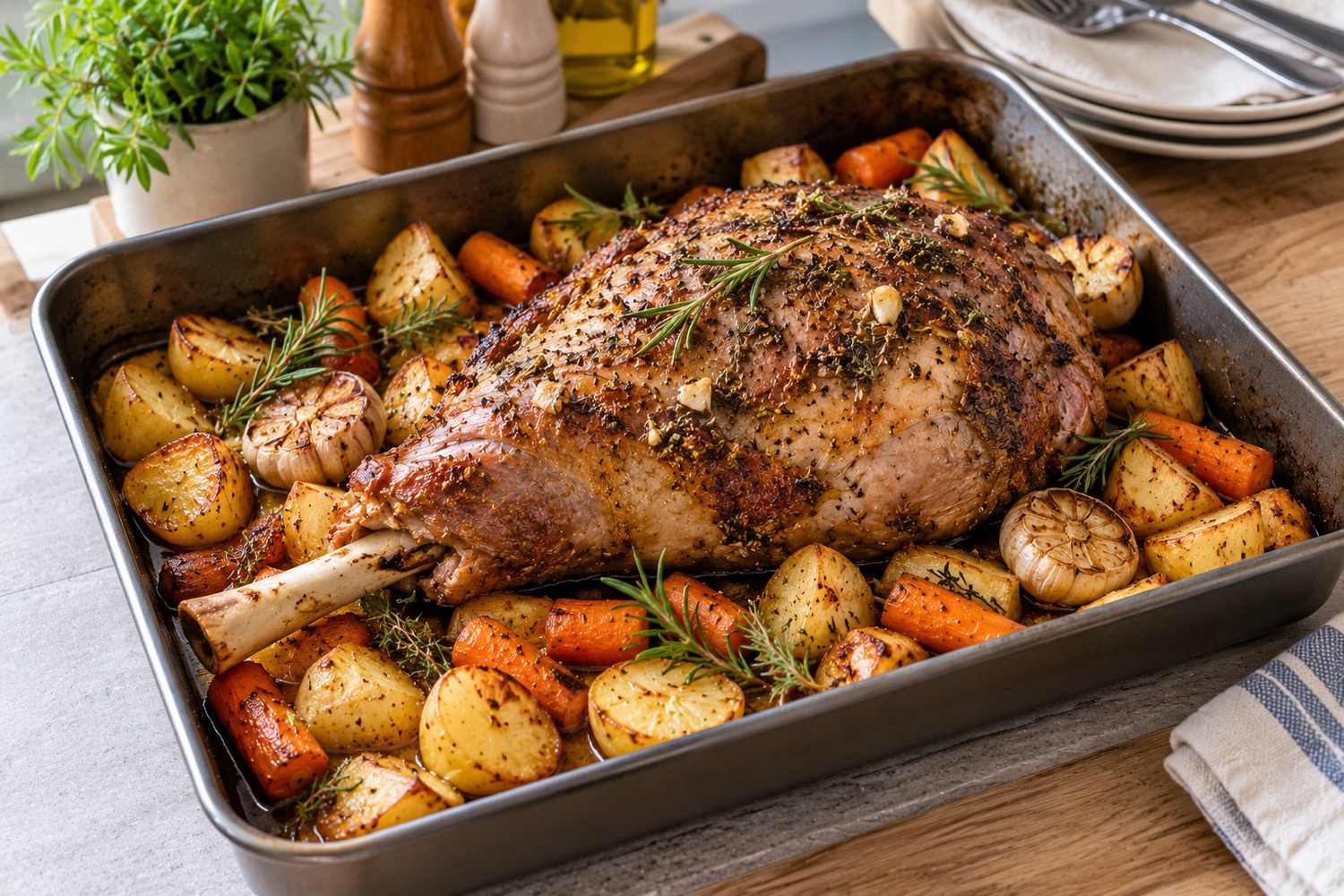
For a 1.5kg leg of lamb, start by looking at roasting tins with an internal cooking area around 35 × 25cm to 40 × 30cm. That isn’t a guaranteed fit: a bone-in leg can be much longer than a rolled boneless joint of the same weight. Measure the joint’s footprint, allow a little room around it, and check the tin fits inside your oven.
If you’d like to roast potatoes and other vegetables alongside the lamb, a roomier tin or a separate baking tray will usually be more practical.
Roasting tin sizes for a 1.5kg leg of lamb
| Approximate internal tin dimensions | Suitability | What to check |
|---|---|---|
| 30 × 20cm | Potentially cramped | May suit a small, compact boneless joint only |
| 35 × 25cm | Useful starting point | Measure length of the bone-in joint carefully |
| 40 × 30cm | Roomier option | More space for cooking juices and a few vegetables |
| 45 × 35cm | Large | Could suit a joint plus vegetables, but check oven fit |
These are practical sizing suggestions, not a standard based on lamb weight. A tray marketed as 40 × 30cm may measure that across its outside rim, while the actual flat base is smaller.
Does a bone-in leg need a larger roasting tin?
Often, yes. A bone-in leg may have a longer, irregular outline and an exposed shank, while a rolled boneless joint is usually more compact. Two joints both weighing 1.5kg can therefore need different amounts of space.
Put the joint on a clean board and measure its length and width at the widest points. Allow a few centimetres around the meat rather than choosing a tin that only just contains it. You’ll want room to handle the joint safely and collect roasting juices.
How to measure a roasting tin correctly
- Measure the usable base. Sloping sides can make the bottom of the tin narrower than its top rim.
- Check the complete outside size. Include handles when seeing whether it’ll fit in your oven.
- Consider depth. The sides need to hold the expected cooking juices and any added liquid without spilling.
- Check the oven’s instructions. Leave the clearance recommended around cookware and don’t obstruct airflow.
- Think about removing the roast. You should have enough room to lift the joint without tipping a hot, crowded tin.
If the lamb’s footprint is roughly 29 × 17cm, for example, a tin with a 35 × 25cm internal base would leave around 3cm at each end and 4cm at each side. That’s a worked example rather than a prediction of your joint’s actual size.
Is a 35 × 25cm roasting tin big enough?
It may be. A compact rolled 1.5kg joint could fit comfortably, while a long bone-in leg could reach the ends of the tin. Measure the meat before deciding. If there’s barely any space for juices, a bigger tin is worth considering.
What if you’re adding roast potatoes?
A 40 × 30cm tin may provide extra space for some potatoes and onions, depending on the lamb’s dimensions. But crowding everything together can stop vegetables browning as you’d like. If you’re making a full family roast, using a second oven tray is often easier than buying one enormous roasting tin.
Don’t choose a tray so large that it blocks the oven’s recommended airflow or can’t sit securely on a shelf.
Does the roasting tin need a rack?
No, not always. Some recipes cook lamb directly in the tin, perhaps on a bed of vegetables. A roasting rack can lift it above the juices, but it also increases the height of the joint inside the oven. Make sure the rack’s compatible with the tin and doesn’t put the meat too close to the top heating elements.
Which roasting tin material should you buy?
Stainless steel is durable, and some stainless-steel tins are suitable for making gravy directly on the hob. Enamelled steel is another robust option. Non-stick tins may be easy to wash but can have limits on temperature and utensil use.
Check the product’s actual oven-temperature rating and hob compatibility. Never assume a roasting tin is safe on a burner just because it’s metal.
Where can you buy the right size?
You can browse roasting tins around 35 × 25cm on Amazon UK, or compare 40 × 30cm models if you’d prefer extra space. Confirm the internal base dimensions, depth, handles and oven compatibility on the actual product listing.
Frequently asked questions on what size roasting tin do you need for a 1.5kg leg of lamb
Is a 30 × 20cm tin too small for 1.5kg lamb?
It may be, particularly for a long bone-in leg. A compact rolled joint might fit, but you should measure it and leave some room around the meat.
Can I use a glass roasting dish?
You can use an oven-safe glass dish if its dimensions suit the joint and you follow the manufacturer’s temperature and handling instructions. Don’t put ordinary glassware into the oven or expose ovenproof glass to sudden temperature changes contrary to its instructions.
How deep should the tin be?
Choose sides deep enough for juices and any liquid required by your recipe. The ideal depth depends on your cooking method; you don’t always need a deep casserole dish for roasting.
Can I roast a 1.5kg leg of lamb in a large oven tray?
Yes, if it’s oven-safe, stable, large enough for the joint and has sides that adequately contain the juices. Check the oven’s shelf capacity and airflow guidance too.
How long should I cook a 1.5kg leg of lamb?
Cooking time varies with the cut, whether it’s bone-in or boneless, oven temperature and the result you want. Follow a reliable recipe and check the centre with a suitable meat thermometer rather than judging doneness from the roasting tin’s size.
Bottom line
A 35 × 25cm roasting tin is a sensible place to start for a 1.5kg leg of lamb, while 40 × 30cm gives you more flexibility. The actual fit depends on the joint’s length and shape, the tin’s internal base and your oven’s available space. Measure those three things before buying.
Further reading
- Which? — How to roast a leg of lamb
- Independent recipe — A 1.5kg roast leg of lamb
- What Size Air Fryer Do You Need for 2 People?
Disclosure: Progressive Housewares may earn a commission from qualifying purchases through affiliate links, at no additional cost to you.