
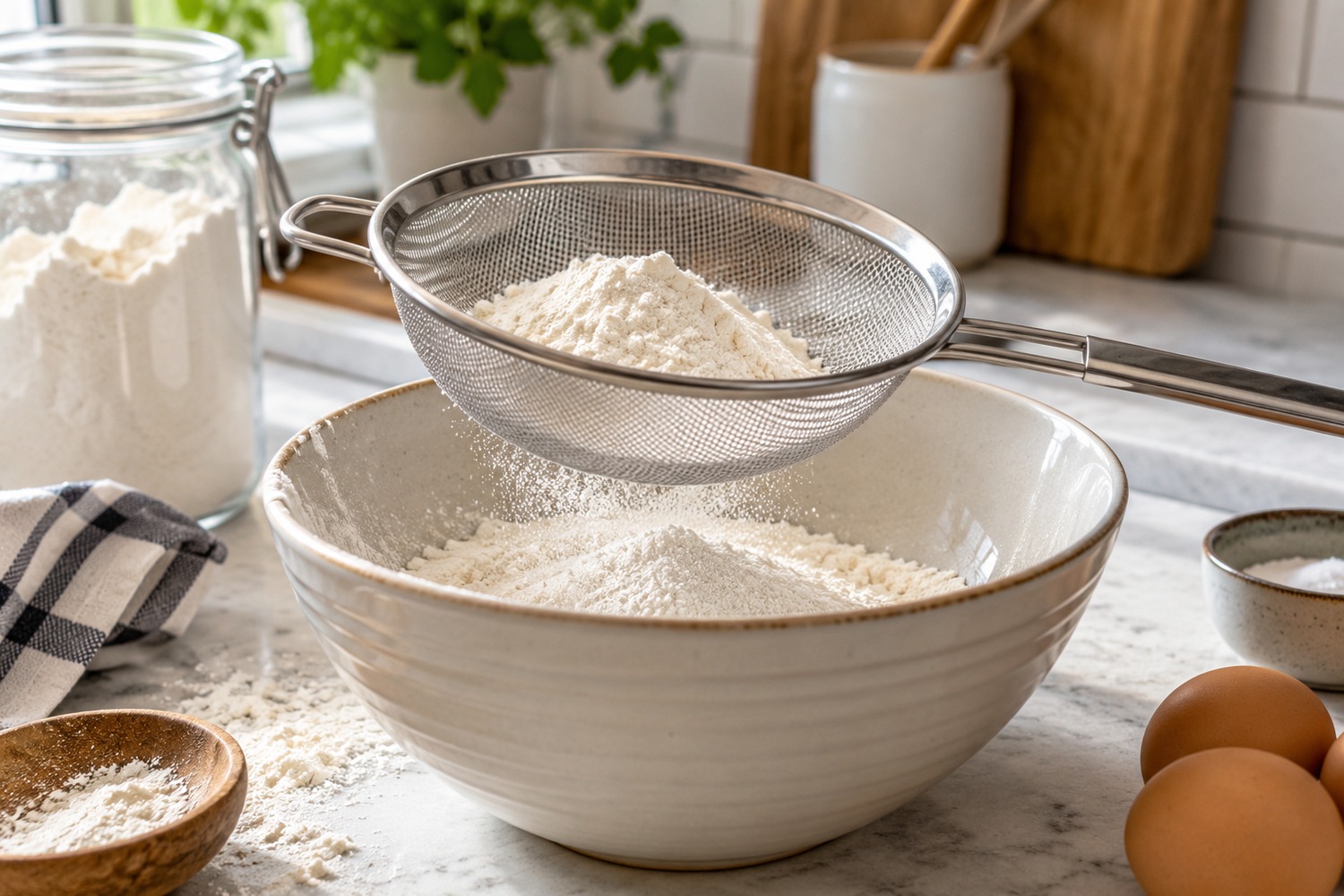
For sifting 500g of ordinary baking flour, an 18–20cm diameter fine-mesh sieve is a sensible starting point. It’s large enough to work comfortably over a mixing bowl without taking up too much cupboard space. You don’t have to fit all 500g into the sieve in one go: sifting in two or three batches is often easier and makes less mess.
The right choice also depends on what you’re sifting. When thinking about what size sieve do you need for 500g of flour, keep in mind that removing lumps from shop-bought plain flour isn’t the same job as separating bran from freshly milled wholegrain flour. For the second task, the mesh size can matter more than the sieve’s diameter.
What diameter sieve works for 500g of flour?
| Sieve diameter | Use for 500g flour | Practical consideration |
|---|---|---|
| 10–12cm | Possible in several small batches | Can be slow and awkward for a large recipe |
| 15–16cm | Suitable for occasional baking | Expect to work in batches |
| 18–20cm | Good all-round starting point | Comfortable for common home-baking quantities |
| 23–25cm | Useful for frequent or larger batches | Needs a wide bowl and more storage space |
These are practical recommendations rather than strict capacity limits. Two 20cm sieves might have very different depths, handles and mesh openings.
Does a sieve need to hold all 500g at once?
No. You can add around a third or half of the flour, sift it into your mixing bowl, then repeat. If you overload a shallow sieve, flour can spill over the rim when you shake or tap it.
Working in smaller batches is especially sensible if you’re mixing self-raising flour with another dry ingredient, such as cocoa powder, and want to sift them together.
How fine should the mesh be?
For ordinary plain flour, self-raising flour and icing sugar, a kitchen sieve described as fine mesh will generally work. You don’t need a specialist laboratory screen for everyday baking.
Freshly milled wholemeal flour is different: bakers sometimes use numbered mesh screens to remove some bran. In a discussion on The Fresh Loaf, a baker reported that a 50-mesh screen passed flour much faster than a 60-mesh screen when sifting 500g batches. That observation concerns home-milled flour, not an essential rule for ordinary supermarket flour.
If you’re buying for bran separation, find guidance for your particular flour and desired result rather than assuming the finest available mesh is always best.
Is an 18cm sieve big enough for 500g of flour?
Yes, for home baking, provided you’re happy to sift in batches. An 18cm sieve can be relatively easy to hold above a mixing bowl and store after use. Specialist flour sieves are sold in this diameter, although their exact mesh specifications vary.
If you bake several loaves at a time or regularly sift large batches, a wider 20–25cm sieve could feel more convenient.
How to sift 500g of flour without making a mess
- Choose a bowl wider than the sieve. Make sure the sieve sits comfortably above it or can be held securely.
- Weigh out the flour. Use kitchen scales rather than relying on cup conversions if your recipe specifies grams.
- Add part of the flour. Don’t heap a shallow sieve right to its rim.
- Shake or tap gently. Let the flour fall into the bowl. A spoon can help break up soft lumps without damaging the mesh.
- Repeat until you’ve sifted the full amount. Check the recipe before discarding anything left in the sieve.
If you’re working with flour you’ve milled yourself, retained bran may be part of the intended process. For ordinary packaged flour, small lumps usually break apart as you sift.
Do you actually need to sift 500g of flour?
Not necessarily. Modern commercially milled flour is generally fine enough for plenty of recipes without sifting. King Arthur Baking notes that sifting can still help break up lumps, aerate flour and make it easier to incorporate into delicate mixtures.
If your recipe specifically tells you to sift the flour, follow that instruction. If it simply says to add 500g of flour, you may not need a sieve at all. In particular, pay attention to whether a recipe says to weigh flour before or after sifting when quantities are given by volume.
Is a flour sifter better than a regular kitchen sieve?
A dedicated flour sifter often has a cylindrical body with a handle or trigger mechanism. It can be convenient, but you don’t need one just for 500g of flour. A good fine-mesh sieve is versatile: you can also use it for icing sugar, cocoa powder and straining suitable ingredients.
Think about how easy it is to clean and store, and whether you’ll comfortably hold it for the time needed. A sieve with a stable rim or support hooks may rest over a mixing bowl, leaving one hand free.
Where to buy a suitable flour sieve
You can browse 20cm fine-mesh kitchen sieves on Amazon UK or compare 18cm flour sieves. Check the mesh, depth, handle design and whether the product is suitable for food use and easy cleaning.
These are general Amazon shopping links, not individually tested product recommendations.
Frequently asked questions on what size sieve do you need for 500g of flour
Can you sift 500g of flour through a 15cm sieve?
Yes. It’ll usually be easier in several smaller batches rather than trying to load the sieve all at once.
Is a 20cm sieve big enough for bread making?
It’s a useful size for sifting dry ingredients, but many bread recipes don’t require flour to be sifted. If you’re sifting freshly milled wholegrain flour to remove bran, the mesh specification becomes particularly important.
Can you use a colander instead of a sieve?
A typical pasta colander has holes that are too large to sift flour effectively. A fine-mesh kitchen sieve is much better suited to the job.
Does a larger sieve make flour finer?
No. The mesh opening determines which particles pass through. The sieve’s diameter mainly affects how much flour you can handle conveniently at a time.
Can you wash a fine-mesh sieve in the dishwasher?
Only if its manufacturer says it’s dishwasher-safe. Some meshes and handles need handwashing. Dry it thoroughly before putting it away.
Bottom line
An 18–20cm fine-mesh sieve is a practical choice for 500g of ordinary flour. Sift in batches if needed, choose a bowl that’s wide enough to catch the flour and don’t pay extra for ultra-fine specialist mesh unless your baking actually calls for it.
Sources and further reading
- King Arthur Baking — Do you need to sift flour?
- The Fresh Loaf — Discussion of mesh sizes for milled flour
- BakeryBits — Example 18cm flour sieve specifications
Disclosure: Progressive Housewares may earn a commission from qualifying purchases through affiliate links, at no extra cost to you.