
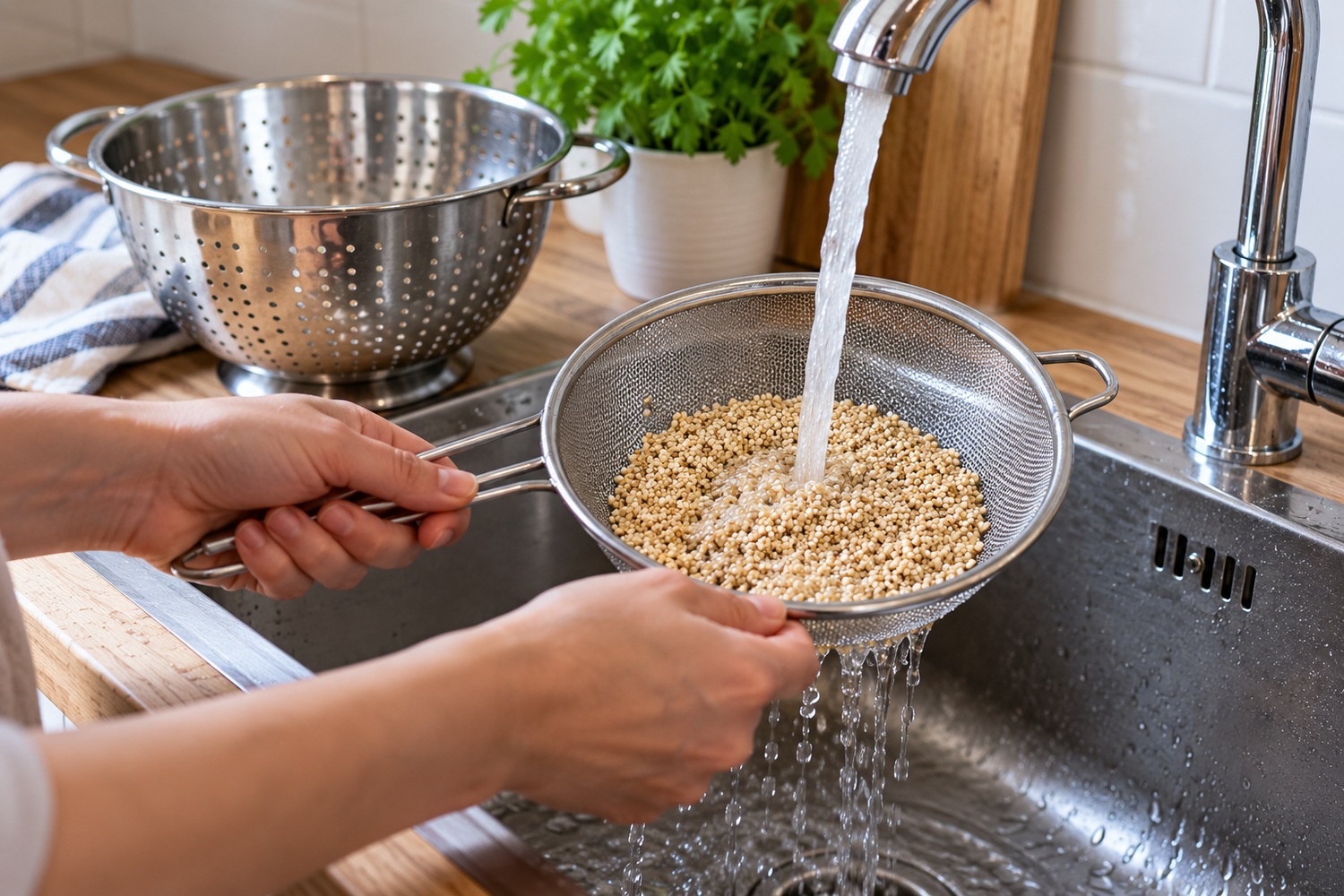
You can rinse quinoa in a regular colander only if its holes are small enough to hold the grains. Most traditional pasta colanders have relatively large holes, so uncooked quinoa can fall straight through. A fine-mesh sieve or a grain-washing colander with tiny perforations is usually the more reliable choice.
Before buying another kitchen tool, try placing a teaspoon of dry quinoa in your existing colander over a bowl. If grains slip through without water, it’ll be difficult to rinse a full batch without losing some.
Why does quinoa fall through a colander?
Uncooked quinoa seeds are much smaller than most pasta shapes or vegetables. Ordinary colanders are designed to drain water quickly, often through relatively large holes. Those openings can let quinoa escape as soon as you add water and move the grains around.
A fine-mesh sieve has a closely woven mesh that can retain small grains while water passes through. It’s particularly useful for quinoa, and it can also work for rinsing other small ingredients when the mesh is fine enough.
Which type of strainer works for quinoa?
| Kitchen tool | Suitable for rinsing quinoa? | What to check |
|---|---|---|
| Standard pasta colander | Often not | Holes may be larger than the seeds |
| Fine-mesh sieve | Usually yes | Mesh must be fine enough to retain dry quinoa |
| Rice or grain-washing colander | Sometimes | Some rice strainers still have openings too large for quinoa |
| Colander lined with suitable clean cloth | Can work | Cloth needs to retain the grains and be suitable for food contact |
| Mixing bowl without a strainer | Yes, with care | Swirl the grains, then decant the water slowly |
Don’t assume a product labelled “rice strainer” is automatically suitable. Some designs are made for much larger grains. Check its perforations or whether the product specifically states that it holds quinoa.
How to rinse quinoa with a fine-mesh sieve
- Check the packet. Some quinoa is sold pre-rinsed, so read the cooking instructions first.
- Put the quinoa into the sieve. Make sure the mesh is intact and the sieve is large enough to hold the batch without spilling.
- Rinse under cool running water. Gently stir or move the grains with clean fingers so the water reaches them evenly.
- Continue for around 30–60 seconds or follow the packet’s instructions. The exact time isn’t critical for every brand.
- Shake off excess water. Let the grains drain briefly before transferring them to your saucepan.
Food Network recommends a fine-mesh strainer and also describes a bowl-rinsing method if you don’t have one. See its quinoa rinsing guide.
Can you rinse quinoa without a sieve?
Yes. Put the quinoa in a clean mixing bowl, cover it with cool water and swirl it gently. Let the grains settle, then carefully pour off the water while holding the quinoa back with a hand or a suitable lid. Repeat as needed and drain carefully before cooking.
This method can take more time and you might lose a few grains while pouring. However, it’s a useful alternative if you only cook quinoa occasionally and don’t want another utensil.
Will a normal metal sieve work?
Usually, provided it’s a fine-mesh sieve rather than a coarse strainer. Check its mesh with a small amount of dry quinoa first. If grains fall through, you’ll need a finer option.
The sieve also needs to be big enough for the amount you’re washing. A small tea strainer may retain quinoa, but it’ll be inconvenient for a full family-sized batch.
What size sieve do you need for quinoa?
For the quantities most people cook at home, a medium kitchen sieve can be convenient. Something around 16–20cm in diameter gives you room to move the grains, although the best size depends on how much you’re rinsing and how the sieve rests over your sink or bowl.
Diameter alone isn’t the deciding factor. A smaller fine-mesh sieve that securely holds all the quinoa is more useful than a large coarse colander that lets grains escape.
Can you use a rice-washing bowl for quinoa?
Some rice-washing bowls have small perforations or a special draining section, but others allow quinoa through. Check whether the seller explicitly lists quinoa as a supported ingredient. A purpose-designed grain strainer may make repeated rinsing easier, particularly if you regularly cook rice, quinoa and lentils.
If you’re using a bowl with draining slots, start with a tablespoon of dry quinoa to test whether the openings hold it. Don’t pour a whole packet into an untested strainer.
Do you actually need to rinse quinoa?
Quinoa naturally contains compounds called saponins on its outer surface, which can contribute a bitter or soapy taste. Many commercial products are prewashed, but advice varies on whether additional rinsing improves their flavour. Check the packet and your preference.
The Kitchn recommends rinsing as a way to reduce bitterness, while Food Network notes that pre-rinsed quinoa may not strictly need an additional wash. If the manufacturer tells you the quinoa is ready to cook without rinsing, you can follow those instructions.
Where to buy a quinoa-friendly sieve
For a simple option, you can browse fine-mesh sieves suitable for quinoa on Amazon UK. You can also compare grain-washing strainers. Check the mesh or hole size, bowl capacity and cleaning instructions before ordering.
These are general shopping links, not recommendations for particular products I’ve tested. A standard fine-mesh sieve you already own may be all you need.
Frequently asked questions about can you rinse quinoa in an ordinary colander
Can you use a pasta colander for quinoa?
Only if its holes are fine enough to retain quinoa. Many pasta colanders have holes that are too large.
Will quinoa fall through a rice strainer?
It depends on the strainer. Some rice-washing tools have relatively large openings, so check for explicit quinoa compatibility or test a small amount first.
Can you rinse quinoa in a bowl?
Yes. Swirl the quinoa with cool water, let it settle and carefully pour off the water. Repeat as necessary.
Is a fine-mesh sieve the same as a colander?
Not quite. A sieve generally has finer openings for smaller ingredients, while a typical colander has larger holes for draining pasta and vegetables.
Can you rinse cooked quinoa in a colander?
The question usually concerns uncooked quinoa. Once cooked, quinoa is softer and can still escape through larger openings. If your recipe calls for draining, use a suitable fine-mesh sieve and handle hot food carefully.
Bottom line on can you rinse quinoa in an ordinary colander
Most regular colanders aren’t ideal for rinsing quinoa because their holes are too large. A fine-mesh sieve is usually the easiest solution, but a bowl-and-decant method can work if you don’t own one. Check the mesh before using it so you don’t lose your grains down the sink.
Sources and further reading
- Food Network — How to Rinse Quinoa
- The Kitchn — Mistakes to Avoid When Making Quinoa
- Food Network — How to Cook Quinoa
Disclosure: Progressive Housewares may earn a commission from qualifying purchases through affiliate links, at no additional cost to you.