
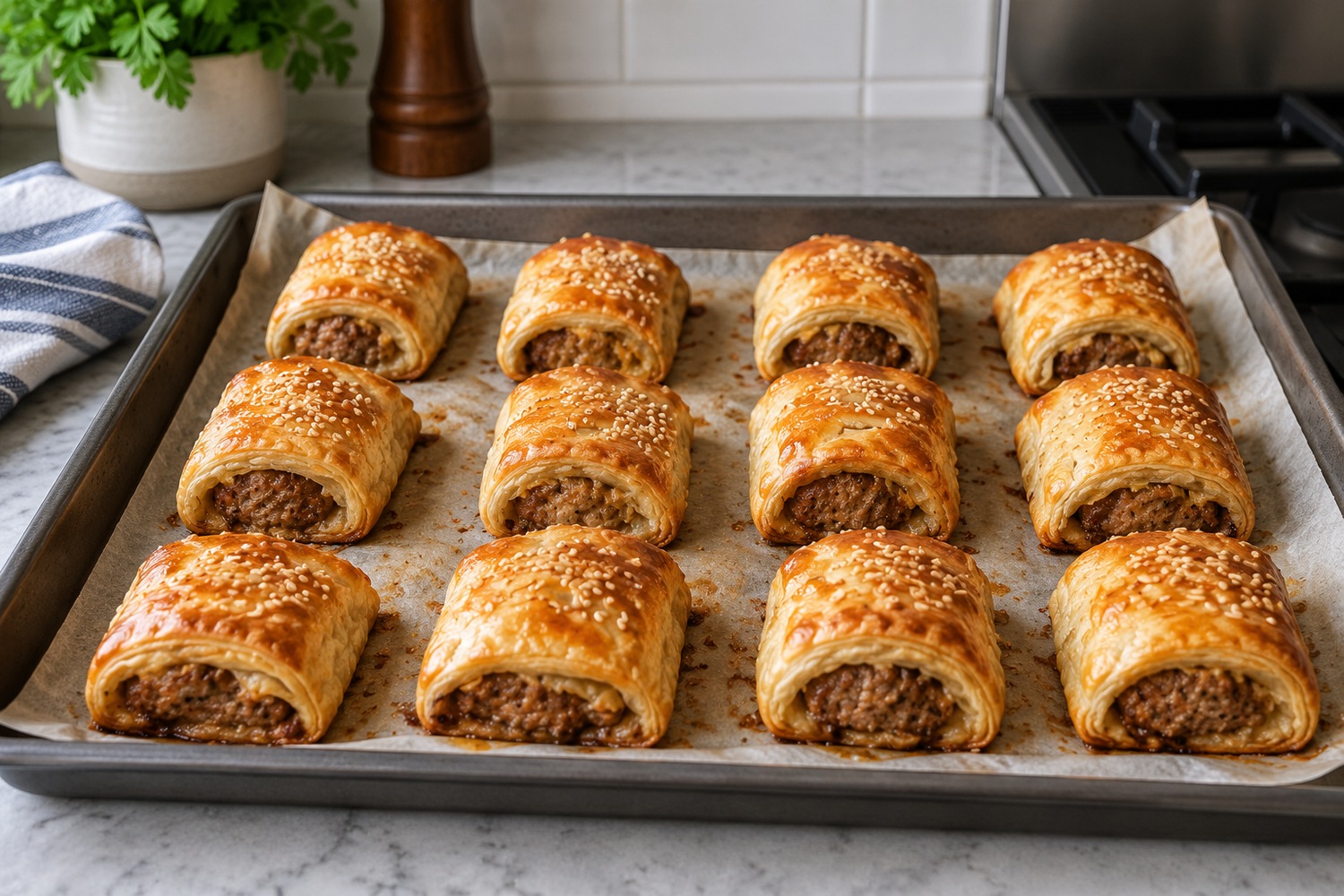
If you’re wondering what size baking tray do you need for 12 sausage rolls, consider this – A baking tray with roughly 40 × 30cm of usable surface is a good starting point for 12 small or medium homemade sausage rolls. One 12-roll recipe uses a 30 × 40cm baking sheet, but there’s no single tray size that works for every batch. The length and width of the individual rolls, and the space you leave between them, determine whether they’ll fit.
If you’re making 12 large sausage rolls rather than 12 party-sized ones, you may need two trays. Check the tray’s usable flat area, not just its advertised external dimensions.
Quick tray-size guide
| Type of sausage rolls | Practical starting point | What to watch |
|---|---|---|
| 12 cocktail-sized rolls | One medium tray, if spacing allows | Rolls can expand during baking |
| 12 small to medium rolls | One 40 × 30cm usable tray, depending on the recipe | Check roll length, width and gaps |
| 12 large bakery-style rolls | Often two trays | They may be too long or wide for one sheet |
| 24 small rolls | Often two medium trays or multiple batches | Don’t overcrowd the pastry |
These are layout suggestions rather than fixed baking standards. For example, the sausage-roll recipe from Christoph and Steffi’s Food and Travel specifies a 30 × 40cm baking sheet and makes 12 servings, while the National Trust’s recipe can make six large or 12 small rolls. Those portions won’t necessarily occupy the same area. See the 30 × 40cm recipe.
How do you work out whether 12 rolls will fit?
The easiest method is to think in rows and columns. Suppose your unbaked sausage rolls are each approximately 8cm long and 4cm wide. A three-by-four arrangement can be worked out as follows:
- Four rolls placed lengthways need 4 × 8cm = 32cm before spacing.
- Three rows need 3 × 4cm = 12cm before spacing.
- Leaving gaps between the rolls and around the tray’s edges increases both measurements.
This is just a worked example. You might arrange your rolls in a different orientation, and puff pastry often expands as it cooks. If your spacing calculation leaves the rolls almost touching, it’s better to split them across two trays.
How much space should you leave between sausage rolls?
For many puff-pastry sausage rolls, leaving roughly 2–3cm between pieces is a reasonable starting point, unless your recipe says otherwise. The pastry needs room to puff and brown, and the exact gap depends on how large the rolls are.
If the rolls touch while baking, their sides may be paler or stick together. Crowding can also make it harder to remove them neatly. Leave enough space for the pastry to expand without running into its neighbours.
Does a 40 × 30cm baking tray actually have that much room?
Not always. Some listings give the tray’s external dimensions, including rolled edges or handles. The flat baking area can be noticeably smaller.
Before buying, look for the internal or usable base dimensions. A tray sold as 40cm long might have a shorter flat area if its sides slope upwards. This matters when you’re trying to arrange a specific number of rolls in neat rows.
What if your oven is too small for a 40 × 30cm tray?
Measure the width and depth of your oven shelf and check the manufacturer’s required clearance around trays. Don’t buy a tray that only just wedges into the oven or obstructs airflow. If you have a compact oven, two smaller baking sheets or multiple batches may work better.
Remember that the tray must slide onto the shelf comfortably, not simply fit through the door at an awkward angle. You also need to be able to remove it safely while it’s hot.
Should you bake sausage rolls on one tray or two?
Use two trays if the rolls won’t fit with adequate gaps on one. A second tray can also be useful when you’re baking a mixture of small and large rolls that may need different cooking times.
If you’re baking on more than one oven shelf, follow your recipe and oven manual. You may need to rotate the trays for even browning, but opening the door unnecessarily can affect baking. Don’t stack trays directly on top of one another.
Is a shallow baking sheet better than a deep roasting tin?
A shallow baking sheet is often convenient for sausage rolls because it’s easy to arrange the pieces and remove them with a spatula. A deep roasting tin can work if the recipe and oven allow it, but high sides can affect how heat circulates around the pastry.
Choose a tray that’s suitable for your oven temperature, sits flat and has enough edge to handle safely. Baking parchment can help prevent sticking if your recipe calls for it; check that the parchment is rated for your cooking temperature.
Can you use a tray with holes?
Perforated trays are designed to let air circulate beneath certain baked foods. Whether they’re suitable depends on your recipe and whether fat or juices can drip through. Sausage rolls can release grease, so don’t use a perforated tray without a safe way to contain drips as directed by your appliance instructions.
Where to buy a suitable baking tray
If you’ve measured your oven and decided on the layout, you can browse 40 × 30cm baking trays on Amazon UK or compare sets of smaller baking sheets. Look for usable dimensions, maximum oven temperature and whether the tray’s coating needs special care.
These are general shopping links, not individually tested product recommendations.
Frequently asked questions about what size baking tray do you need for 12 sausage rolls
Can you fit 12 sausage rolls on one baking tray?
Often, yes, if they’re small or medium-sized and the tray has enough usable space. Twelve large rolls may need two trays.
Will a 35 × 25cm tray fit 12 sausage rolls?
Possibly if they’re small. Lay them out before baking and leave enough space for the pastry to expand. Don’t force all 12 onto one tray if they’re touching.
How many trays do you need for 24 sausage rolls?
For small or medium rolls, plan on at least two reasonably sized trays as a starting point, or bake in batches. The exact number depends on roll dimensions and oven space.
Can you cook frozen sausage rolls on the same tray?
Follow the instructions on the frozen product packaging. Frozen rolls may have specific spacing and cooking requirements that differ from homemade pastry.
Do sausage rolls need baking parchment?
Not always. It depends on the recipe and tray surface. If you use parchment, check that it’s suitable for the oven temperature and doesn’t touch heating elements.
Bottom line
A baking sheet with approximately 40 × 30cm of usable area is a sensible starting point for 12 small or medium sausage rolls. Check the actual size of your rolls, leave gaps for expansion and measure the oven before buying. If they’re large rolls, using two trays is usually the easier option.
Sources
- Christoph and Steffi’s Food and Travel — sausage rolls made on a 30 × 40cm sheet
- National Trust — pork sausage rolls recipe
Disclosure: Progressive Housewares may earn a commission from qualifying purchases through affiliate links, at no additional cost to you.