
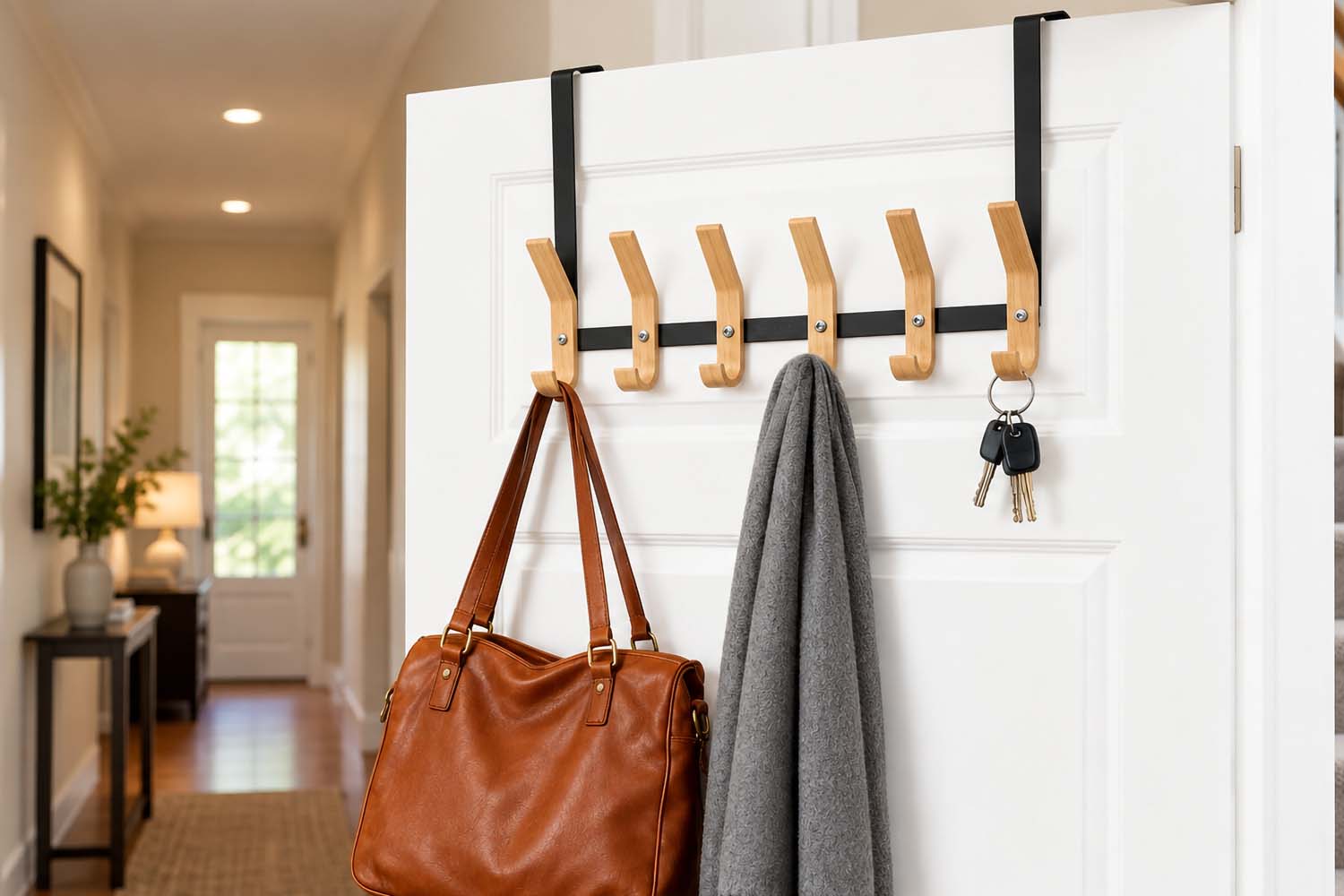
The answer depends on the thickness of the internal door – so there isn’t a universal size or a one size fits all. With that said, most standard UK internal doors are around 35mm thick, so over-door hooks advertised as fitting 35mm doors may work. But some internal doors are 40mm thick, and many fire doors are around 44mm thick. So when asking; what size over door hooks fit a standard UK door? The important detail is the maximum door thickness stated by the hook manufacturer. You also need enough clearance between the top of the door and its frame for the metal or plastic bracket.
In other words, measure your actual door before ordering: a hook can fit over the door edge yet still stop it closing.
Quick guide: what size hook should you buy?
| Measured door thickness | What to look for | Check before buying |
|---|---|---|
| 35mm | Hooks explicitly rated for at least 35mm doors | Top gap and bracket thickness |
| 40mm | Hooks rated for at least 40mm doors | Don’t assume a 35mm hook will stretch |
| 44mm | Hooks specifically listed for 44mm or thicker doors | Fire-door requirements and clearance |
| Other or uncertain | A product with a published fit range that covers your measurement | Exact product specification |
These are selection rules, not a claim that every door in a given category measures exactly that amount. Older houses, replacement doors and specialist doors vary.
How to measure a door for over-door hooks
You only need a tape measure or ruler; a set of callipers helps if the measurements are close.
- Open the door. Look at the exposed vertical or top edge of the door itself, not the surrounding frame.
- Measure the thickness across the edge, front to back. Record the result in millimetres.
- Check the top clearance. Slowly close the door and examine the gap between its top edge and the frame. Do not force a ruler or hook into a tight gap.
- Compare the actual hook specification. Look for both the supported door-thickness range and the thickness of the part that lies across the top of the door.
- Consider where the hook hangs. Check that the rack and anything hanging on it won’t strike a wall, handle or adjacent furniture as the door opens.
An over-door hook sold as fits doors up to 40mm is not automatically suitable for a 44mm door. For example, Argos has confirmed that its Habitat round over-door hooks suit doors up to 40mm and not a 44mm door.
Will over-door hooks stop the door from closing?
They can. Door thickness and top clearance are different measurements. A bracket that fits the door’s thickness may still rub against the frame or prevent the latch from engaging.
Products vary in how thick their top brackets are, so there is no universal minimum gap that guarantees all hooks will work. Choose a slim, low-profile design only after checking its stated dimensions. If the door catches, remove the hook rather than forcing the door shut or altering the frame.
Also check whether the hook has protective pads. Pads can help minimise marks, but they add to the effective bracket thickness.
What about 44mm fire doors?
Some thicker internal doors are fire-rated. Don’t assume an ordinary over-door hook is suitable for a fire door, even if it physically fits. Anything that interferes with self-closing, seals, latching or the door assembly may compromise its function.
Check with the building manager, landlord, door manufacturer or a competent fire-door professional before fitting accessories to a fire door. Never trim the door, remove seals or stop it closing in order to accommodate a hook.
Which hooks are best for bathrooms and bedrooms?
For a typical bedroom door, a simple single or multi-hook hanger may be sufficient for dressing gowns, towels or lightweight clothing. A bathroom can benefit from moisture-resistant finishes, while a hallway may need a rack with a clearly stated load rating.
When comparing products, prioritise:
- Published door fit: 35mm, 40mm, 44mm or a clearly specified range.
- Bracket profile: The thinner the top bracket, the easier it may be to accommodate a limited gap, but check the actual measurements.
- Maximum load: Check the manufacturer’s limit and avoid piling on heavy bags or coats beyond it.
- Surface protection: Padding or a non-scratch finish may help protect paintwork.
- Projection: Check how far the hook sticks out from the door.
Finding compatible hooks on Amazon UK
Once you have measured the door, you can browse over-door hooks on Amazon UK. Add your measurement to the search, such as over door hooks 40mm or over door hooks 44mm, then confirm the fit in the individual product specifications before buying.
Frequently asked questions about what size over door hooks fit a standard UK door
Do all UK internal doors have the same thickness?
No. 35mm is common, but 40mm and 44mm doors are also found in UK properties. Always measure your door rather than relying on the description standard.
Will 40mm over-door hooks fit a 35mm door?
Possibly, if the manufacturer’s stated fit range includes 35mm. However, a loose-fitting hanger may move or rattle. Look for a product that explicitly supports your door thickness and check whether it includes protective pads or spacers.
Can you put over-door hooks on a uPVC door?
Only if the specific product and door manufacturer permit it. uPVC doors can have unusual profiles, seals and tight closing clearances, so ordinary internal-door hooks may be unsuitable.
Why won’t my door close with an over-door hook fitted?
The bracket may be thicker than the available gap above the door, or the hanger may be hitting the frame. Remove it and choose a compatible low-profile alternative; don’t force the door shut.
Bottom line
For a 35mm internal door, start by looking at hooks specified for 35mm doors. For 40mm or 44mm doors, choose products that explicitly accommodate those thicknesses. Then check the clearance above the door and the hook’s top-bracket thickness. Those two measurements matter more than a product description saying fits standard doors.