
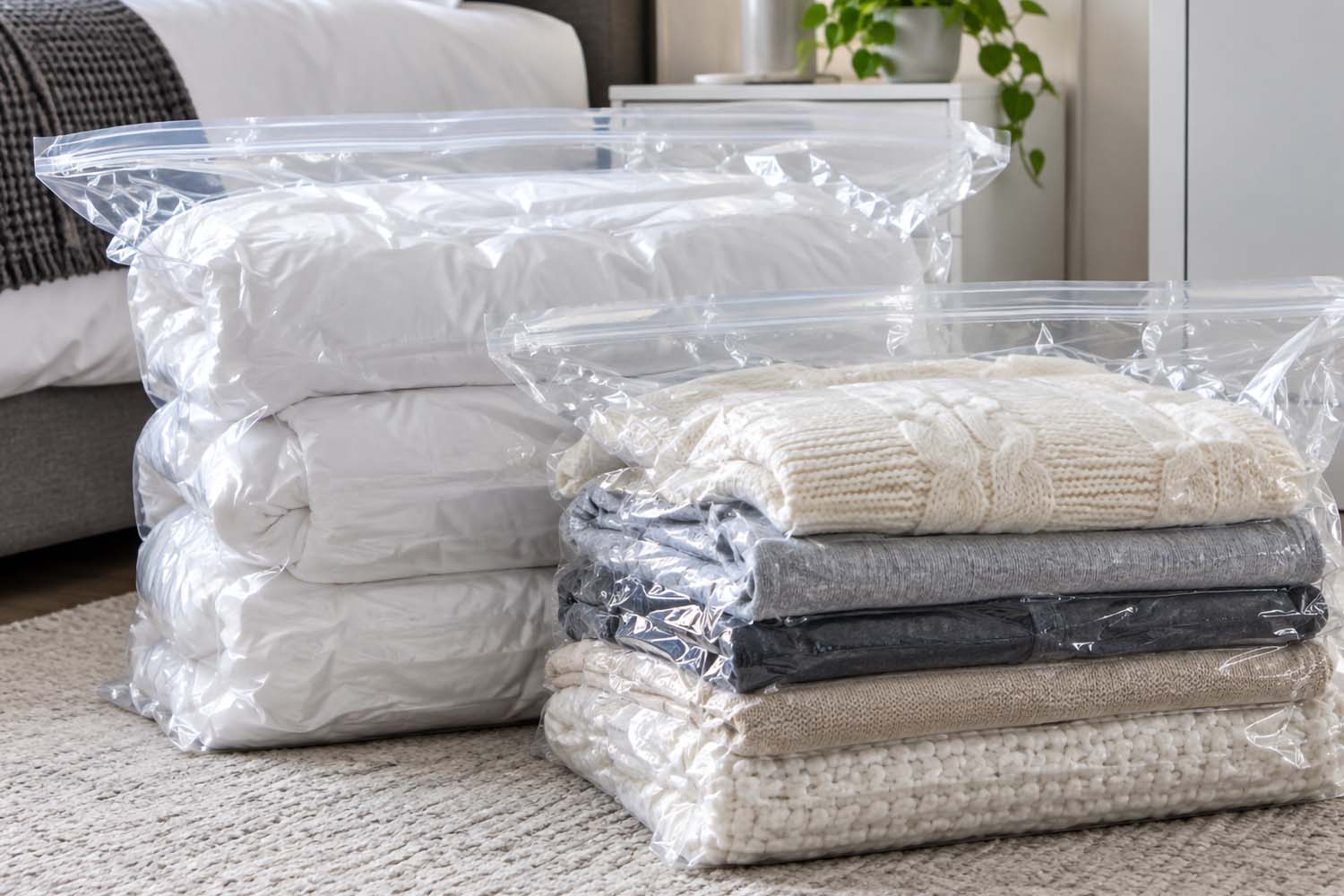
A 100 × 70 cm vacuum storage bag is a useful starting point for storing one standard UK double duvet. However, a thick winter duvet may need a larger bag, such as 110 × 80 cm or 130 × 100 cm, depending on its filling and how tightly it can be folded. Always check the bag’s usable opening and your folded duvet’s dimensions before buying.
The key detail is that vacuum bags compress after you seal them. Your duvet must fit inside the bag while it is still full of air.
Quick size guide
| What you’re storing | Size to consider | What to check |
|---|---|---|
| Lightweight double summer duvet | Around 100 × 70 cm | Folded size and bag opening |
| Standard double synthetic duvet | Around 100 × 70 cm | Whether the duvet fits without forcing the seal |
| Thick double winter duvet | Around 110 × 80 cm or larger | Filling, loft and actual usable bag dimensions |
| Double duvet plus pillows | Extra-large or jumbo bag | Whether the manufacturer rates it for multiple bulky items |
These are shopping starting points, not universal capacities. Brands measure and label bags differently, and two duvets with the same bed size can have very different bulk.
Does the duvet’s bed size tell you which bag to buy?
Not by itself. A standard UK double duvet is commonly 200 × 200 cm when laid flat, but you will fold it before putting it into storage. A thin 4.5-tog duvet folds into a much smaller bundle than a thick 13.5-tog duvet, even though both cover the same bed.
Filling matters too. Synthetic, wool, feather and down duvets behave differently when folded and compressed. Check your duvet’s care label before using vacuum storage: some natural fillings and specialist bedding are better stored loosely to avoid prolonged compression.
How to check whether a bag will fit
- Fold the duvet as you plan to store it. Start with halves, then fold again until you have a manageable rectangle. Don’t force an extremely tight bundle.
- Measure the folded width and length. If possible, also note how thick the bundle is.
- Check the bag’s usable width and opening. A listing that says 100 × 70 cm may describe the outer dimensions rather than the space available once the seal and edges are taken into account.
- Allow room for sealing. The duvet should slide in without pressing against the zip closure. If it’s a struggle, go up a size.
- Only then remove the air. Follow the bag manufacturer’s instructions and don’t over-compress the contents.
Example: If your folded duvet measures roughly 65 × 55 cm and is bulky, a bag marked 70 × 100 cm might sound ample, but the sealed edges and thickness can make it awkward. A larger bag may be easier to load and reseal.
Is a 100 × 70 cm vacuum bag big enough for a double duvet?
Often, yes. Some storage-bag sellers specifically describe 100 × 70 cm bags as suitable for double duvets. But other sellers recommend larger or jumbo bags for bulky bedding. The difference isn’t necessarily a contradiction: bag construction, opening size and duvet thickness vary.
For a light or medium synthetic double duvet, 100 × 70 cm is a reasonable size to investigate first. For a thick winter duvet, choosing the next size up is less frustrating than discovering that the bag closes only when you sit on it.
Should you buy large, extra-large or jumbo?
Don’t rely on those labels alone. One brand’s large bag may be smaller than another brand’s extra-large. Compare the measurements in centimetres and look for an explicit statement that the bag can accommodate a double duvet.
When shopping online, check customer questions and reviews for the exact product. A helpful review saying that a thick double duvet fitted is more relevant than a generic claim that the bag is suitable for ‘bedding’.
Amazon UK shopping option: See vacuum storage bags for double duvets on Amazon UK
Can you vacuum-pack a feather or down duvet?
Check the care label first. Long-term compression can affect the loft of some natural-filled duvets, and some manufacturers recommend breathable storage instead. If the label advises against compression, use a roomy cotton storage bag or a breathable bedding case rather than a vacuum bag.
Even with a synthetic duvet, avoid storing it in a damp space. Vacuum bags can save room, but they don’t fix an existing moisture problem.
How long can you keep a duvet in a vacuum bag?
Follow the duvet and storage-bag manufacturers’ guidance. For longer storage, make sure the duvet is completely dry and clean before sealing, store it away from heat and sharp objects, and inspect the bag occasionally for leaks or trapped moisture. If the filling does not recover its shape after unpacking, prolonged compression may not suit that duvet.
Frequently asked questions
Will a 70 × 50 cm vacuum bag fit a double duvet?
It’s generally too small for a typical double duvet, particularly a winter one. It’s more commonly suitable for smaller clothing items and towels.
Will a 100 × 80 cm bag fit a double duvet?
It may be a good option for many double duvets, but confirm the usable dimensions and the folded thickness before ordering.
Can I put a double duvet and two pillows in one bag?
Possibly, if you choose a sufficiently large bag and the manufacturer supports that load. For bulky winter bedding, separate bags can be easier to fill, seal and store.
Do vacuum storage bags work with any vacuum cleaner?
Not necessarily. Many use a valve designed for standard vacuum hoses, while some include a hand pump or electric pump. Check the valve type and your vacuum’s attachments before buying.
The bottom line about what size vacuum storage bag do You need for a Double Duvet
For most shoppers, start by checking 100 × 70 cm vacuum bags for a double duvet, then size up if your duvet is especially thick or the bag has a narrow opening. The safest buying method is to fold and measure your actual duvet, compare centimetre measurements rather than large or jumbo labels, and follow the duvet’s care instructions.